
Wiring an Electrical Outlet in Canada: Navigating the CEC
Wiring an electrical outlet in Canada requires strict adherence to the Canadian Electrical Code (CEC), Part I. While the fundamental physics of electricity remain the same across North America, the CEC enforces distinct material standards, safety protocols, and circuit configurations that differ significantly from the US National Electrical Code (NEC). Whether you are replacing a damaged receptacle in a 1970s Toronto bungalow or roughing-in new construction in Vancouver, understanding these regional nuances is critical for passing inspection and ensuring fire safety.
In this comprehensive wiring diagram reference, we break down the exact procedures for wiring standard 15A NEMA 5-15R receptacles and the uniquely Canadian split-wired duplex outlet, complete with material specifications and 2026 code updates.
⚠️ CEC Code Alert (2026): All 15A and 20A, 125V receptacles installed in residential dwellings must be Tamper-Resistant (TR). Furthermore, any receptacle you purchase must bear a recognized Canadian certification mark, such as CSA, cUL, or cETL. A standard US-only 'UL' mark is a code violation in Canada and will fail inspection.
Core CEC Requirements for Canadian Receptacles
Before stripping any wire, you must verify your materials against CEC standards. The Canadian market relies on specific cable types and breaker configurations that dictate how your outlet is wired.
- Cable Type: Canada uses NMD90 (Non-Metallic Drywire, rated for 90°C), whereas the US uses NM-B (Romex, rated for 90°C but ampacity limited to 60°C). NMD90 features a distinct brown or grey jacket and includes a bare copper ground wire.
- AFCI Protection: As of the latest CEC updates, Arc-Fault Circuit Interrupter (AFCI) protection is mandatory for nearly all 15A and 20A residential living spaces, including bedrooms, living rooms, and hallways. You will likely be wiring to an AFCI breaker rather than a standard thermal-magnetic breaker.
- Wire Gauge & Ampacity: 14 AWG NMD90 is standard for 15A circuits. 12 AWG NMD90 is required for 20A circuits. You can install a 15A receptacle on a 20A circuit, but you must use 12 AWG wire and a 20A breaker.
Standard 15A NEMA 5-15R Wiring Procedure
The standard 15A duplex receptacle (such as the Leviton Decora 015-05320-WMP or Pass & Seymour 3515-TR) remains the backbone of Canadian residential wiring. Here is the step-by-step physical wiring sequence.
Step 1: Preparation and Stripping
Turn off the breaker and verify zero voltage with a non-contact voltage tester and a multimeter. Strip the outer NMD90 jacket back about 8 inches from the electrical box. Strip exactly 5/8 inch (16mm) of insulation from the black (hot), white (neutral), and bare (ground) wires. Do not nick the copper conductor, as this creates a micro-fracture that can lead to arcing under load.
Step 2: Grounding First
Always wire the ground first. Form a J-hook in the bare copper wire and loop it clockwise around the green ground screw. Tighten to the manufacturer's specification—typically 14 in-lbs of torque. If the metal box is grounded, you must also run a 6-inch bare copper pigtail from the box's ground clip to the receptacle's ground screw to ensure continuous grounding.
Step 3: Neutral and Hot Connections
Connect the white (neutral) wire to the silver terminal and the black (hot) wire to the brass terminal. Pro-Tip for 2026: Avoid using the 'push-in' backstab holes on the rear of the receptacle. While technically permitted by older codes, they rely on spring tension that degrades over time, leading to high-resistance connections and melted plastic. Instead, use the side-wiring screws or the 'back-wire with screw clamp' feature found on commercial-grade (spec-grade) receptacles.
The Canadian Specialty: Split-Wired Duplex Receptacles
If you are wiring an electrical outlet in Canada, you will inevitably encounter the split-wired receptacle. Under CEC Rule 30-100, every habitable room requires a permanent lighting outlet. If a ceiling fixture is not installed, a wall-switch-controlled receptacle satisfies this rule. To maintain usable wall power, Canadian electricians split the duplex outlet: the top half is controlled by a wall switch, and the bottom half remains always-on.
Wiring the Split Receptacle (14/3 NMD90)
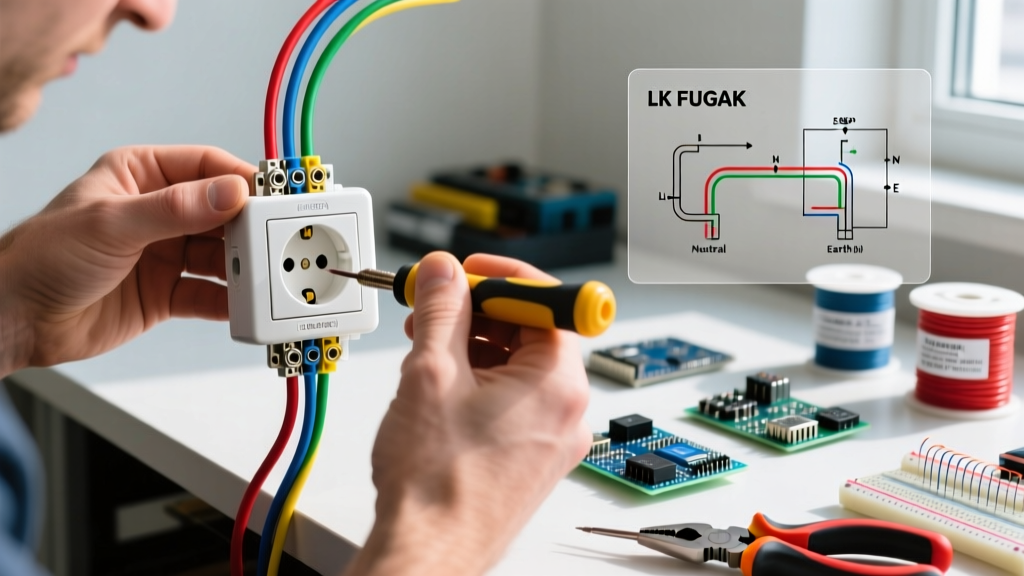
This configuration requires a 3-wire cable (14/3 or 12/3 NMD90) running from the switch to the outlet, utilizing a Multi-Wire Branch Circuit (MWBC) or a dedicated switch loop.
- Break the Brass Tab: On the side of the receptacle with the brass screws (the hot side), use needle-nose pliers to snap off the small metal connecting fin between the top and bottom screws. Do not break the silver tab on the neutral side.
- Connect the Neutral: Attach the white wire from the 14/3 NMD90 cable to the top silver screw.
- Connect the Ground: Attach the bare wire to the green screw.
- Connect the Always-Hot: Attach the black wire (continuous power from the panel) to the bottom brass screw.
- Connect the Switched-Hot: Attach the red wire (power returning from the wall switch) to the top brass screw.
Crucial MWBC Safety Rule: If the black and red wires originate from a Multi-Wire Branch Circuit (sharing a single neutral white wire), the CEC mandates that they be connected to a 2-pole breaker or have an approved handle-tie installed on two single-pole breakers. This ensures both halves of the outlet are de-energized simultaneously when a technician turns off the breaker, preventing lethal shock from the shared neutral.
Comparison Matrix: US NEC vs. Canadian CEC Outlet Rules
Understanding the divergence between US and Canadian codes prevents costly material returns and failed inspections. Below is a structural comparison of outlet wiring standards.
| Feature | United States (NEC) | Canada (CEC) |
|---|---|---|
| Standard Cable | NM-B (Romex) | NMD90 (Drywire) |
| Certification Marks | UL, ETL | CSA, cUL, cETL |
| Kitchen Small Appliance | Minimum two 20A circuits | Minimum two 20A circuits (often 3+ for islands) |
| Split-Wired Outlets | Rare, mostly replaced by smart bulbs/hardwired | Extremely common to satisfy CEC lighting rules |
| Grounding Pigtails | Required for metal boxes | Mandatory for all metal and plastic box continuity |
Common Failure Modes & Troubleshooting
When troubleshooting an existing electrical outlet in Canada, be on the lookout for these specific failure modes inherent to local wiring practices:
1. The Forgotten Split-Tab Short Circuit
Symptom: The breaker trips violently the moment the wall switch is flipped on. Cause: The electrician or DIYer failed to break the brass connecting tab on the hot side of a split-wired receptacle. When the switch closes, the always-hot black wire and the switched-hot red wire are bridged together, creating a direct phase-to-phase or hot-to-neutral short circuit. Fix: Remove the receptacle, verify the tab is completely severed, and check for scorch marks on the brass terminals.
2. Open Neutral on MWBC Circuits
Symptom: Devices plugged into the outlet experience severe voltage fluctuations (e.g., a lamp glows blindingly bright, then dims to almost nothing). Cause: The shared white neutral wire has disconnected at the panel or a junction box. In a 14/3 MWBC setup, an open neutral forces the two 120V circuits to act as a 240V series circuit, sending up to 240V to your 120V appliances, destroying electronics instantly. Fix: Immediately turn off the 2-pole breaker. Trace the NMD90 cable back to the panel and re-terminate the neutral on the grounded bus bar.
Frequently Asked Questions (FAQ)
Can I buy US outlets online and install them in my Canadian home?
While the physical NEMA 5-15R configuration is identical, importing US-only receptacles (marked only with 'UL') violates the CEC. According to the Electrical Safety Authority (ESA), products must be approved for use in Canada by a recognized certification agency. Always look for the 'cUL' or 'CSA' stamp on the strap of the receptacle. Furthermore, US outlets may lack the internal shutter mechanisms required for Canadian Tamper-Resistant (TR) compliance.
What is the standard mounting height for outlets in Canada?
The CEC does not mandate a specific height for standard residential receptacles. However, the standard trade practice across Canadian provinces is to mount the center of the electrical box 12 inches to 16 inches above the finished floor. For accessibility compliance (such as in barrier-free washrooms or commercial builds), the CSA Group and provincial building codes often dictate a minimum height of 15 inches to the center of the box to accommodate wheelchair users.
Do I need a permit to replace an electrical outlet in Canada?
Replacing an existing, like-for-like receptacle (e.g., swapping an old beige outlet for a new white TR Decora outlet) generally does not require an electrical permit or an ESA inspection, provided you are not altering the circuit wiring or adding new outlets. However, if you are running new NMD90 cable, adding a new box, or converting a standard circuit to an AFCI-protected circuit, a permit from your local provincial authority is legally required.