
Defining Normal Electrical Outlet Voltage: The ANSI Standard
Before investing in diagnostic equipment, it is critical to understand what constitutes normal electrical outlet voltage in North America. While most residential receptacles are nominally rated at 120V, the actual voltage at the terminal rarely sits at exactly 120.0 volts. According to the ANSI C84.1 standard, published by the National Electrical Manufacturers Association (NEMA), a nominal 120V circuit has two acceptable operating ranges:
- Range A (Optimal): 114V to 126V. Equipment is designed to operate satisfactorily within this band.
- Range B (Tolerable): 110V to 127V. These conditions can occur due to utility supply fluctuations or voltage drop, but sustained operation at these extremes can reduce the lifespan of sensitive electronics and motors.
To verify that your receptacles fall within Range A, you need precision diagnostic tools. Guessing based on a flickering light or a humming refrigerator is not just inadequate; it is dangerous. This guide details the exact tools, testing materials, and safety protocols required to measure outlet voltage accurately in 2026.
The 2026 Tool Arsenal for Accurate Voltage Measurement
Testing receptacles requires a tiered approach. You need tools for initial safety verification, precise quantitative measurement, and wiring topology checks. Below is a comparison matrix of the essential tool categories.
| Tool Category | Primary Function | Recommended Model (2026) | Est. Price | Accuracy Level |
|---|---|---|---|---|
| Non-Contact Voltage Tester (NCVT) | Verifying presence/absence of AC voltage | Klein Tools NCVT-2 Dual Range | $35 - $40 | Binary (On/Off) |
| Digital Multimeter (DMM) | Precise quantitative voltage measurement | Fluke 117 True RMS Electricians DMM | $210 - $230 | High (±0.5%) |
| Plug-In Receptacle Tester | Checking wiring topology and GFCI trip | Sperry ET6403 GFI/AFI Tester | $25 - $30 | Diagnostic (Pass/Fail) |
Digital Multimeters (DMM): The Professional Standard
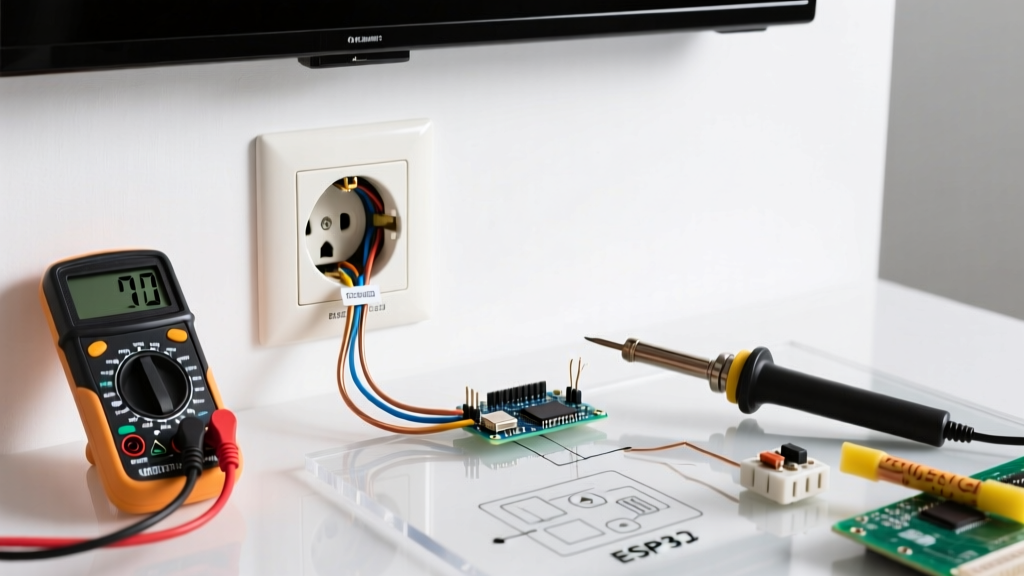
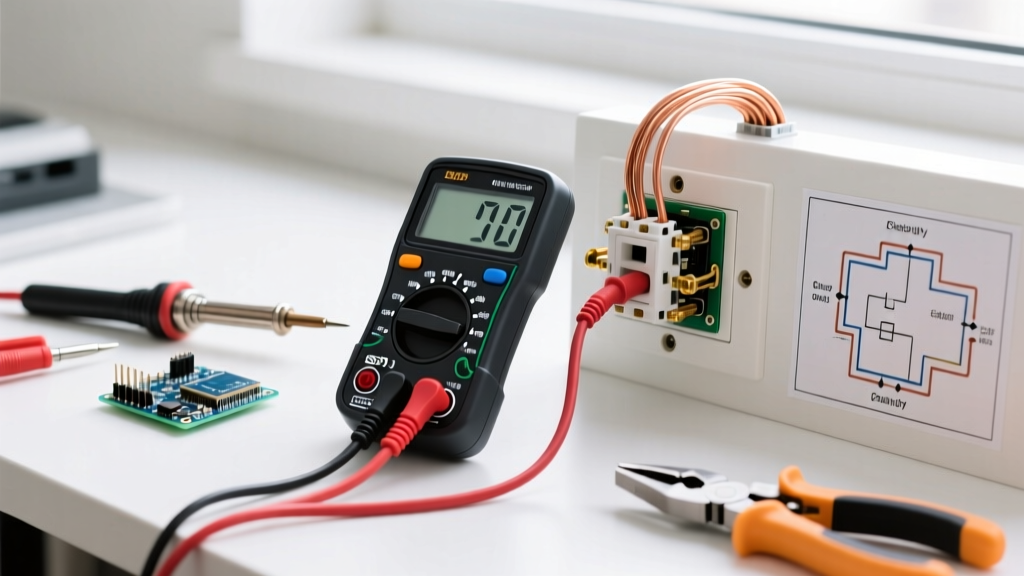
A Digital Multimeter is the only tool capable of telling you the exact numerical voltage of a receptacle. When selecting a DMM for outlet testing, you must prioritize three specific features:
- CAT III or CAT IV Rating: According to Fluke's safety guidelines, CAT III ratings are mandatory for measuring at the receptacle level, as these devices are tested to withstand transient voltage spikes (up to 4,000V to 6,000V) that can occur on branch circuits.
- True RMS: Standard average-responding multimeters assume a perfect sine wave. Modern homes are filled with non-linear loads (LED drivers, switching power supplies) that distort the AC waveform. A True RMS meter calculates the actual heating value of the distorted wave, giving you an accurate reading of normal electrical outlet voltage.
- LoZ (Low Impedance) Mode: This feature places a low-impedance load on the circuit during testing, effectively draining 'ghost voltages' caused by capacitive coupling in adjacent wires. Without LoZ, you might read 40V on a disconnected wire and mistakenly believe the circuit is live.
Pro-Tip: The Fluke 117 remains the industry benchmark for residential and light commercial electricians due to its VoltAlert (NCVT built into the tip) and AutoVolt feature, which automatically switches between AC and DC.
Non-Contact Voltage Testers (NCVT): The First Line of Defense
Never insert multimeter probes into a receptacle without first using an NCVT. These tools detect the electromagnetic field generated by AC voltage. The Klein Tools NCVT-2 is highly recommended because it features dual-range detection (12-1000V AC and 70-1000V AC). The lower range is crucial for identifying standard 120V outlet voltage without being triggered by low-level static or induced voltages from nearby data cables.
Plug-In Receptacle Testers: Quick Fault Detection
While a DMM tells you the voltage magnitude, a plug-in tester tells you about the wiring topology. Devices like the Sperry ET6403 use a matrix of neon LEDs to instantly identify common faults: open ground, reverse polarity, open neutral, and hot/ground reversed. This tool is indispensable for verifying that the physical wiring matches the voltage readings you are taking.
Essential Safety Materials and PPE
Testing live circuits carries inherent risks. The Occupational Safety and Health Administration (OSHA) mandates specific personal protective equipment (PPE) when working on or testing energized electrical parts. According to OSHA Standard 1910.335, workers must use protective equipment rated for the voltage and environment.
- Class 00 Rubber Insulating Gloves: Rated for up to 500V AC. Brands like Oberon or Salisbury provide reliable protection against accidental shock when handling probes. Expect to pay $45 to $65 for a quality pair, plus $20 for leather protectors to prevent punctures.
- CAT-Rated Test Probes: Never use cheap, unbranded probes. Ensure your probes have a CAT III 1000V rating and feature finger guards to prevent your hand from slipping onto the metal tip while probing the narrow slots of a 120V receptacle.
- Voltage Rated Insulated Mat: If you are testing outlets in damp areas (garages, basements), standing on a Class 0 insulated rubber mat (approx. $80-$120) provides a secondary barrier to ground.
Step-by-Step Protocol: Measuring Outlet Voltage Safely
Follow this exact sequence to measure normal electrical outlet voltage while minimizing arc flash and shock risks:
- Visual Inspection: Check the receptacle faceplate for scorch marks, melted plastic, or loose fitting. If the plug falls out easily, the internal contacts are worn; replace the receptacle before testing.
- Live/Dead/Live Test: Verify your DMM is working. Test the meter on a known live source (like a confirmed working outlet), then test the target outlet, then test the known live source again. This ensures the meter's internal fuse didn't blow mid-test, giving you a false 'dead' reading.
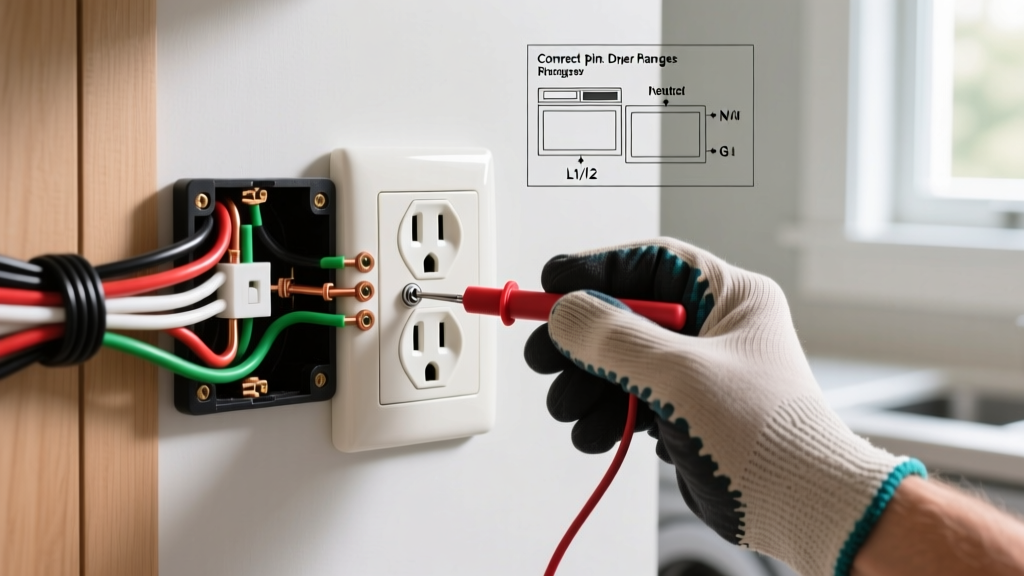
- Measure Hot to Neutral: Insert the red probe into the shorter (hot) slot and the black probe into the longer (neutral) slot. A normal reading should be between 114V and 126V.
- Measure Hot to Ground: Move the black probe to the U-shaped ground hole. The reading should be identical (or within 1-2 volts) of the Hot-Neutral reading.
- Measure Neutral to Ground: Place probes in the neutral and ground slots. This should read as close to 0V as possible. A reading above 2V indicates a voltage drop on the neutral wire, often caused by a loose connection at the panel or an overloaded circuit.
Troubleshooting Abnormal Voltage Readings
When your diagnostic tools reveal that the normal electrical outlet voltage is outside the ANSI C84.1 Range A parameters, you must identify the root cause. The NEMA ANSI C84.1 standard emphasizes that sustained abnormal voltages require immediate correction.
Scenario A: Low Voltage (Below 114V)
Symptoms: Motors run hot, lights dim when appliances start, electronics fail to boot.
Common Causes:
- Voltage Drop: The National Electrical Code (NEC) recommends a maximum 3% voltage drop on branch circuits. If you are testing an outlet at the end of a 100-foot run of 14 AWG wire carrying 12 amps, you will experience significant voltage drop. Fix: Upgrade wire gauge or shorten the run.
- Utility Brownout: If the entire house reads 108V, the issue is on the utility side. Contact your power provider immediately.
- Loose Neutral at Panel: If one half of your house reads 90V and the other reads 150V, you have a floating neutral at the main service panel. This is a severe fire hazard requiring an emergency electrician.
Scenario B: High Voltage (Above 126V)
Symptoms: Premature bulb burnout, power supply failures, sensitive audio/video equipment humming.
Common Causes:
- Transformer Tap Settings: The local utility transformer may be tapped too high to compensate for distant voltage drop, resulting in over-voltage for homes closest to the transformer. Request a utility tap adjustment.
- Solar Grid Backfeed: In neighborhoods with high concentrations of rooftop solar, mid-day grid backfeed can push local outlet voltages up to 128V or 130V. Modern smart inverters usually manage this, but legacy systems may require a utility intervention.
Scenario C: Ghost Voltages (Reading 40V - 80V on Dead Wires)
If you are testing a disconnected wire in a multi-gang outlet box and your standard DMM reads 65V, do not panic. This is capacitive coupling. Switch your DMM to LoZ (Low Impedance) mode. The ghost voltage will instantly drop to 0V, confirming the wire is safely de-energized.
Final Thoughts on Tool Investment
Verifying normal electrical outlet voltage is not a task for improvised methods or substandard equipment. A $200 True RMS multimeter and a $35 dual-range NCVT are not just expenses; they are critical investments in your safety and the longevity of your home's electrical infrastructure. By understanding the ANSI standards and utilizing the correct diagnostic protocol, you can confidently identify, troubleshoot, and resolve voltage anomalies before they escalate into equipment failure or electrical fires.