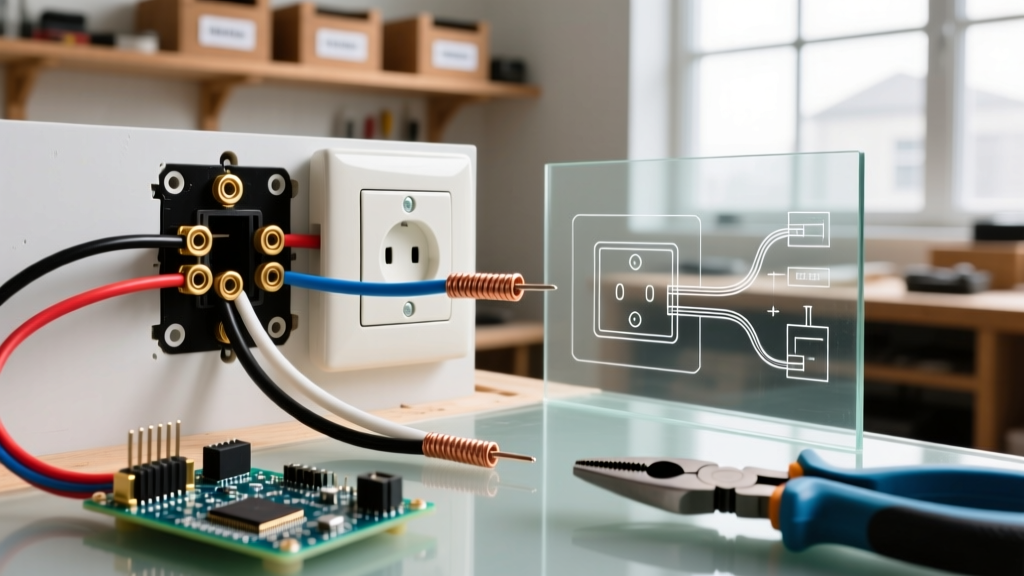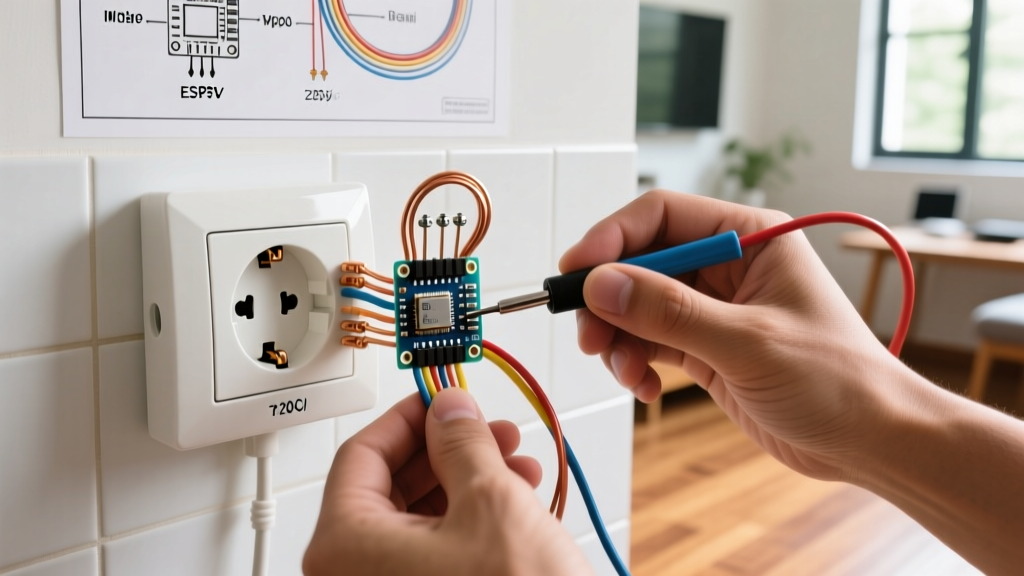

Understanding the Vietnamese Electrical Grid and Infrastructure
Installing an electrical outlet in Vietnam requires a fundamental understanding of the local power grid and regional infrastructure quirks. Vietnam operates on a 220V / 50Hz alternating current (AC) grid. As of 2026, rapid urban development in cities like Ho Chi Minh City, Hanoi, and Da Nang has modernized residential wiring, but a significant portion of older housing stock still features legacy wiring systems that demand extreme caution.
Unlike North American systems that utilize 120V, the higher 220V voltage means that arc faults and short circuits carry significantly more destructive energy. According to the International Electrotechnical Commission (IEC), Vietnam primarily utilizes Type A, Type C, and Type G plug configurations. However, the physical installation of the receptacle into the wall follows specific regional masonry and flush-box standards that differ from Western drywall installations.
Common Socket Types and Universal Receptacles
Walk into any Vietnamese hardware store or browse local e-commerce platforms like Shopee or Tiki, and you will immediately notice the dominance of the Universal Socket. These receptacles are designed to accept Type A (two flat pins), Type C (two round pins), and sometimes Type G (three rectangular pins) simultaneously. While convenient for expats and travelers, universal sockets often rely on internal spring-steel contacts rather than rigid brass grips, which can lead to poor contact resistance and overheating when drawing high continuous loads (like space heaters or high-wattage kettles).
| Socket Type | Pins | Typical Use Case | Popular Local Brands |
|---|---|---|---|
| Type A / C Combo | 2 (Flat/Round) | General lighting, low-draw electronics, older apartments | Sino, Vanlock, Panasonic (Wide Series) |
| Type G (Universal) | 3 (Rectangular/Round) | Modern builds, grounded appliances, kitchens | Schneider Electric (AvatarOn), Clipsal |
| Dedicated Type C | 2 (Round) | European appliance imports, specific industrial uses | Legrand, ABB |
Tools and Materials for 2026 Installations
To ensure a safe and code-compliant installation, you must use properly insulated tools rated for at least 1,000V. Do not rely on standard hardware store screwdrivers.
- Multimeter: Fluke 117 True-RMS Multimeter (approx. 4,500,000 VND / $180 USD) or a reliable Uni-T UT61E+ for budget-conscious DIYers.
- VDE Insulated Screwdrivers: Wera or Wiha VDE-rated Phillips (#2) and Flathead (5.5mm) drivers.
- Wire Strippers: Knipex Automatic Wire Strippers calibrated for 1.5mm² to 2.5mm² solid copper wire.
- Receptacle: Panasonic WEG1191 (Universal with shutter) or Schneider Electric AvatarOn A-Series (approx. 120,000 to 280,000 VND / $5 to $12 USD).
- Wire Gauge: 2.5mm² solid copper conductor (standard for 16A/20A socket circuits in Vietnam).
Decoding Local Wiring Colors (TCVN vs. Legacy)
This is where most beginners make critical, potentially fatal errors. Modern Vietnamese electrical installations generally align with IEC 60446 color codes, but older homes (pre-2010) often feature chaotic or non-standard color schemes. Global electrical standards dictate strict color coding, but local reality requires verification.
Modern Standard (TCVN / IEC Aligned)
- Phase (Live): Brown (or sometimes Red)
- Neutral: Blue (or sometimes Black)
- Earth (Ground): Green/Yellow striped
Legacy / Non-Standard (Common in older Hanoi/HCMC tube houses)
- Phase (Live): Red, Black, or even White
- Neutral: Blue, Black, or Green
- Earth: Often missing entirely, or bare copper wire wrapped in electrical tape
Critical Safety Warning: Never trust wire colors in a Vietnamese home built before 2015. Always treat every conductor as live until proven otherwise with a calibrated multimeter. It is incredibly common for local handymen to use whatever wire color was left over in their truck, resulting in a black wire carrying 220V phase voltage.
Step-by-Step Installation Guide
Step 1: Isolate the Circuit at the Distribution Board
Locate your main distribution board (DB). In Vietnam, these are often concealed behind plastic covers in the hallway or near the main entrance. Identify the correct MCB (Miniature Circuit Breaker) or RCBO (Residual Current Breaker with Overcurrent) for the room you are working in. Flip the breaker to the OFF position. If the breakers are unlabeled—a common scenario—turn off the main 63A isolator switch to ensure total safety.
Step 2: Verify Zero Voltage
Remove the existing faceplate using your VDE screwdriver. Set your multimeter to AC Voltage (V~). Place one probe on the suspected Live wire and the other on the Neutral wire. The reading must be 0.0V. Next, test between Live and Earth, and Neutral and Earth. If you register any voltage above 3V, stop immediately; the circuit is still energized or you are dealing with induced voltage from parallel runs.
Step 3: Prepare the Conductors and Flush Box
Vietnamese masonry walls typically utilize rectangular steel or PVC flush boxes, or standard 86x86mm square boxes. Clean out any masonry dust or debris from the box. Using your wire strippers, remove exactly 12mm to 14mm of insulation from the 2.5mm² solid copper wires. Do not nick the copper conductor, as this creates a weak point that can snap under the torque of the terminal screw.
Step 4: Terminate the Connections
Modern high-quality receptacles (like the Schneider AvatarOn) use screw-terminal clamps rather than push-in backstabs. Backstab connections are notorious for failing under the 220V thermal load cycles common in Vietnam's hot climate.
- Insert the Phase (Live) wire into the terminal marked L (or the brass-colored screw) and tighten firmly.
- Insert the Neutral wire into the terminal marked N (or the silver-colored screw) and tighten.
- Insert the Earth wire into the terminal marked E or with the ground symbol (green screw). Note: If your older home lacks an earth wire, you must install a GFCI/RCD breaker at the panel to provide shock protection, as the physical ground path is missing.
Step 5: Mount and Test
Carefully fold the wires into the back of the flush box. Avoid sharp bends that could damage the insulation over time. Align the receptacle chassis with the mounting holes and secure it using the provided M4 machine screws. Snap the decorative faceplate into place. Restore power at the DB and use a receptacle tester or multimeter to verify 220V across Live and Neutral, and 0V between Neutral and Earth.
Edge Cases and Troubleshooting in Vietnam
The 'Missing Earth' Dilemma in Tube Houses
Traditional Vietnamese 'tube houses' (nha ong) built in the 1990s and 2000s frequently lack a centralized grounding rod system. If you are installing a 3-pin universal socket and only find two wires in the wall, do not bridge the Neutral and Earth terminals. This is a lethal practice known as a 'bootleg ground.' If the neutral wire ever breaks upstream, the metal chassis of any plugged-in appliance will become energized at 220V. Instead, install a 2-pin socket or ensure the circuit is protected by a highly sensitive 30mA RCBO at the panel.
Humidity and IP Ratings
In coastal cities like Da Nang or the high-humidity environment of Ho Chi Minh City during the monsoon season, standard IP20 indoor sockets can suffer from internal corrosion. If you are installing an electrical outlet in Vietnam near an open balcony, a ground-floor patio, or an outdoor kitchen, you must specify an IP44 or IP65 rated weatherproof enclosure (such as the Clipsal 56 Series) to prevent moisture ingress and subsequent short circuits.
Frequently Asked Questions
Can I use a US 120V appliance in a Vietnamese outlet?
No. Plugging a strictly 110V/120V North American appliance into a 220V Vietnamese outlet will instantly destroy the appliance and likely cause a fire. You must use a heavy-duty step-down transformer (rated for at least 1.5x the appliance's wattage) or verify that the appliance's power supply is 'dual voltage' (100-240V, 50/60Hz), which is common for modern laptop chargers and smartphones.
Why does my universal socket feel loose when I plug in a Type C Europlug?
Universal sockets use flexible internal metal tangs to accommodate multiple pin shapes. Over time, especially with high-draw appliances, these tangs lose their spring tension. For dedicated European appliances, it is highly recommended to replace the universal socket with a dedicated Type C or Type E/F receptacle to ensure a tight, low-resistance connection. For further safety guidelines on global electrical compatibility, refer to the National Fire Protection Association (NFPA) resources on international electrical safety.
What size breaker should protect a standard wall outlet circuit?
In Vietnam, standard wall outlet circuits wired with 2.5mm² copper wire are typically protected by a 16A or 20A MCB/RCBO. Never install a 32A breaker on a 2.5mm² wire circuit, as the wire will melt and catch fire before the breaker trips during an overload.