
The Hidden Dangers of Legacy Moroccan Electrical Infrastructure
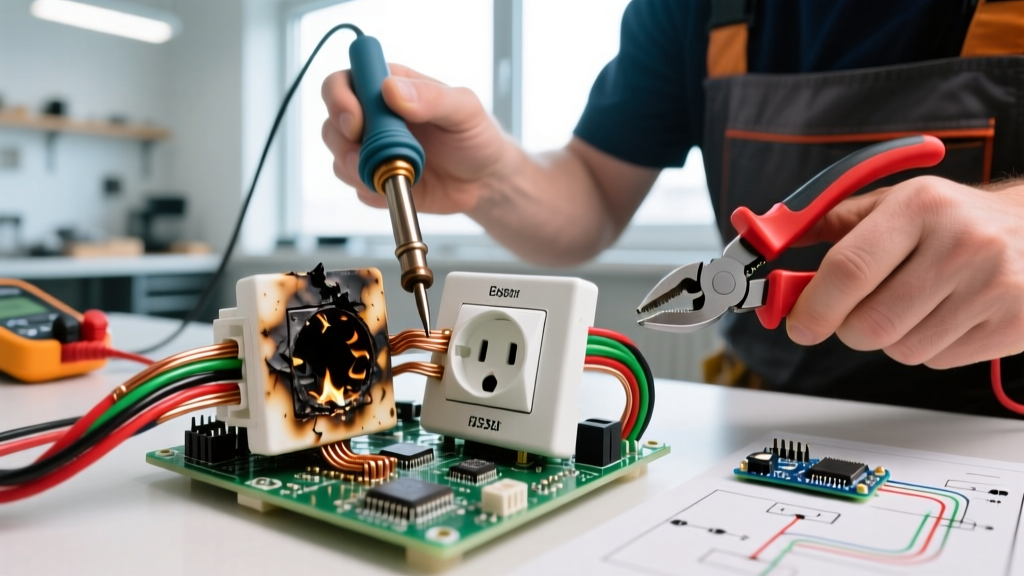
If you have recently purchased a traditional Riad in the Medina of Marrakech, an apartment in Casablanca, or a coastal villa in Essaouira, you are likely dealing with outdated electrical infrastructure. For decades, the standard Morocco electrical outlet was the ungrounded Type C (CEE 7/16) Europlug receptacle. While these two-prong sockets are sufficient for low-draw devices like phone chargers, they pose a severe shock and fire hazard when used with modern, high-draw appliances like space heaters, air conditioners, or high-end kitchen equipment.
As of 2026, the Moroccan grid, managed by ONEE (Office National de l'Electricité et de l'Eau Potable), operates at a nominal 220V (harmonizing toward 230V) at 50Hz. Upgrading your legacy outlets to the grounded Type E (CEE 7/5) standard is not just a cosmetic improvement; it is a critical safety intervention. This guide provides a master-class, step-by-step framework for replacing ungrounded Type C outlets with modern, grounded Type E receptacles, addressing the unique architectural and electrical challenges found in Moroccan properties.
⚠️ CRITICAL SAFETY WARNING: Morocco utilizes a 220V/50Hz alternating current system. Lethal voltage is present at the receptacle. Never attempt this upgrade without first isolating the circuit at the main distribution board (tableau électrique) and verifying zero voltage with a CAT III or CAT IV multimeter.
Understanding the Standards: Type C vs. Type E
Before pulling out your screwdriver, it is vital to understand the physical and electrical differences between the legacy and modern standards. According to the International Electrotechnical Commission (IEC), Type E and Type C serve vastly different safety functions.
| Feature | Legacy Type C (CEE 7/16) | Modern Type E (CEE 7/5) |
|---|---|---|
| Grounding / Earth | None (Ungrounded) | Male Earth Pin (Receptacle) |
| Max Current Rating | Typically 2.5A (Unfused) | 16A (Standard Circuit) |
| Child Safety Shutters | Rarely present in older builds | Mandatory in modern 2026 models |
| Appliance Compatibility | Double-insulated (Class II) only | Class I (Grounded) & Class II |
Tools and Materials for the 2026 Upgrade
Sourcing high-quality components in Morocco is straightforward if you know which brands to trust. Avoid unbranded, counterfeit sockets sold in local souks; they often use aluminum internal contacts that overheat and cause fires. Stick to premium brands like Schneider Electric or Legrand, which are widely available at authorized distributors (e.g., Comptoir Métallurgique Marocain or local specialty electrical shops).
Required Components
- Receptacle: Schneider Electric Odace Type E Socket (Model S520058) or Legrand Mosaic Type E. (Ensure it features the protruding male earth pin characteristic of Type E).
- Wire: 2.5mm² solid copper wire (H07V-U). You will need Brown (Phase), Blue (Neutral), and Green/Yellow (Earth).
- Flush-Mount Box: Standard 67mm diameter batibox (boîte d'encastrement) if the existing cavity is damaged.
- Circuit Protection: Ensure the circuit is protected by a 16A or 20A MCB (Magnetic Circuit Breaker) and a 30mA RCD (Residual Current Device) at the main panel.
Required Tools
- CAT III Digital Multimeter (e.g., Fluke 117)
- Insulated VDE screwdrivers (Flathead 4mm, Phillips #2)
- Wire strippers (calibrated for 2.5mm²)
- Oscillating multi-tool (crucial for Medina plaster walls)
- Non-contact voltage tester (NCVT)
Moroccan Wire Color Codes & ONEE Regulations
Morocco's electrical color codes closely mirror the French NF C 15-100 standard. Misidentifying wires in older properties where previous contractors may have ignored code is a common failure mode. Always verify with a multimeter.
| Function | Modern Standard Color | Legacy / Non-Standard Colors (Pre-2000) |
|---|---|---|
| Phase (Line) | Brown or Red | Black, Grey, or White |
| Neutral | Light Blue | Blue or Black |
| Earth (Ground) | Green/Yellow Stripe | Bare Copper or Solid Green |
Step-by-Step Replacement Procedure
Step 1: Isolate and Verify Power
Locate your main distribution board. Turn off the specific 16A/20A MCB controlling the room. If the panel is unlabeled (common in older Riads), turn off the main 30mA RCD switch. Insert your multimeter probes into the legacy Type C outlet. Set the dial to AC Voltage (V~). A reading of 0V confirms isolation. Follow up with an NCVT to ensure no phantom voltage or induced current is present.
Step 2: Extract the Legacy Receptacle
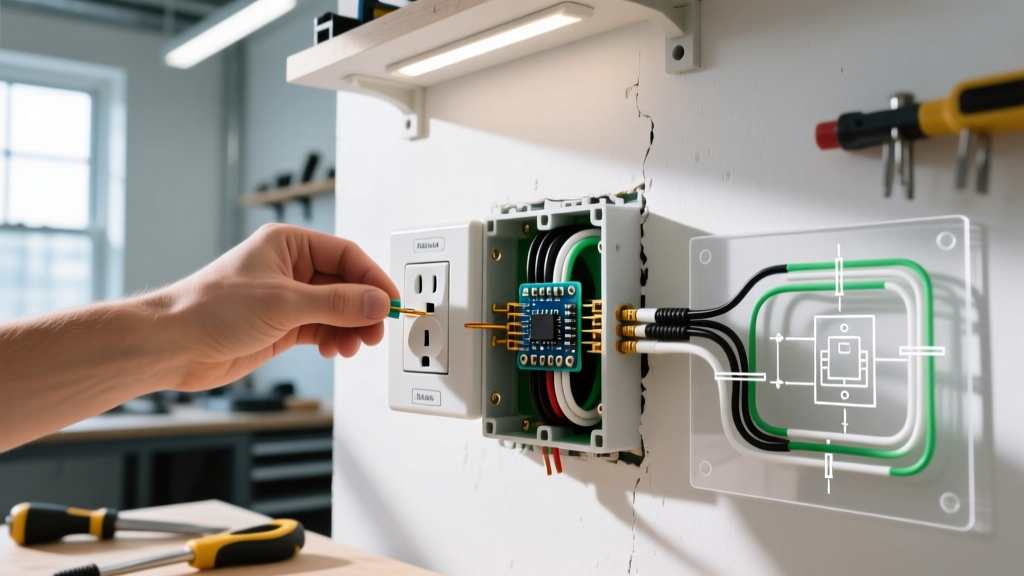
Remove the single center screw holding the Type C faceplate. Gently pull the socket body outward. You will likely find only two wires connected (Phase and Neutral) via friction push-in terminals or small set screws. Loosen the terminals and extract the wires. Inspect the copper ends; if they are oxidized (blackened) or brittle, snip them back and strip a fresh 12mm of insulation.
Step 3: Addressing the Missing Earth Wire (The Medina Challenge)
This is the most critical phase. A Type E outlet requires an earth wire. In pre-1990s Moroccan builds, the conduit (gaine ICTA) often lacks a ground wire. Solution A (Preferred): Use a fiberglass fish tape to pull a new 2.5mm² Green/Yellow wire from the nearest grounded junction box or the main panel through the existing corrugated conduit. Solution B (Retrofit): If the conduit is crushed or blocked (common in hollow brick / brique creuse walls), you must run surface-mounted trunking (plinthe électrique) to a verified earth point, or install a local earth rod (piquet de terre) driven into the courtyard soil, bonded back to the outlet. According to the National Fire Protection Association (NFPA), proper equipment grounding is essential for fault-current clearing; never simply bond the neutral to the ground terminal at the receptacle (a bootleg ground), as this creates a lethal shock hazard if the neutral breaks.
Step 4: Wiring the Schneider Odace Type E
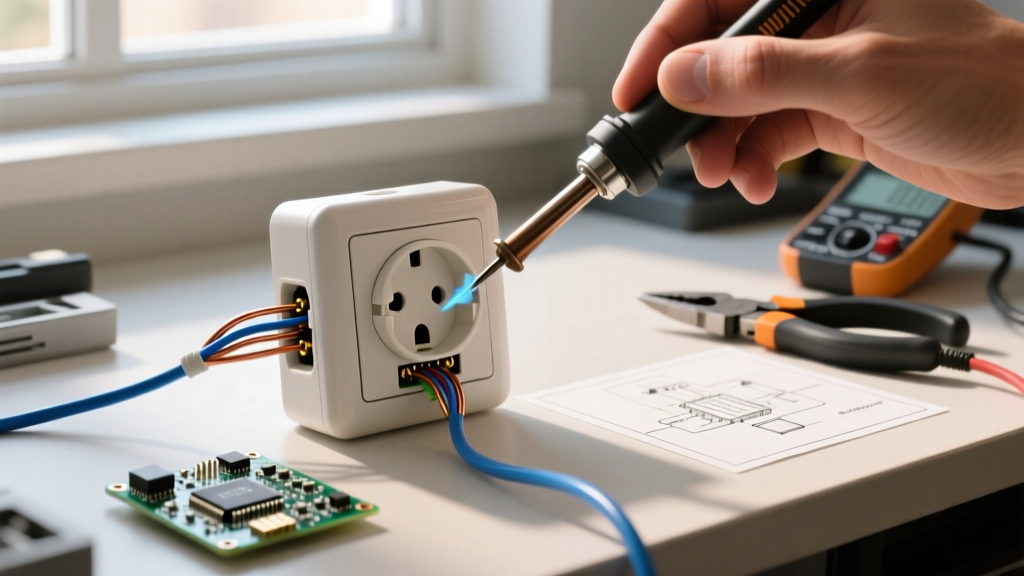
Connect the wires to the new Type E mechanism. Modern Schneider and Legrand sockets utilize automatic clamp terminals (bornes automatiques). 1. Insert the Brown (Phase) wire into the terminal marked 'L' or 'Phase'. 2. Insert the Blue (Neutral) wire into the terminal marked 'N'. 3. Insert the Green/Yellow (Earth) wire into the terminal marked with the Earth symbol (⏚). Give each wire a firm tug to ensure the clamp has engaged. Fold the wires neatly in a Z-pattern behind the mechanism to avoid pinching the insulation against the plaster.
Step 5: Mounting and Final Testing
Secure the mechanism to the flush-mount box using the two M3.5 expansion screws. Ensure the claws (griffes) do not crush the wires inside the box. Snap on the Odace faceplate. Restore power at the main panel. Use a receptacle tester (adapted with a Type E plug) to verify correct Phase/Neutral polarity and confirm the Earth fault loop impedance is within acceptable limits.
Troubleshooting Edge Cases in Moroccan Architecture
Crumbling Tadelakt and Lime Plaster
Traditional Moroccan walls are often finished with Tadelakt (a waterproof lime plaster) or soft lime-based stucco. Standard flush-mount box claws will fail to grip these surfaces, causing the outlet to pull out of the wall when you unplug a device. The Fix: Do not rely on the metal claws. Use 40mm drywall screws to anchor the receptacle mechanism directly into the plastic batibox. If the batibox itself is loose, inject a two-part epoxy resin or polyurethane expanding foam around the box edges, let it cure for 4 hours, and then mount the socket.
Voltage Drop in Long Cable Runs
In large rural villas or extended Riads, the distance from the main panel to the outlet may exceed 25 meters. On a 2.5mm² wire, this can cause a voltage drop below 207V under heavy load, causing air conditioners to trip or overheat. If you measure less than 210V at the outlet under load, you must upgrade the circuit wiring to 4.0mm² copper or split the circuit into two distinct 16A MCB branches.
2026 Cost and Sourcing Breakdown
Budgeting for an electrical upgrade in Morocco requires understanding local pricing dynamics. Prices below reflect the 2026 market averages in major hubs like Casablanca, Rabat, and Marrakech.
| Item / Service | Cost (MAD) | Cost (USD Approx.) |
|---|---|---|
| Schneider Odace Type E Socket | 85 - 120 MAD | $8.50 - $12.00 |
| 100m Roll 2.5mm² H07V-U Wire | 450 - 600 MAD | $45.00 - $60.00 |
| Electrician Labor (Per Outlet Point) | 150 - 300 MAD | $15.00 - $30.00 |
| Main Panel RCD Upgrade (30mA) | 600 - 900 MAD | $60.00 - $90.00 |
Final Verification and Compliance
Upgrading a Morocco electrical outlet from an ungrounded Type C to a robust Type E receptacle dramatically improves the safety, functionality, and resale value of your property. Always ensure your main distribution board features a 30mA differential switch (interrupteur différentiel) to provide life-saving protection against earth leakage, especially in wet areas like Moroccan hammams and kitchens. By adhering to ONEE guidelines and utilizing premium components, your electrical infrastructure will safely support modern loads for decades to come.