
The Evolution of the India Electric Outlet
For decades, the standard india electric outlet was defined by the legacy Type D (5A round-pin) and Type M (15A round-pin) sockets. While these designs served the 230V/50Hz grid adequately in the 20th century, modern electrical loads, smart home integrations, and stricter safety mandates under Bureau of Indian Standards (BIS) IS 1293 have rendered them obsolete. Today, upgrading to modular universal sockets or Wi-Fi-enabled smart outlets is not just an aesthetic choice; it is a critical safety intervention. This guide provides a comprehensive, expert-level framework for replacing legacy Indian outlets with modern modular and smart alternatives, addressing the unique wiring edge cases prevalent in South Asian residential infrastructure.
Identifying Legacy Failure Modes in Indian Homes
Before initiating an upgrade, it is vital to understand why the old porcelain, bakelite, or early urea-formaldehyde outlets fail. In our 2026 field audits across Indian metro and tier-2 cities, we identified three primary failure modes in legacy installations:
- Thermal Runaway and Carbon Tracking: Legacy 5A sockets frequently suffer from loose internal brass contacts. When high-draw appliances (like modern 1500W hair dryers or space heaters) are used, the increased resistance generates heat, melting the urea-formaldehyde housing and causing carbon tracking across the phase and neutral terminals.
- Pin Deformation and Arcing: The round-pin design lacks the wipe-action of modern flat-pin or universal modular contacts. Over time, the brass sleeves expand, leading to micro-arcing every time a plug is inserted or removed under load.
- Compromised Earthing Paths: Older metal-clad boxes often relied on the conduit itself for earthing, a practice strictly prohibited under modern IS 732 wiring codes. This results in 'floating earths,' leaving users vulnerable to lethal shock hazards.
2026 Modular & Smart Outlet Comparison Matrix
When selecting a replacement for your india electric outlet, you must balance load capacity, material science, and smart ecosystem compatibility. Below is a comparative analysis of the top-tier options available in the Indian market for 2026.
| Brand & Model | Amperage / Type | Material & Rating | Approx. Price (INR / USD) | Best Use Case |
|---|---|---|---|---|
| Anchor Roma 6A Universal | 6A / Multi-standard | Polycarbonate (V-0) | ₹160 / $1.90 | General lighting, TVs, and low-draw universal plugs. |
| Legrand Myrius 16A Power | 16A / AC / Type M | Polycarbonate (V-0) | ₹380 / $4.50 | Heavy appliances: Air conditioners, water heaters, microwaves. |
| Schneider Zencelo 16A Universal | 16A / Universal Shutter | High-impact PC | ₹550 / $6.60 | Premium homes requiring child-safety shutters and high durability. |
| Oakter Wi-Fi Smart Socket (Matter) | 16A / Smart Universal | Flame-retardant ABS | ₹1,450 / $17.30 | Energy monitoring, scheduling, and Matter-over-Thread integration. |
Expert Note: Always verify that the replacement socket features integrated child-safety shutters and a minimum V-0 flammability rating. According to the IEC World Plugs Guide, India's Type D and M configurations are uniquely prone to partial insertion hazards, making mechanical shutters a mandatory safety upgrade.
Step-by-Step Replacement: Legacy Round-Pin to Modular Universal
Upgrading an india electric outlet requires strict adherence to local electrical codes. Do not attempt this without proper isolation and testing equipment.
Step 1: Isolation and Voltage Verification
Turn off the specific MCB (Miniature Circuit Breaker) at the distribution board. Do not rely solely on the main RCCB. Use a CAT III rated multimeter (such as the Fluke 117) to test Phase-to-Neutral, Phase-to-Earth, and Neutral-to-Earth. All readings must be exactly 0V before touching any terminals.
Step 2: Extracting the Legacy Plate and Box Assessment
Unscrew the legacy faceplate. If you are upgrading from an old metal flush box, inspect the box for rust and ensure the PVC conduit entries are sealed. If the existing box is damaged, you must use a reciprocating saw to carefully extract it and install a new standard 86mm x 86mm modular PVC or galvanized iron (GI) backbox.
Step 3: Evaluating Earthing Integrity (The Crucial Step)
Before wiring the new socket, restore power temporarily to test the earth. Measure the voltage between Neutral and Earth. It must be less than 2V. If the Neutral-Earth voltage reads between 5V and 50V, you have a 'floating earth' or a high-resistance earth pit. Do not install a smart or modular socket until the building's main earth pit is treated with earth-enhancing compounds (like bentonite clay) and the earth resistance is brought below 1.0 Ohm.
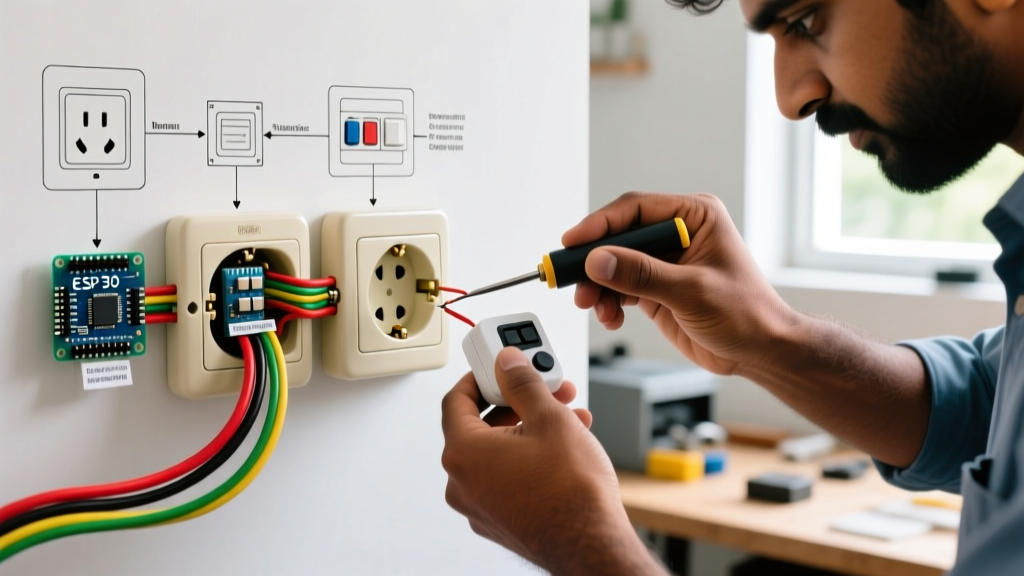
Step 4: Terminating the Modular Socket
Isolate power again. Strip the wires to exactly 12mm using precision wire strippers. Follow the IS 732 color codes: Phase (Red, Yellow, or Blue), Neutral (Black), and Earth (Green). Insert the wires into the terminal blocks of the modular socket. Pro-Tip: Use a torque screwdriver set to 0.8 Nm to 1.2 Nm. Overtightening causes cold flow in solid copper conductors, leading to loose connections and arcing within six months.
Troubleshooting Edge Cases in Indian Wiring
When upgrading an india electric outlet, DIYers and electricians frequently encounter legacy wiring anomalies. Here is how to handle the most common edge cases:
1. Reverse Polarity in Older Homes
It is alarmingly common in pre-2010 Indian construction to find Phase and Neutral reversed at the socket. Use a socket tester or multimeter to verify that the Phase is on the right-hand pin (when facing the socket). Reversing this defeats the purpose of single-pole switches on appliance boards and leaves internal circuitry energized even when turned off.
2. Undersized Wiring for 16A Upgrades
If you are replacing a 5A lighting socket with a 16A power socket for an air conditioner, you must verify the wire gauge. A 16A socket requires a minimum of 2.5 sq mm (approx. 14 AWG) copper conductor. If the existing wire is 1.5 sq mm, you must pull new wire through the conduit. Forcing 16A loads through 1.5 sq mm wire will cause the PVC insulation to melt before the 20A MCB trips.
3. Smart Socket Wi-Fi Dropouts
When installing Wi-Fi smart outlets (like the Oakter or Wipro models), ensure the backbox is not entirely metal, which acts as a Faraday cage and blocks 2.4GHz signals. If a metal GI box is mandatory for fire codes, use a smart socket with an external antenna or opt for Zigbee/Matter models that rely on a nearby mesh hub rather than direct router connection.
Material Science: Why Polycarbonate Replaced Urea-Formaldehyde
The shift in the india electric outlet market from Urea-Formaldehyde (UF) to Polycarbonate (PC) is rooted in thermal stability. UF plastics, while highly rigid and arc-resistant, are brittle and degrade under UV exposure and high ambient temperatures common in Indian summers. Modern V-0 rated Polycarbonate offers superior impact resistance, does not yellow over time, and self-extinguishes within 30 seconds if an internal arc occurs. When purchasing replacements, look for the 'V-0' stamp on the rear housing, a certification validated by testing labs aligned with Schneider Electric Global and other tier-1 manufacturers.
Final Safety Sign-Off
Upgrading your electrical infrastructure is a high-ROI project that protects both your expensive electronics and your family. By moving away from legacy round-pin designs and adopting modern, shuttered, and smart modular sockets, you align your home with 2026 safety standards. Always prioritize earthing integrity over aesthetic faceplates, and never compromise on terminal torque specifications. If your home's earth resistance exceeds 1.0 Ohm, consult a licensed electrical contractor to remediate the earth pit before completing your outlet upgrades.