
Navigating Czech Electrical Standards for DIYers and Expats
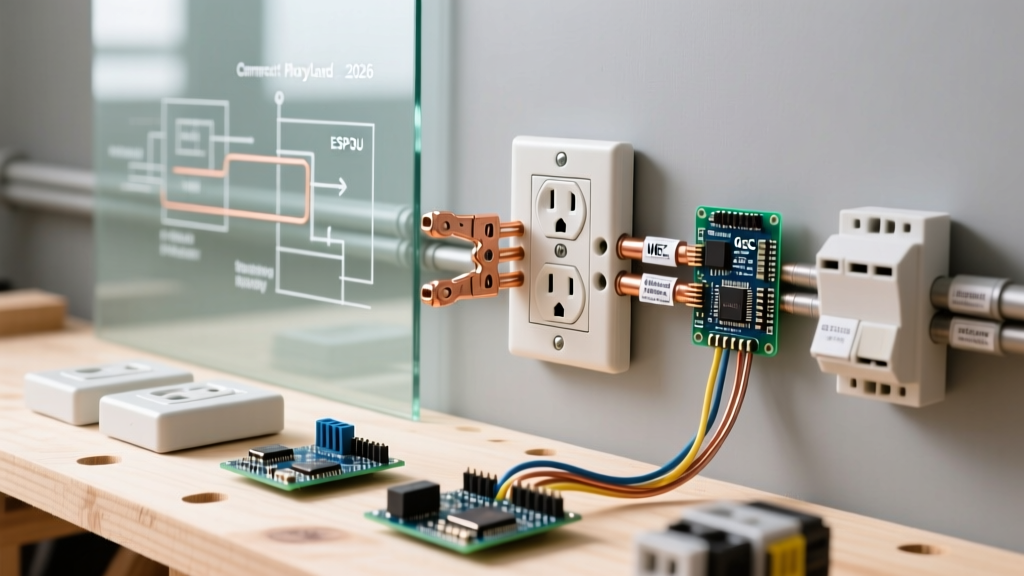
Wiring an electrical outlet in the Czech Republic requires strict adherence to local building codes, specifically the ČSN (České technické normy) standards which harmonize with broader European IEC regulations. Whether you are renovating a historic brick home in Prague or upgrading a mid-century panelák (prefabricated apartment), understanding the local 230V/50Hz infrastructure is critical for safety and compliance.
Unlike the US (120V) or the UK (Type G), the Czech Republic utilizes the Type E (CEE 7/5) socket standard. This guide provides a deep-dive into cable specifications, color codes, and the unique edge cases you will encounter in Czech residential wiring scenarios in 2026.
The Type E Socket: Anatomy and Orientation
According to the International Electrotechnical Commission (IEC), the Czech Republic relies on the Type E plug and socket system. The defining feature of this system is the male earth (ground) pin that protrudes from the socket itself, which mates with a female hole in the plug.
⚠️ CRITICAL ORIENTATION RULE: In the Czech Republic, the protruding earth pin MUST be positioned at the top (12 o'clock). While the Schuko (Type F) standard allows for reversible insertion, Czech electrical inspectors strictly enforce the 'pin-up' orientation for Type E sockets to maintain uniformity and ensure proper phase alignment in specialized switched appliances.
Socket Compatibility
Modern Type E sockets installed in the Czech Republic are typically 'hybrid' designs. They feature the protruding earth pin but also include side earthing clips. This allows them to accept both Type E plugs and German Type F (Schuko) plugs safely. Look for sockets labeled as CEE 7/4 + CEE 7/5 compatible when purchasing from local suppliers like Alza or specialized electrical wholesalers.
Czech Wiring Color Codes & Cable Specifications
Using the correct cable type and adhering to the harmonized EU/Czech color code is non-negotiable. The standard installation cable embedded in Czech masonry and plaster is the CYKY-J (solid copper core, PVC insulated, PVC sheathed). For standard 16A receptacle circuits, you must use CYKY-J 3x2.5 mm².
| Function | Wire Color | Czech Designation | Terminal Marking |
|---|---|---|---|
| Phase (Live) | Brown | Fáze (L) | L |
| Neutral | Light Blue | Nulový vodič (N) | N |
| Protective Earth | Green/Yellow | Ochranný vodič (PE) | PE / ⏚ |
Expert Warning: Never use CYKY-J 3x1.5 mm² for wall sockets. While 1.5 mm² is standard for lighting circuits (protected by a 10A breaker), using it on a 16A socket circuit violates fire safety codes and will fail a standard revize (electrical inspection).
Step-by-Step: Wiring a Standard Czech Wall Socket
Before beginning, ensure the main breaker (hlavní jistič) is OFF and verified with a CAT III or CAT IV voltage tester. Standard socket circuits in the CZ are protected by a 16A Type B or Type C MCB (e.g., Eaton PL7-B16/1 or Schneider Acti9 iC60N).
- Prepare the Wall Box: Czech sockets typically use standard 68mm diameter flush-mounted boxes (instalační krabice). Clean out plaster debris.
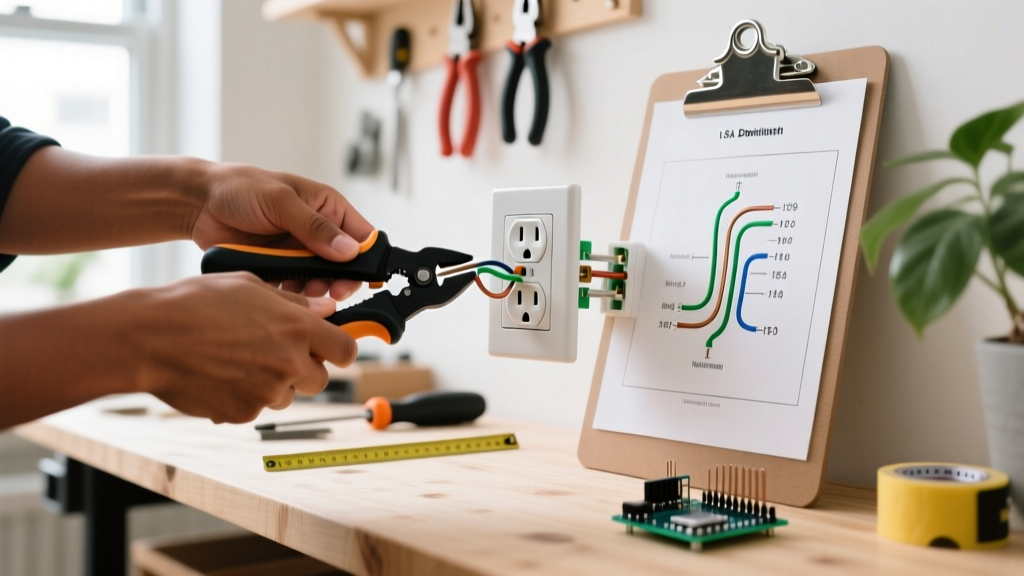
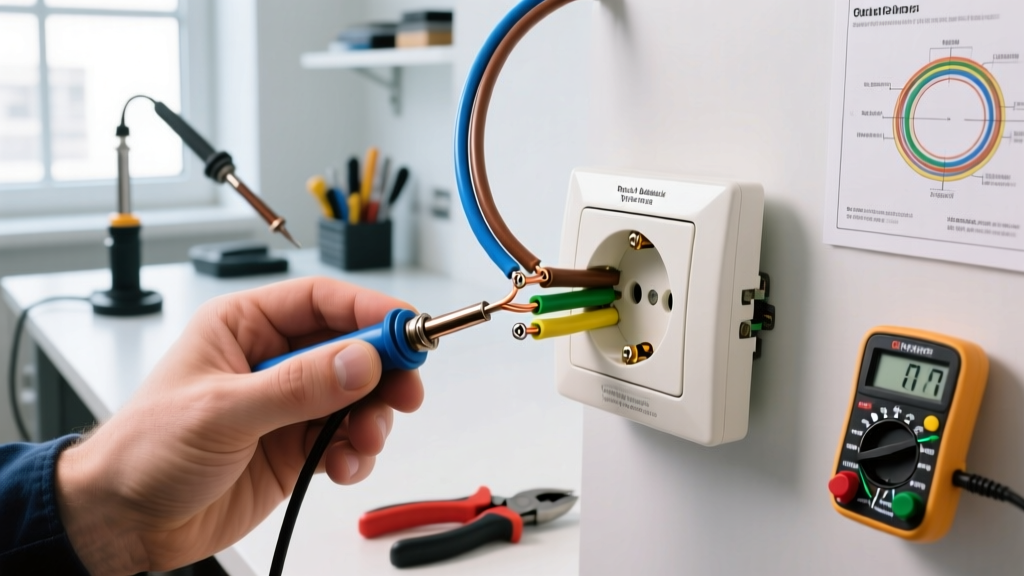
- Strip the CYKY-J Cable: Remove the outer PVC sheath to leave about 50mm of working length. Strip exactly 12mm of insulation from the individual 2.5 mm² solid copper cores using a precision wire stripper to avoid nicking the conductor.
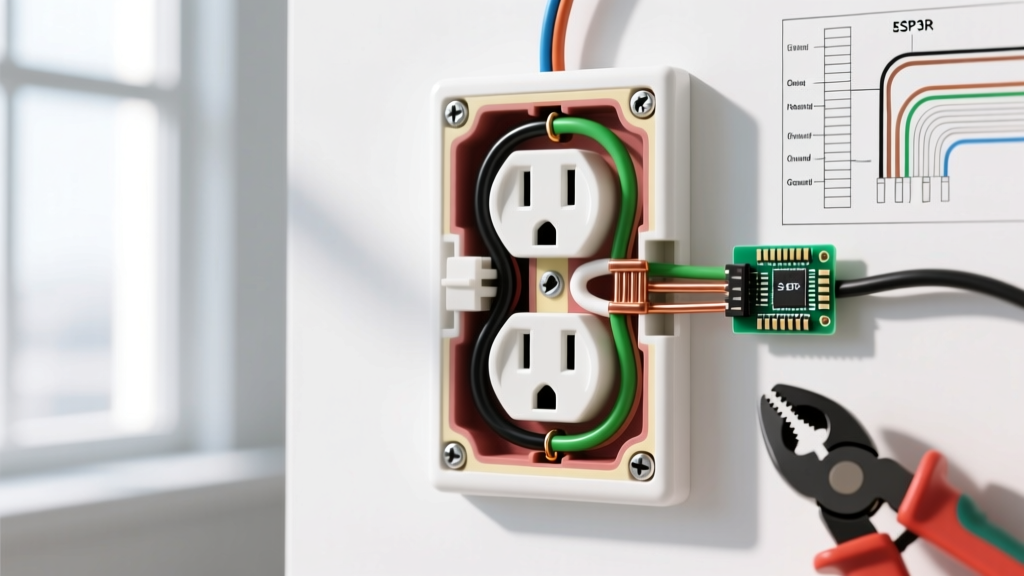
- Connect the Earth (PE): Insert the Green/Yellow wire into the central or top earth terminal. Tighten to the manufacturer's specified torque (usually 0.5 to 0.8 Nm).
- Connect Neutral (N) and Phase (L): Insert the Blue wire into the 'N' terminal and the Brown wire into the 'L' terminal. Note: Czech convention does not strictly dictate left/right for L and N on standard unswitched sockets, but maintaining consistency across the room is best practice.
- Secure the Socket: Push the wires neatly into the back of the box using a 'Z' or 'S' fold. Use the dual-expansion claws (drápky) and the M3.5 mounting screws to secure the socket frame to the box. Ensure the earth pin is pointing precisely UP.
Edge Case Scenario: Upgrading 'Panelák' Aluminum Wiring
If you are working in a Czech panelák (prefabricated concrete apartment building) constructed between the 1960s and 1980s, you will likely encounter aluminum core wiring (Al 2.5 mm²). This presents a severe hazard if not handled correctly.
Directly connecting modern copper pigtails or copper terminal screws to aluminum wires causes galvanic corrosion. Over time, this creates a high-resistance joint that generates intense heat, leading to melted sockets and electrical fires. Furthermore, aluminum creeps under pressure, meaning screw terminals will loosen over a few years.
The 2026 Compliant Solution
To bridge old aluminum wall wires to a modern copper socket, you must use push-wire connectors specifically rated for Cu/Al mixing, paired with a chemical inhibitor.
- Connector: WAGO 221 Series (e.g., 221-413) lever-nuts.
- Compound: WAGO Alu-Plus contact paste. This paste breaks down the aluminum oxide layer and prevents moisture ingress.
- Method: Fill the WAGO connector port with Alu-Plus paste, insert the stripped aluminum wire, clamp it down, and then insert your new 2.5 mm² copper pigtail into the adjacent port. This safely transitions the connection to the socket.
Material Costs & Sourcing in the Czech Republic (2026 Estimates)
Budgeting for electrical renovations requires knowing local pricing. Below is a breakdown of standard material and labor costs in CZK and USD for 2026.
| Item / Service | Typical Brand / Model | Cost (CZK) | Cost (USD Est.) |
|---|---|---|---|
| Standard Wall Socket | ABB Tango / Schneider Asfora | 160 - 250 Kč | $6.80 - $10.50 |
| CYKY-J 3x2.5 Cable | Draka / Prysmian (per meter) | 38 - 45 Kč | $1.60 - $1.90 |
| 16A MCB Breaker | Eaton PL7-B16/1 | 180 - 220 Kč | $7.60 - $9.30 |
| Cu/Al Connector Kit | WAGO 221 + Alu-Plus Paste | 130 Kč | $5.50 |
| Electrician Labor | Certified 'Revizní technik' | 900 - 1400 Kč/hr | $38.00 - $59.00/hr |
Frequently Asked Questions
Do I need a residual current device (RCD/GFCI) for Czech sockets?
Yes. According to modern ČSN 33 2000-7-701 ed. 3 standards, all socket circuits in bathrooms and outdoor areas must be protected by an RCD (locally called a proudový chránič) with a tripping current of 30mA. For general living room and bedroom sockets, RCD protection is now highly recommended and increasingly mandated in new builds for fire prevention.
Can I use US or UK appliances in a Czech outlet?
Physically, you will need a travel adapter. Electrically, the Czech Republic operates on 230V/50Hz. Plugging a 120V US appliance directly into a Czech socket via an adapter will instantly destroy the appliance and may cause a fire. You must use a step-down voltage transformer rated for the appliance's wattage. For more on global voltage compatibility, refer to the comprehensive CEE 7 standard documentation.
What is a 'revize' and why do I need one?
A revize is a mandatory electrical safety inspection performed by a certified technician (revizní technik). If you are renting out an apartment or selling a property, a valid inspection report (typically not older than 5 years for residential) is legally required. The inspector will test earth loop impedance, RCD trip times, and verify that your wiring matches the schematic. For deeper insights into European workplace and residential electrical safety compliance, consult the EU-OSHA electrical safety guidelines.
Final Thoughts on Safety and Compliance
Wiring an electrical outlet in the Czech Republic is a precise task that blends standardized European practices with specific local conventions like the 'pin-up' Type E orientation and the prevalence of CYKY-J cabling. Always prioritize proper torque on terminals, respect the Cu/Al boundaries in older buildings, and when in doubt, hire a licensed Czech electrician to perform the final termination and testing.