
The Hidden Dangers of Ungrounded 2-Prong Receptacles
If your, simply swapping the receptacle does not magically create a ground path. You must follow strict National Electrical Code (NEC) guidelines to ensure fire and shock safety. In this guide, we break down the three NEC-compliant methods to convert 2 prong to 3 prong electrical outlet configurations, complete with 2026 material costs, code references, and step-by-step installation protocols.
NEC Article 406.4(D): The Legal Framework for Upgrades
The National Fire Protection Association (NFPA) outlines the exact rules for replacing ungrounded receptacles in NEC Article 406.4(D). You cannot simply install a standard 3-prong receptacle on an ungrounded circuit. Doing so creates a severe shock hazard and violates electrical code. The NEC provides three distinct pathways for compliance when the main panel has been upgraded to a modern grounded system but the branch circuits remain legacy 2-wire (hot and neutral only).
The 'Bootleg Ground' Hazard
Before exploring legal upgrades, we must address the most dangerous shortcut in residential wiring: the bootleg ground. This occurs when an installer places a jumper wire between the neutral (silver) terminal and the ground (green) terminal on a 3-prong receptacle. While a standard plug tester will read this as 'correctly wired,' it is lethal. If the neutral wire ever becomes disconnected upstream, the metal chassis of any plugged-in appliance will become energized with 120V. Never use a bootleg ground.
Method 1: The True Ground Upgrade (Running a New EGC)
The gold standard for converting a 2-prong outlet is to install a new Equipment Grounding Conductor (EGC). This provides a true, low-impedance path to the earth, which is mandatory for surge protectors, sensitive AV equipment, and modern smart home hubs.
Execution and Material Requirements
- Wire Gauge: You must pull a bare copper or green-insulated wire that matches the circuit breaker amperage. Use 14 AWG for 15-amp circuits and 12 AWG for 20-amp circuits.
- Routing: The new ground wire must be routed back to the main service panel's ground bar, or to a nearby metal junction box that is already bonded to the main panel via a continuous metal conduit or existing ground wire.
- Termination: Connect the EGC to the green grounding screw on the new 3-prong receptacle (e.g., Leviton 16242-W) and bond it to a metal outlet box using a 10-32 green grounding screw and pigtail.
Cost & Effort: Pulling new wire through finished walls is highly invasive. Expect to pay a licensed electrician between $250 and $450 per outlet in 2026, or $1,500 to $3,500+ for a full room rewire, depending on drywall repair and attic/crawlspace accessibility.
Method 2: The GFCI Protection Workaround (No New Wiring)
If running a new ground wire is structurally impossible or financially prohibitive, NEC Article 406.4(D)(2) permits the installation of a Ground Fault Circuit Interrupter (GFCI) receptacle. A GFCI does not create a ground; rather, it monitors the current balance between the hot and neutral wires. If it detects a leakage as small as 4 to 6 milliamps (indicating current is passing through a person), it trips in milliseconds, preventing lethal electrocution.
Crucial Limitation: While a GFCI protects human life from shock, it does not provide an equipment ground. Surge protectors plugged into a GFCI-protected ungrounded outlet will not function properly, as Metal Oxide Varistors (MOVs) inside the surge protector require a true ground path to shunt voltage spikes away from your electronics.
Step-by-Step GFCI Installation
- Kill the Power: Turn off the breaker and verify zero voltage using a non-contact voltage tester (e.g., Klein Tools NCVT-3).
- Remove the Old Receptacle: Unscrew the 2-prong outlet. Note which wire is hot (usually black) and which is neutral (white).
- Identify Line vs. Load: Modern GFCIs like the Leviton 20952-W have 'LINE' and 'LOAD' terminals. Connect the incoming power wires to the LINE terminals. If you are protecting downstream outlets, connect the continuing wires to the LOAD terminals.
- Apply the Mandatory Label: The NEC requires that the faceplate be labeled with the included sticker reading 'No Equipment Ground' and 'GFCI Protected'.
Method 3: Bonding to an Existing Metal Conduit System
In homes built between the 1930s and 1960s, wiring was often run through rigid metal conduit (EMT) or BX/AC armored cable. In many cases, the metal casing itself serves as a continuous ground path back to the panel.
Testing for Continuity
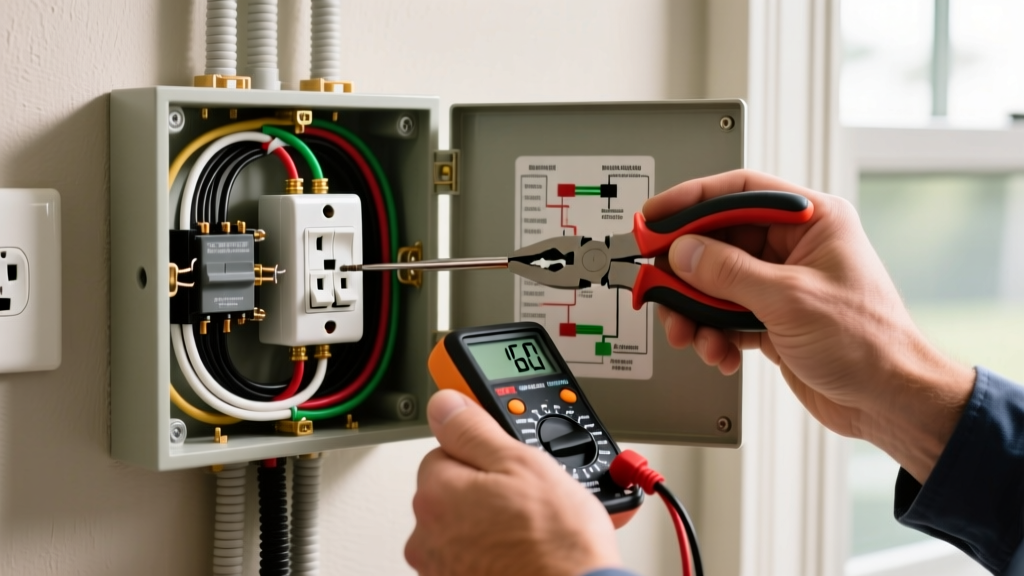
Before relying on the metal box for grounding, you must verify continuity. Use a multimeter set to AC voltage. Measure between the hot wire and the metal outlet box. If you read a solid ~120V, the box is likely grounded. For absolute certainty, turn off the power and use the multimeter's continuity/ohms setting to test between the metal box and the main panel's ground bar. If resistance is less than 1 ohm, you can legally install a standard 3-prong receptacle by bonding the receptacle's green ground screw directly to the metal box using a grounding pigtail and a 10-32 green hex screw.
Upgrade Method Comparison Matrix
| Upgrade Method | NEC Compliance | Provides True Ground? | Surge Protector Compatible? | Avg. 2026 Cost (Pro) |
|---|---|---|---|---|
| Run New EGC Wire | Yes (406.4(D)(1)) | Yes | Yes | $250 - $450 / outlet |
| GFCI Receptacle | Yes (406.4(D)(2)) | No | No | $120 - $180 / outlet |
| Metal Box Bonding | Yes (250.134) | Yes (if verified) | Yes | $150 - $220 / outlet |
| Bootleg Ground (Jumper) | Illegal / Hazardous | Fake | Dangerous | N/A |
Required Tools and 2026 Material Costs
To execute these upgrades safely, you need professional-grade diagnostic and installation tools. Do not rely on cheap, plastic plug-in testers for diagnosing ungrounded circuits.
- Digital Multimeter: Fluke 117 or Klein Tools MM400 ($50 - $180). Essential for verifying true ground continuity and identifying switched loops.
- Non-Contact Voltage Tester: Klein Tools NCVT-3 ($35). Dual-range detection for both standard and low-voltage wiring.
- GFCI Receptacle: Leviton 20952-W or Eaton GFTR15W ($22 - $32). Ensure it is a 'Tamper Resistant' (TR) model, as required by modern NEC codes for all residential living spaces.
- Grounding Pigtails & Screws: 12 AWG or 14 AWG bare copper pigtails and 10-32 green hex screws ($5 per pack).
Frequently Asked Questions
Can I just use a 3-prong to 2-prong cheater plug adapter?
Cheater plugs (the small grey adapters with a green wire) are intended for temporary use only. To work safely, the green wire must be screwed directly into the metal faceplate cover screw, which only provides a ground if the wall box is metal and properly bonded to the panel. In most modern homes with plastic boxes, the cheater plug provides zero ground protection and should be avoided.
Will a GFCI outlet protect my expensive PC or TV from power surges?
No. As the Consumer Product Safety Commission (CPSC) notes, GFCIs are designed solely to prevent lethal electric shock by detecting current leakage. They do not regulate voltage spikes. Without a true equipment ground, a surge protector cannot divert excess voltage away from your electronics, leaving them vulnerable to lightning strikes and grid fluctuations.
Does replacing 2-prong outlets increase home value?
Yes. During a home inspection, ungrounded 2-prong outlets are frequently flagged as a safety defect. Upgrading them to NEC-compliant GFCI or fully grounded 3-prong receptacles removes a major negotiation point for buyers and brings older properties up to modern safety expectations, as highlighted by the Electrical Safety Foundation International (ESFI).