
Diagnosing the Tanzania Electrical Outlet: Standards and Grid Realities
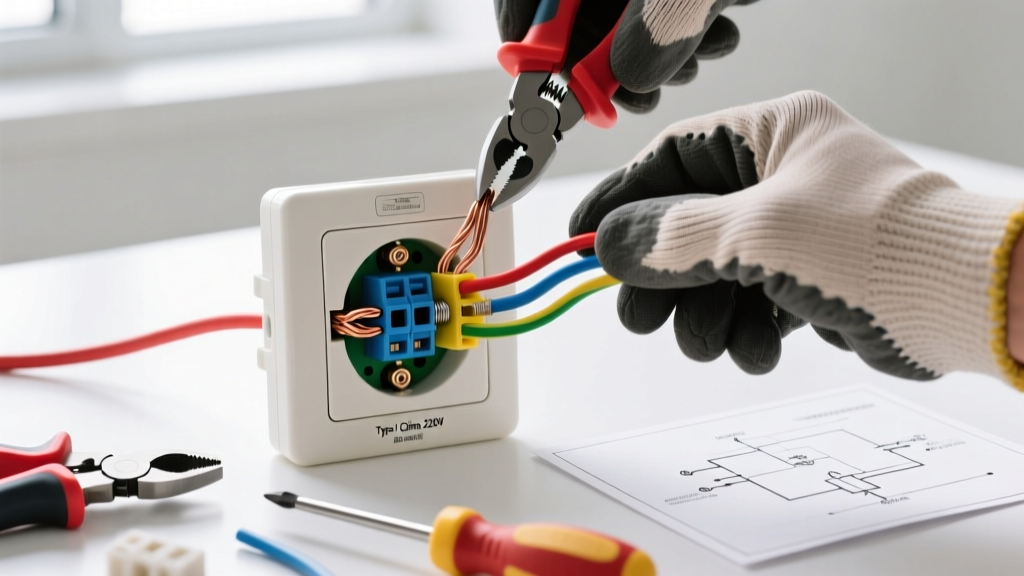
As of 2026, Tanzania's electrical infrastructure continues to modernize, yet diagnosing a faulty Tanzania electrical outlet remains a complex task for electricians and DIY enthusiasts alike. The country primarily utilizes the Type G (BS 1363) standard for modern installations, alongside legacy Type D (BS 546) sockets in older buildings. Nominally, the grid operates at 230V / 50Hz, managed by the Tanzania Electric Supply Company (Tanesco). However, frequent voltage fluctuations, harmonic distortion, and the prevalence of non-compliant counterfeit sockets in local markets introduce unique failure modes not found in more stable grids.
Whether you are an expatriate dealing with melted appliance plugs in Dar es Salaam, or a local technician troubleshooting a dead socket in Arusha, understanding the intersection of British wiring standards and East African grid realities is critical. This guide provides a deep-dive diagnostic protocol for troubleshooting Tanzania electrical outlets, complete with multimeter testing matrices and hardware upgrade paths.
Anatomy of Tanzanian Socket Standards
Before touching a screwdriver, you must identify the socket generation. According to the IEC World Plugs database, Tanzania officially recognizes Type G and Type D.
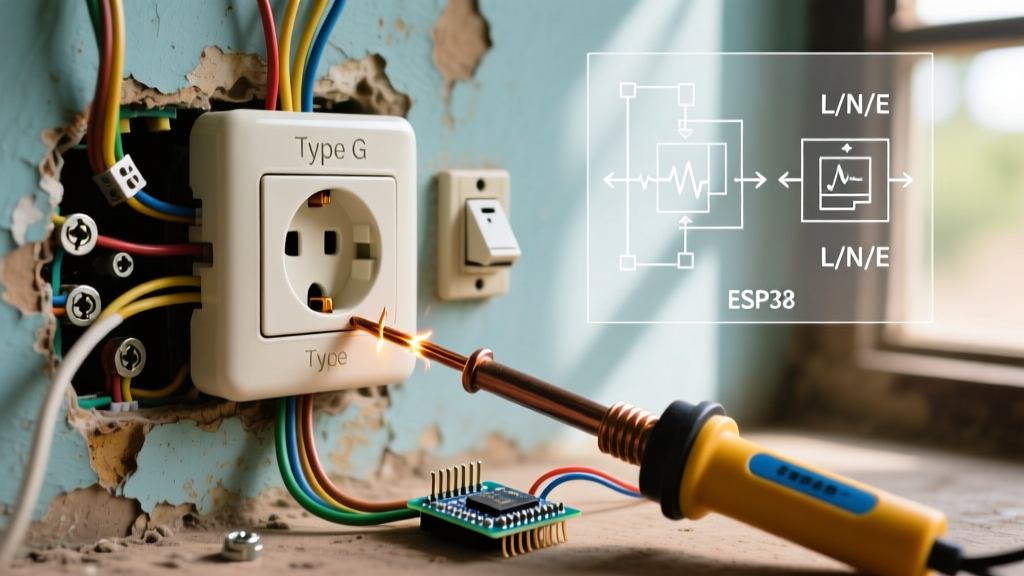
- Type G (BS 1363): The modern standard. Features three rectangular pins, integrated shutters on the live and neutral apertures, and requires a fused plug (typically 3A, 5A, or 13A). The socket itself is rated for 13A continuous load.
- Type D (BS 546): The legacy standard. Features three round pins. Often rated at 5A for lighting circuits or 15A for heavy appliances. Crucially, these lack internal safety shutters, making them a severe shock hazard in homes with children.
⚠️ SAFETY WARNING: Never attempt to diagnose a Tanzanian outlet while the circuit is energized unless you are using a Category III (CAT III) or Category IV (CAT IV) True RMS multimeter. Tanesco grid surges can exceed 300V momentarily, which will destroy standard CAT II electronics and pose a fatal arc-flash risk.
Top 4 Failure Modes in Tanzanian Homes
1. Thermal Degradation from Contact Resistance
The most common physical failure in a Tanzania electrical outlet is localized melting around the Live (L) pin aperture. This is rarely a Tanesco issue; it is a mechanical one. BS 1363 terminals require a specific torque (typically 0.4 Nm to 0.5 Nm) to secure the 2.5mm² or 4.0mm² copper conductors. In humid coastal regions like Dar es Salaam or Tanga, oxidation builds up on loose terminal screws, increasing contact resistance. When a 10A load (like a kettle or space heater) is drawn, the I²R heating melts the urea-formaldehyde socket faceplate.
2. Tanesco Overvoltage and Varistor Failure
While the nominal voltage is 230V, Tanesco's distribution network can experience severe load-shedding transients. When power is restored after a blackout, inductive kickback from local transformers can send spikes exceeding 270V down the line. If your outlet is integrated with a surge-protective device (SPD), the internal Metal Oxide Varistors (MOVs) may have sacrificed themselves. A dead outlet with a tripped upstream RCBO often points to a shorted MOV inside the socket module.
3. Open Neutral in Ring Final Circuits
Tanzania inherited the UK's Ring Final Circuit topology for ground-floor sockets. If a neutral wire pulls out of the back of a socket due to poor termination, the downstream sockets will still show 230V between Live and Earth, but appliances will not function. This creates a dangerous "floating neutral" scenario where the neutral wire downstream can become energized at full line voltage if a load is connected.
4. The Counterfeit Socket Hazard
Markets in Kariakoo are flooded with counterfeit MK Logic Plus and Crabtree sockets. These fakes lack the internal phosphor bronze spring tension required for BS 1363 compliance. Diagnosis is simple: insert a standard BS 1363 plug. If it slides in without firm resistance and wobbles, the internal leaf springs are weak, leading to micro-arcing and eventual fire.
Step-by-Step Diagnostic Protocol
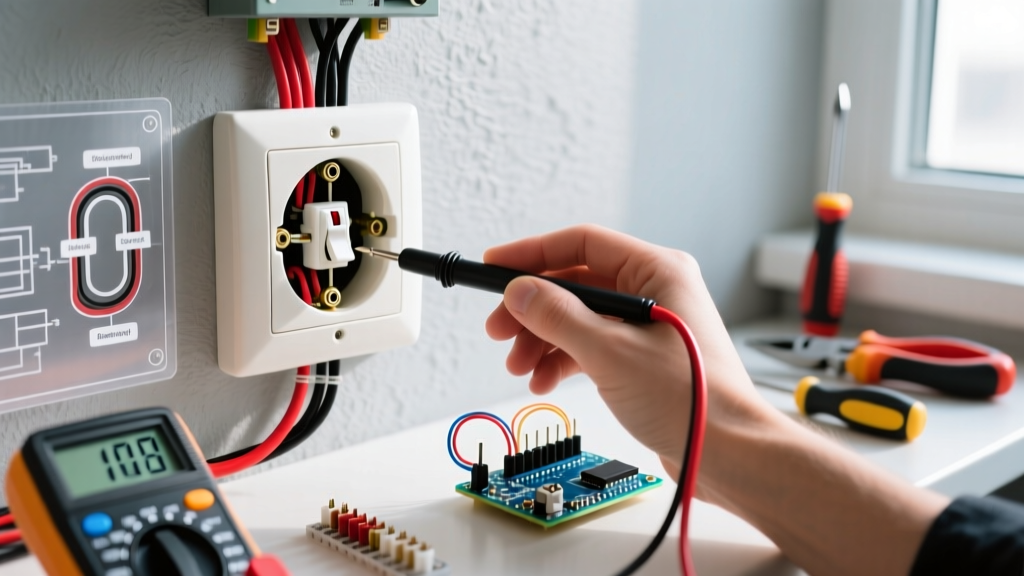
Grab your Fluke 117 or UNI-T UT61E True RMS multimeter and follow this systematic isolation process.
Step 1: Visual and Thermal Inspection
- Use an infrared thermometer (like the Fluke 62 MAX+) to scan the socket faceplate while a heavy load is operating. Any reading above 45°C (113°F) indicates dangerous terminal resistance.
- Look for brown scorch marks inside the pin apertures, indicating internal arcing.
Step 2: The 3-Point Voltage Test
With the circuit energized, carefully probe the socket apertures using insulated test leads. Record your readings against the IEC 60038 standard matrix below.
| Measurement Points | Expected Reading (Tanesco 230V) | Fault Reading | Probable Diagnosis |
|---|---|---|---|
| Live to Neutral (L-N) | 216V – 253V | < 200V or > 260V | Tanesco transformer tap issue, or severe voltage drop undersized wiring. |
| Live to Earth (L-E) | 216V – 253V | 0V or fluctuating | Open circuit earth, or missing grounding rod at the DB board. |
| Neutral to Earth (N-E) | < 2V | > 5V up to 115V | High-resistance neutral connection, or neutral-earth cross-wiring upstream. |
Step 3: Polarity and Shutter Verification
Use a dedicated BS 1363 socket tester (e.g., Robin K1210 or Megger RT10). Insert it into the Tanzania electrical outlet. If the "Live/Neutral Reversed" LED illuminates, the installer has swapped the brown and blue wires at the terminal block. This is highly dangerous because the appliance's internal switch will only isolate the neutral, leaving the appliance internals energized at 230V even when turned off.
Upgrading for Grid Stability in 2026
If your diagnostic tests reveal that the outlet is mechanically sound but the Tanesco power quality is destroying your appliances, you must upgrade the protection topology at the Distribution Board (DB) feeding the outlet.
Implementing RCBO Protection
Standard Miniature Circuit Breakers (MCBs) only protect against overloads and short circuits. They do not protect against earth leakage or grid surges. For critical outlets (e.g., home offices, medical equipment, refrigeration), upgrade the circuit to an RCBO (Residual Current Breaker with Overcurrent).
- Recommended Hardware: Schneider Electric Acti9 iRCBO or ABB DS201 series.
- Specifications: 20A Type C curve, 30mA earth leakage sensitivity. Type C is preferred over Type B in Tanzania to handle the high inrush currents of local air conditioning compressors and water pumps without nuisance tripping.
- Cost Estimate: Authentic Schneider Acti9 RCBOs cost between $65 and $95 USD in authorized East African electrical distributors. Avoid grey-market imports, as counterfeit RCBOs frequently fail to trip during earth faults.
Point-of-Use Surge Suppression
If replacing the DB breaker is not an option, replace the standard Type G socket with a surge-protected variant. Look for sockets featuring replaceable MOV cartridges. When diagnosing a dead surge-protected socket, always check the thermal fuse integrated into the MOV block; a Tanesco lightning strike will blow this fuse to prevent a sustained short circuit.
Sourcing Authentic Components in Tanzania
The success of your outlet repair hinges on component authenticity. When replacing a melted or faulty Tanzania electrical outlet, adhere to these procurement rules:
- Verify the BS 1363 Stamp: Authentic sockets from brands like Legrand, MK, or Crabtree will have the BS 1363 standard number molded directly into the rear thermoset casing, not just printed on the cardboard box.
- Check the Terminal Screws: High-quality sockets use captive, brass terminal screws with deep square or Pozidriv heads. Counterfeits often use soft, slotted steel screws that strip easily under torque.
- Weight Test: A genuine 13A double socket weighs approximately 220-250 grams due to the dense urea-formaldehyde plastic and heavy copper busbars. Fakes often weigh under 150 grams.
Summary of Best Practices
Troubleshooting a Tanzania electrical outlet requires looking beyond the socket itself. By combining rigorous True RMS voltage testing with an understanding of local grid transients and the mechanical demands of the BS 1363 standard, you can accurately diagnose faults, eliminate fire hazards, and protect sensitive electronics. Always prioritize authentic, tested hardware over cheap market alternatives, and ensure your earthing system is verified annually to handle the realities of the local 230V environment.