
The SN SEV 1011 Standard: Decoding Swiss Socket Types
When working with electrical systems in Central Europe, electricians and DIYers quickly discover that the switzerland electrical outlet ecosystem operates entirely outside the standard Schuko (Type F) or Europlug (Type C) norms used by its neighbors. Switzerland relies on the SN SEV 1011 national standard, which governs the unique Type J plug and socket family. Understanding this standard is not merely a matter of convenience; it is a strict legal requirement under Swiss electrical safety law, overseen by the Federal Inspectorate for Heavy Current Installations (ESTI).
The Swiss system operates at a nominal 230V AC at 50Hz for single-phase circuits, and 400V AC for three-phase systems. According to the IEC World Plugs guide, Type J is unique to Switzerland and Liechtenstein, featuring three 4mm diameter round pins arranged in a flattened triangular pattern. However, the SEV 1011 standard actually encompasses several distinct outlet configurations, each with specific amperage and phase ratings.
SN SEV 1011 Outlet Classification Matrix
| Standard Type | Poles | Current Rating | Voltage | Phase Configuration | Common Application |
|---|---|---|---|---|---|
| Type 12 (T12) | 2 (Ungrounded) | 10A | 250V | Single-Phase | Legacy lighting, low-draw appliances (Obsolete for new installs) |
| Type 13 (T13) | 3 (Grounded) | 10A / 16A | 250V | Single-Phase | Standard residential wall sockets, general appliances |
| Type 15 (T15) | 4 | 10A | 250V/400V | Three-Phase (No Neutral) | Specialized industrial motors, legacy heavy equipment |
| Type 23 (T23) | 4 (Grounded) | 16A | 250V/400V | Three-Phase (No Neutral) | Commercial kitchen equipment, heavy HVAC units |
| Type 25 (T25) | 5 (Grounded) | 16A | 250V/400V | Three-Phase + Neutral | Modern EV chargers, industrial machinery, data center PDUs |
The Recessed Socket Mandate: A Masterclass in Passive Safety
One of the most defining physical characteristics of a compliant switzerland electrical outlet is its recessed faceplate. Under the SN SEV 1011:2009 amendment, all new socket installations must feature a recessed cavity, typically measuring 12mm to 15mm in depth.
Why the Recess? The 12mm depth is engineered to a precise safety tolerance. The live and neutral pins on a standard T13 plug are 19mm long. If a user partially inserts a plug, or if a child attempts to manipulate a partially engaged plug, the recessed wall physically blocks fingers from bridging the gap between the exposed live pins and the grounded faceplate. It effectively eliminates the 'partial insertion' shock hazard that plagues non-recessed Schuko and UK Type G designs.
When sourcing replacement receptacles for residential or commercial projects in 2026, look for premium Swiss-manufactured lines such as the Feller EDURO 2 or Schneider Electric Exxact series. These models feature integrated, high-tension child safety shutters that require simultaneous, equal-pressure insertion of the phase and neutral pins to open, further layering active safety over the passive recessed design. Expect to pay between CHF 18 and CHF 45 per single-gang T13 receptacle, depending on the finish and smart-home integration capabilities.
NIN Code Compliance: RCDs, AFDDs, and Circuit Protection
Wiring a switzerland electrical outlet requires strict adherence to the SN SEV 1000, commonly known as the NIN (Niederspannungs-Installations-Norm). The Swiss Federal Inspectorate (ESTI) heavily enforces these rules, and non-compliant work can result in failed inspections, voided building insurance, and severe liability in the event of a fire or electrocution.
Residual Current Device (RCD) Requirements
- Mandatory 30mA Protection: All standard 16A T13 sockets used by laypersons must be protected by a 30mA RCD. This is non-negotiable for residential, commercial, and public spaces.
- Type A vs. Type F: Standard Type A RCDs are sufficient for general household circuits. However, if the T13 outlet is designated for a washing machine or a portable EV charging cable (IC-CPD), upgrading to a Type F or Type B RCD is highly recommended to handle smooth DC fault currents and high-frequency AC leakage.
- AFDD Integration (2026 Standard): The latest NIN revisions strongly advocate for Arc Fault Detection Devices (AFDDs) on all 16A socket circuits supplying bedrooms, living rooms, and spaces with combustible building materials. Combining an AFDD with an RCD (RCBO) is now considered best practice for premium installations.
Step-by-Step Wiring Guide: Installing a Type 13 (16A) Outlet
Proper termination is critical. Swiss terminals are notoriously unforgiving of poorly stripped wires or under-torqued screws. Follow this procedure to ensure a code-compliant, low-resistance connection.
1. Preparation and Wire Stripping
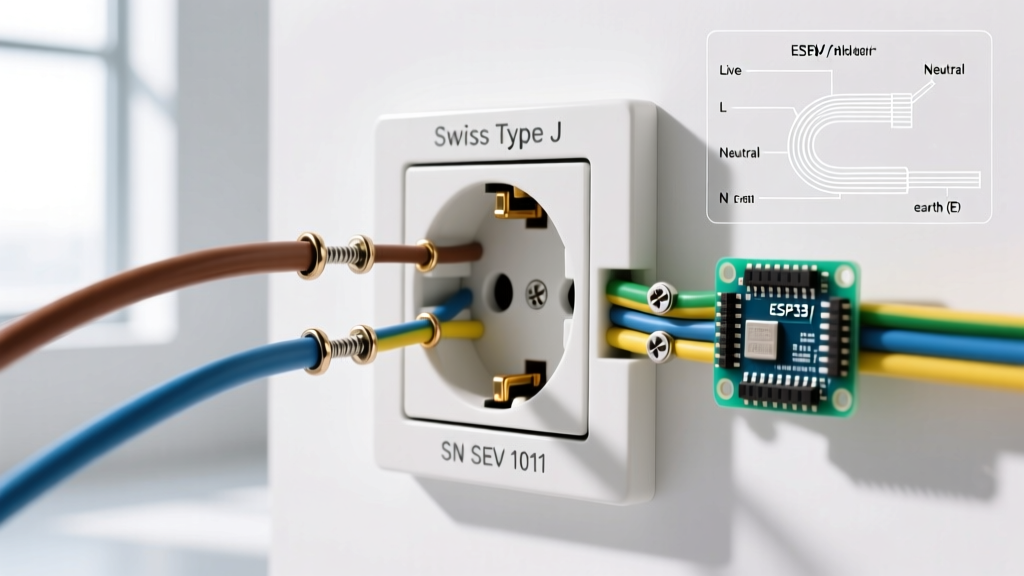
Swiss wiring color codes align with IEC 60446 standards: Brown (Phase/L1), Blue (Neutral/N), and Green/Yellow (Earth/PE). Using a precision wire stripper, remove exactly 11mm to 12mm of insulation from the 1.5mm² or 2.5mm² solid copper conductors. Do not score the copper conductor, as this creates a micro-fracture that can lead to thermal runaway under sustained 16A loads.
2. Terminal Sequencing and Connection
- Earth (PE) First: Always connect the Green/Yellow wire to the center earth terminal first. The earth wire should be cut slightly longer than the phase and neutral wires so that if the cable is yanked, the earth connection is the last to break.
- Neutral (N): Insert the Blue wire into the left terminal (when facing the socket front).
- Phase (L1): Insert the Brown wire into the right terminal.
3. Torque Verification
Do not rely on 'hand-tight' estimates. Use a calibrated torque screwdriver set to 1.2 Nm to 1.5 Nm (check the specific manufacturer's stamp on the rear of the receptacle, e.g., Hager cubyko models often specify exactly 1.2 Nm). Under-torquing causes arcing and heat; over-torquing strips the brass threads or crushes the copper wire, reducing the cross-sectional area.
4. Flush Mounting and Recess Alignment
When screwing the receptacle into the flush-mounted backbox, ensure the faceplate sits perfectly flush with the wall. If the wall is uneven, use leveling spacers. The 12mm recess must remain unobstructed by wallpaper or thick paint layers, which can effectively reduce the safety depth.
Common Adapter Hazards and Traveler Safety
Because the switzerland electrical outlet is geographically isolated, millions of tourists and expats rely on travel adapters. As an electrical professional, you must be aware of the severe hazards posed by cheap, non-compliant adapters.
The most dangerous configuration is the Schuko (Type F) to Type J adapter. The Schuko plug relies on side grounding clips, while the Swiss T13 relies on a dedicated 4mm earth pin. Many universal adapters attempt to bridge this using a fragile metal tab that frequently bends or loses tension. If the earth connection fails while the phase remains connected, any metal-cased appliance (like a laptop charger or espresso machine) becomes a lethal shock hazard. Always recommend that clients purchase dedicated, grounded Type J cables for their appliances rather than relying on universal adapters for high-draw or grounded equipment.
Frequently Asked Questions (FAQ)
Can I install a standard European Schuko (Type F) socket in my Swiss home?
No. Under the SN SEV 1000 (NIN) regulations, installing non-standard foreign sockets in fixed building installations is strictly prohibited by Electrosuisse guidelines. You must use SEV 1011 compliant T13 or T23 receptacles. If you have a Schuko appliance, you must replace the plug with a molded Type J plug or use a high-quality, fused, and grounded adapter.
Are 10A and 16A Type 13 sockets physically different?
Historically, 10A and 16A sockets had slightly different pin spacing and recess depths to prevent overloading 10A circuits. However, the modern SEV 1011 standard harmonized the physical dimensions. Today, a standard T13 socket is universally rated to accept both 10A and 16A plugs, provided the circuit breaker and wiring (minimum 1.5mm² for 10A, 2.5mm² for 16A) are correctly sized and protected.
What is the required IP rating for outdoor Swiss outlets?
Outdoor switzerland electrical outlets must meet a minimum of IP44 if they are covered and angled downward, but IP55 or IP66 is strongly recommended and often required by local inspectors for exposed locations. Ensure the outdoor enclosure maintains the recessed safety profile even when the weatherproof flap is open.