
Understanding the Canadian Electrical Code (CEC) for Receptacles
Wiring a residential property in Canada requires strict adherence to the Canadian Electrical Code, Part I (CSA C22.1). Unlike the US National Electrical Code (NEC), the CEC has unique mandates regarding receptacle spacing, split-wired kitchen circuits, and specific tamper-resistant testing standards. As we navigate the 2026 enforcement cycles across provinces like Ontario, British Columbia, and Alberta, local safety authorities are cracking down on outdated wiring methods and improper ground-fault protection.
Whether you are a licensed apprentice, a journeyman reviewing provincial amendments, or a homeowner trying to understand an inspector's "red tag," this guide breaks down the exact CEC rules governing every Canada electrical outlet installation. For authoritative reference, always consult the CSA Group Electrical Standards and your provincial regulator, such as the Electrical Safety Authority (ESA) in Ontario or Technical Safety BC.
The 1.8-Meter Spacing Mandate (Rule 26-712)
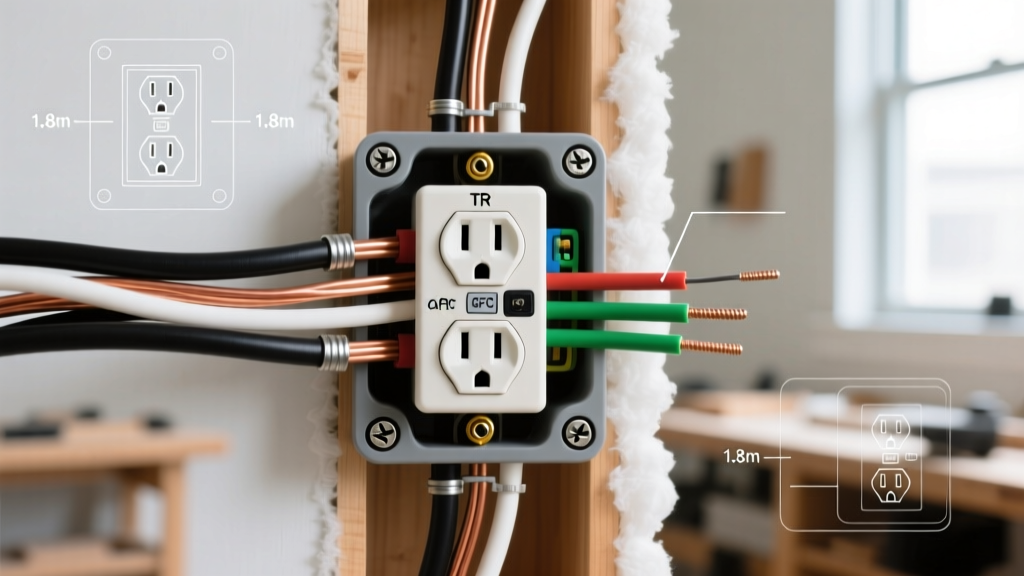
The most frequently cited rule for general living spaces is CEC Rule 26-712(1)(a). The code dictates that no point along the floor line of any wall space can be more than 1.8 meters (approximately 6 feet) from a receptacle outlet. This is designed to prevent the use of extension cords for standard appliances like lamps or vacuum cleaners.
Defining "Wall Space"
Inspectors define a "wall space" as any unbroken horizontal space that is 900 mm (3 feet) or more in width. This includes space measured around corners. If you have a 1-meter wide wall segment between a doorframe and a corner, it legally requires a receptacle. Furthermore, floor receptacles can only count toward this requirement if they are located within 300 mm (12 inches) of the wall.
Tamper-Resistant (TR) Receptacles: The Universal Standard
Under Rule 26-700(5), all 15A and 20A, 125V receptacles installed in residential dwellings must be Tamper-Resistant (TR). This is not a recommendation; it is a strict mandate for new construction, renovations, and replacements.
Mechanical Differences and Insertion Force
A TR receptacle features internal, spring-loaded shutter mechanisms (typically made of acetal or nylon) that block foreign objects. Both shutters must be depressed simultaneously with equal force to allow a plug blade to enter. When purchasing materials for a 2026 project, expect to pay between $3.50 and $6.50 CAD per unit for standard TR receptacles (e.g., Leviton 5362-TR or Hubbell 5262-TR), compared to the $1.50 CAD cost of obsolete non-TR models, which are now illegal to install in living spaces.
Pro-Tip for 2026: If you encounter stiff TR shutters during installation, do not use pliers to force them open. Instead, slightly angle the plug blades or use a plug with beveled blades. Painters frequently clog TR shutters with drywall mud or latex paint during rough-ins; always install temporary covers or use "paint-safe" TR models like the Legrand Pass & Seymour TR5262.
GFCI and AFCI Protection Matrix
The CEC draws a hard line between Ground Fault Circuit Interrupter (GFCI) and Arc Fault Circuit Interrupter (AFCI) protection. A Class A GFCI trips at a leakage current of 4 to 6 milliamperes (mA) to prevent lethal shock, while a Combination-Type AFCI detects parallel and series arcing conditions to prevent electrical fires.
| Location | Protection Type | CEC Rule Reference | Recommended 2026 Device | Est. Cost (CAD) |
|---|---|---|---|---|
| Bathrooms (within 1.5m of basin) | GFCI | 26-700(11) | Leviton 9880-TRGW (GFCI/TR) | $28.00 - $34.00 |
| Kitchen Countertops (within 1.5m of sink) | GFCI | 26-700(11) | Hubbell GFR83-W (20A GFCI) | $35.00 - $42.00 |
| Bedrooms & Living Rooms | AFCI | 26-722 | Schneider HomeLine CAFI151C (Breaker) | $45.00 - $55.00 |
| Unfinished Basements & Garages | GFCI | 26-700(11) | Leviton 9880-TRGW (GFCI/TR) | $28.00 - $34.00 |
| Outdoor Patios & Decks | GFCI + Weatherproof Cover | 26-700(11) / 26-700(15) | TayMac MM540C In-Use Cover + GFCI | $45.00 (Combined) |
Kitchen Countertops: Small Appliance Branch Circuits (SABCs)
Kitchen wiring is where the CEC differs most drastically from the US NEC. Under Rule 26-722(d), receptacles serving kitchen countertop surfaces must be supplied by at least two separate 20-ampere small appliance branch circuits. These circuits cannot supply any other outlets, lighting, or built-in appliances.
The Split-Receptacle MWBC Method
In Canada, the standard method for achieving this is using a Multi-Wire Branch Circuit (MWBC) feeding 15A split-wired receptacles (CSA configuration 5-15R). By using a 3-conductor cable (e.g., 14/3 NMD90 or 12/3 NMD90), an electrician connects the red wire to the top brass terminal and the black wire to the bottom brass terminal, breaking off the connecting brass fin. This provides two independent 15A circuits to a single duplex outlet.
Critical Safety Requirement: Handle Ties
If you use an MWBC to feed split receptacles, Rule 14-010(b) strictly requires a common-trip mechanism (an approved handle tie or a 2-pole breaker) at the panel. This ensures that if an appliance on the top half of the receptacle trips the breaker, the bottom half is also de-energized, protecting anyone servicing the outlet. Missing handle ties on MWBCs remain the #1 reason for kitchen inspection failures in 2026.
Specialty Receptacles: 20A T-Slot Configurations
While 15A (5-15R) receptacles are standard, Rule 26-700(4) dictates that if a single 20-ampere branch circuit supplies a single receptacle, that receptacle must be rated for 20 amperes. In Canada, this means installing a 5-20R (T-Slot) receptacle, which accepts both standard 15A plugs and 20A plugs with a horizontal neutral blade. These are commonly required in commercial settings or specific residential locations like RV parking pads or heavy-duty garage workshop stations. A standard 20A T-slot TR receptacle (like the Hubbell 5362-TR) costs approximately $9.00 to $12.00 CAD.
Common Inspector "Red Tags" to Avoid
Based on recent provincial safety authority bulletins, avoid these frequent code violations that will result in a failed inspection and a costly re-work order:
- Painted TR Shutters: Painters spraying walls without masking outlets, causing the tamper-resistant mechanical shutters to seize. Inspectors will fail the rough-in or final if a standard test plug cannot be inserted smoothly.
- Daisy-Chaining GFCIs: Wiring the "LOAD" terminals of a GFCI to feed another GFCI downstream. This causes nuisance tripping and makes fault-location impossible. Always feed downstream standard TR receptacles from the LOAD terminals, or use pigtails to feed the next GFCI from the "LINE" side.
- AFCI/GFCI Neutral Mixing: Sharing a neutral wire between an AFCI-protected bedroom circuit and a standard lighting circuit. AFCI breakers monitor the neutral-to-ground balance; mixing neutrals will cause the breaker to trip instantly upon energization.
- Improper Box Fill: Stuffing GFCI devices (which have large, deep bodies) into standard 3-inch deep octagonal or shallow device boxes. The CEC requires adequate cubic inch capacity. Always use 4-inch square boxes with deep mud rings (minimum 2-1/8 inches deep) for GFCI and smart receptacle installations to accommodate the bulky electronics and 12 AWG pigtails.
Conclusion
Compliance with the Canadian Electrical Code is non-negotiable for life safety and property protection. By strictly adhering to the 1.8-meter spacing rule, universally applying TR receptacles, correctly zoning GFCI/AFCI protection, and properly executing kitchen MWBCs with handle ties, you ensure a safe, code-compliant installation. Always verify local provincial amendments before pulling a permit, as municipalities may enforce stricter energy or safety bylaws on top of the baseline CEC requirements.