
Introduction to Swiss Electrical Standards
When planning an installation or troubleshooting an electrical outlet Switzerland property owners and expats must navigate a highly specific national standard. Unlike the rest of Europe, which largely adopted the Schuko (Type F) or Europlug (Type C) systems, Switzerland relies on the SEV 1011 standard (internationally recognized as Type J). This system features a unique recessed, hexagonal socket design that provides superior physical protection against accidental contact with live pins.
As of 2026, the Swiss Federal Inspectorate for Heavy Current Installations (ESTI) strictly enforces these regulations. Improper wiring of a Type J socket not only violates cantonal building codes but introduces severe shock hazards due to the 230V / 50Hz grid. This wiring diagram reference provides the exact pinouts, color codes, and mechanical installation steps required for compliant Swiss receptacle wiring.
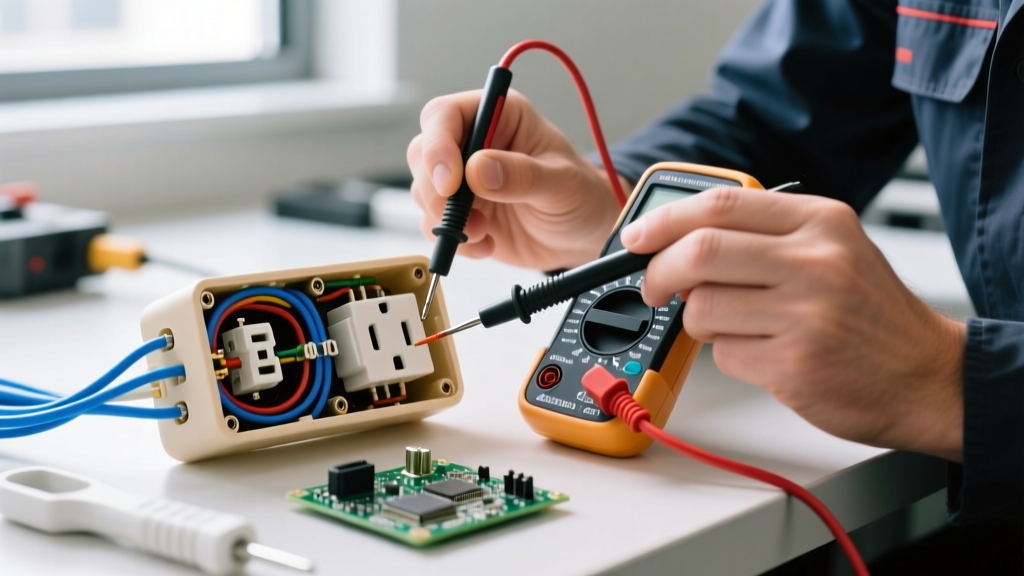
Safety Warning: Always isolate the circuit at the main distribution board (Sicherungsautomat) and verify zero voltage with a CAT III or CAT IV multimeter before opening any Swiss flush-mounted box. The standard residential voltage is 230V AC, which is lethal.
Understanding the SEV 1011 Standard (Type J)
The Swiss national standard, maintained by the Swiss Association for Standardization (SNV), dictates precise mechanical and electrical tolerances for all receptacles. The most common residential socket is the T13 (10 Ampere, 3-pole with earth).
| Parameter | Specification (SEV 1011 / Type J) |
|---|---|
| Nominal Voltage | 230V AC |
| Frequency | 50 Hz |
| Pin Diameter | 4.0 mm (Phase, Neutral, Earth) |
| Earth Pin Offset | Offset from the center axis to prevent reverse polarity |
| Socket Recess Depth | Approx. 12 mm (prevents touching live pins) |
| Standard Wall Box | Swiss Unterputzdose (68mm diameter, 60mm lug spacing) |
Swiss Electrical Outlet Wiring Diagram Reference
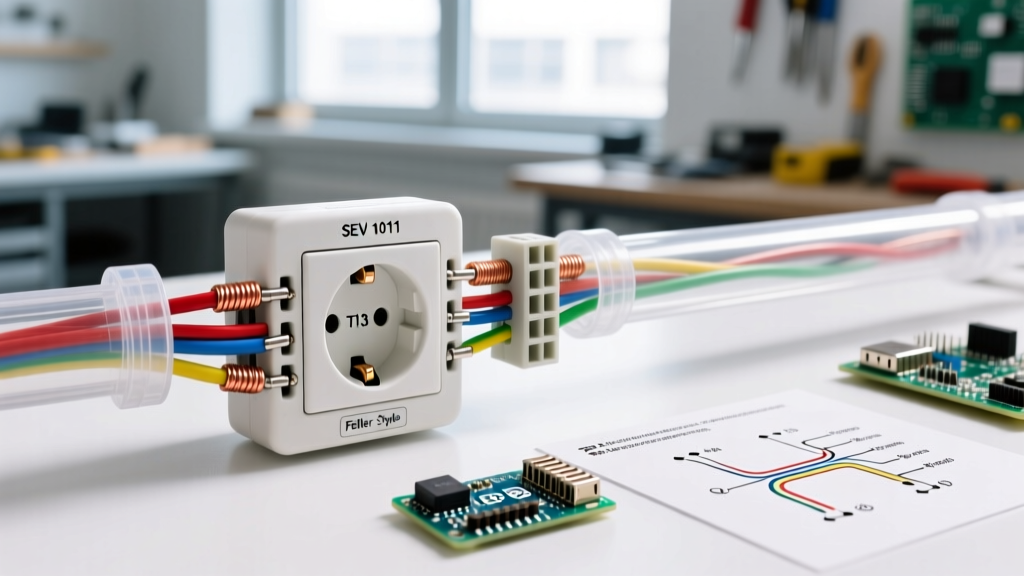
Switzerland follows the harmonized European CENELEC HD 308 S2 color code for flexible and fixed wiring. However, the physical terminal layout on the back of a Swiss socket (such as a Feller Edizio or ABB Busch-Jaeger model) requires specific attention to the earth pin orientation.
Terminal Mapping and Color Codes
- Phase (L - Line): Brown wire. Connects to Terminal 1 (usually marked 'L' or left-side terminal when facing the back).
- Neutral (N): Blue wire. Connects to Terminal 2 (marked 'N' or right-side terminal).
- Protective Earth (PE): Green/Yellow striped wire. Connects to Terminal 3 (marked with the earth symbol ⏚, centrally located but offset).
Critical Orientation Note: While SN SEV 1011 does not strictly mandate the earth pin to be at the top or bottom, modern Swiss industry practice (and Feller's official installation guidelines) dictates that the earth pin should point UP (12 o'clock position) when the socket is mounted on the wall. This ensures that if a plug is partially pulled out and a conductive object falls on the pins, the earth pin shields the live pins.
Step-by-Step Wiring Procedure for T13 Sockets
Follow this precise sequence to ensure a mechanically sound and electrically safe installation in a standard Swiss flush-mounted box.
- Prepare the Wires: Strip the outer sheath of the NYM-J 3x1.5mm² or 3x2.5mm² cable. Strip exactly 12mm of insulation from the individual copper conductors. Swiss socket terminals (especially modern screwless or clamp-style terminals) require this exact length to prevent exposed copper outside the terminal block.
- Connect the Earth (PE) First: Insert the Green/Yellow wire into the PE terminal. If using a screw terminal, tighten to 0.6 Nm using a calibrated torque screwdriver. This ensures the ground path is secure before introducing live conductors.
- Connect Neutral (N) and Phase (L): Insert the Blue wire into 'N' and the Brown wire into 'L'. Ensure no stray copper strands are splaying outside the terminal cage, which could cause a short circuit inside the recessed box.
- Verify Earth Pin Orientation: Before pushing the socket into the wall box, rotate the mechanism so the earth pin is at the 12 o'clock position.
- Mount to the Unterputzdose: Align the M4 mounting screws with the 60mm spaced lugs on the Swiss wall box. Tighten the screws evenly, alternating between left and right to keep the faceplate level. Do not overtighten, as older plastic boxes may crack.
- Attach the Cover Plate: Snap on the outer decorative frame (e.g., Feller Edizio Due cover), ensuring it sits flush against the wall surface without pinching the internal wiring.
Common Swiss Socket Variants & Applications
Beyond the standard T13, Swiss electricians utilize several other variants depending on the load requirements and environment. The International Electrotechnical Commission (IEC) classifies these under the broader Type J umbrella, but local nomenclature is specific.
| Designation | Amperage | Poles | Primary Application |
|---|---|---|---|
| T12 | 10A | 2 (No Earth) | Legacy lighting circuits, double-insulated appliances (rare in new builds). |
| T13 | 10A | 3 (+ Earth) | Standard residential wall sockets, offices, general appliances. |
| T15 | 16A | 3 (+ Earth) | Heavy residential loads (ovens, large AC units), industrial. Pins are 4mm but spaced wider. |
| T23 | 16A | 3 (+ Earth) | Modern 16A standard replacing T15 in many commercial settings; compatible with T13 plugs. |
| T25 | 16A | 3 (+ Earth) | Specialized commercial/industrial applications with specific shutter mechanisms. |
Troubleshooting & Edge Cases in Swiss Installations
Even with correct wiring diagrams, field conditions in Swiss properties can introduce unique failure modes.
1. RCD (FI-Schutzschalter) Nuisance Tripping
Symptom: The main 30mA RCD trips when plugging in an appliance, even if the appliance works fine in another room.
Diagnosis: In older Swiss bathrooms or outdoor installations, moisture can accumulate in the recessed hexagonal cavity of the T13 socket, creating a high-resistance leakage path between the Phase and Earth terminals.
Solution: Replace the standard socket with an IP55-rated Feller socket featuring an integrated spring-loaded flap seal. Ensure the cable entry at the back of the Unterputzdose is sealed with silicone to prevent condensation from entering the wall cavity.
2. Loose Mounting in 1980s Era Boxes
Symptom: The socket pulls out of the wall when unplugging a stiff cord.
Diagnosis: Many Swiss buildings from the 1970s and 1980s used early plastic flush-mounted boxes where the 60mm threaded brass lugs have stripped or broken off.
Solution: Do not rely on drywall anchors. Use a specialized Swiss box repair ring (Dosenrepaturring) that grips the inside rim of the 68mm cavity, providing new, robust M4 threaded lugs for the socket mechanism.
3. Adapter Overheating (Tourist/Expat Issue)
Symptom: A Schuko-to-Swiss adapter melts or becomes excessively hot under a 2000W load (e.g., a hair dryer or space heater).
Diagnosis: Cheap travel adapters often use thin brass clips that do not maintain the 4.0mm pin contact pressure required by SEV 1011, leading to high contact resistance.
Solution: For permanent or high-load use, always replace the appliance's plug head with a molded Swiss T13 plug (e.g., by manufacturer STEFFEN) or use a heavy-duty, fused adapter rated explicitly for 10A/2300W.
Sourcing Compliant Components in 2026
When procuring materials for a Swiss wiring project, you must source components certified by SEV. The dominant market leaders in 2026 include:
- Feller (Schneider Electric): The undisputed market leader in Switzerland. The Edizio Due and Edizio Elegance lines are the standard for residential builds. A standard T13 Edizio socket mechanism retails between 18 CHF and 28 CHF ($20 - $32 USD), while decorative glass or metal cover plates can push the total unit cost to 65 CHF ($73 USD).
- ABB (Busch-Jaeger Swiss Line): Highly prevalent in commercial and high-end residential projects. Their Busch-axcent series offers excellent screwless terminal technology, speeding up installation time by roughly 30%.
- Steffen: Primarily known for power strips, extension cords, and replacement molded plugs that strictly adhere to SEV 1011 dimensions.
Frequently Asked Questions (FAQ)
Can I install a standard European Schuko (Type F) socket in a Swiss wall box?
No. While the wall box diameter (68mm) is similar to standard European boxes, the screw lug spacing and the faceplate dimensions differ. More importantly, installing a Schuko socket violates Swiss ESTI regulations and will fail the mandatory periodic electrical inspection (Periodische Kontrolle). You must use a Type J (T13/T23) socket.
What wire gauge is required for a standard T13 socket circuit?
Standard residential lighting and socket circuits in Switzerland are wired with 1.5mm² copper conductors, protected by a 10A Type C circuit breaker. If the circuit is designed for 16A (using T23 sockets), you must upgrade the wiring to 2.5mm² copper and use a 16A breaker.
Do Swiss sockets require child protection shutters?
Yes, modern SEV 1011 compliant sockets manufactured after 2009 feature integrated, recessed safety shutters (Kinderschutz). The shutters only open when equal, simultaneous pressure is applied to both the Phase and Neutral pins, preventing children from inserting single objects into the live terminals.