
The Critical Intersection of Water and Electricity
Installing a pool electrical outlet is not a standard exterior wiring job; it is a high-stakes electrical procedure governed by strict safety codes. Water drastically lowers human skin resistance, meaning a fault current that might cause a minor shock in a dry living room can be instantly lethal poolside. According to the U.S. Consumer Product Safety Commission (CPSC), faulty pool wiring, improperly grounded underwater lights, and unshielded receptacles remain leading causes of aquatic electrocutions. To mitigate these risks, the National Electrical Code (NEC) enforces rigorous standards under Article 680.
This guide breaks down the exact code requirements for poolside receptacles as of the latest NEC adoption cycles heading into 2026, covering distance mandates, Ground Fault Circuit Interrupter (GFCI) specifications, weatherproof enclosures, and the crucial distinction between grounding and equipotential bonding.
The Core Mandate: NEC Article 680 Overview
Article 680 of the NEC covers swimming pools, fountains, hot tubs, spas, and hydromassage bathtubs. When dealing with a pool electrical outlet, you must first classify the pool type, as the code treats them differently:
- Permanently Installed Pools: Constructed in the ground or partially in the ground, or any pool capable of holding water to a depth greater than 42 inches (1.07 meters).
- Storable Pools: Typically above-ground, inflatable, or frame pools (like Intex or Bestway brands) designed for rapid assembly and holding water to a maximum depth of 42 inches.
The rules for receptacle placement, wiring methods, and GFCI protection vary significantly between these two categories. The National Fire Protection Association (NFPA) updates these codes every three years to address new failure modes and equipment advancements.
Minimum Distance Requirements: The 10-Foot Rule
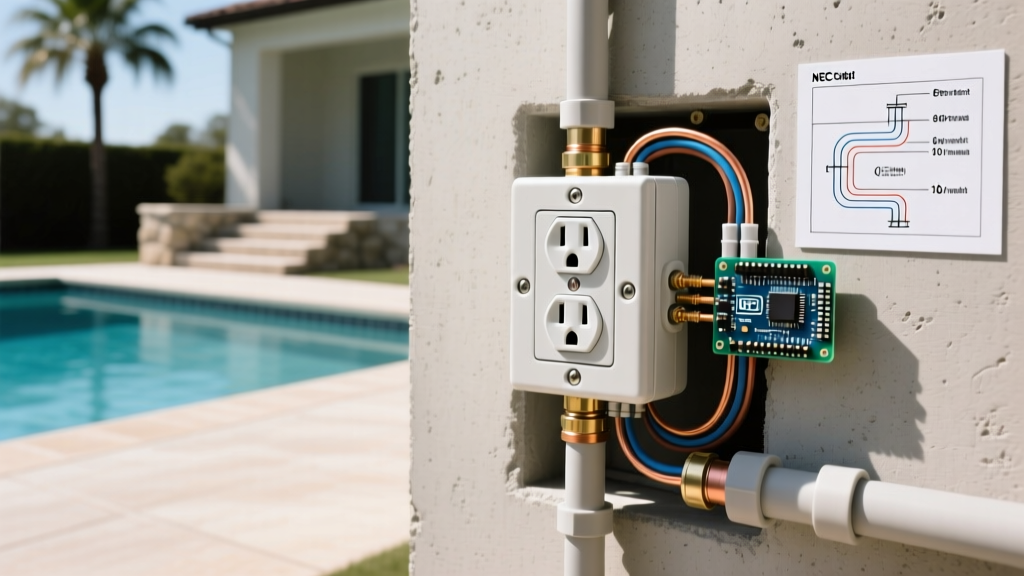
The most common code violation during residential pool inspections is improper receptacle placement. NEC Section 680.22(A) dictates exactly where you can and cannot mount a pool electrical outlet relative to the water's edge.
Permanently Installed Pools
For permanent pools, general-purpose 125-volt or 250-volt receptacles must be located at least 10 feet from the inside wall of the pool. This 10-foot measurement is taken horizontally from the water's edge to the center of the receptacle.
The 6-to-10 Foot Exception: You may install a receptacle between 6 and 10 feet from the pool's inside wall only if it meets all of the following strict criteria:
- It is protected by a GFCI device.
- It is a single receptacle (not a duplex/multi-outlet configuration).
- It employs a locking configuration (though standard 15A/20A NEMA 5-15/5-20 are often permitted if GFCI protected and single, local AHJs may demand twist-lock).
Pool Pump Motor Receptacles
Outlets dedicated to supplying pool pump motors have a different spatial requirement. Under NEC 680.21(A), these receptacles must be located at least 6 feet away from the inside wall of the pool. If installed between 6 and 10 feet, they must be GFCI protected.
Inspector's Note: Never measure from the outside edge of the pool coping or deck. The NEC explicitly states measurements are taken from the 'inside wall' of the pool—the actual water line. Failing to account for a 2-foot wide stone coping can result in a failed inspection.
Receptacle Placement Matrix
| Receptacle Type | Minimum Distance | GFCI Required? | NEC Reference |
|---|---|---|---|
| General Purpose (Permanent Pool) | 10 feet | No (if >10ft); Yes (if 6-10ft) | 680.22(A)(4) |
| Pool Pump Motor (Permanent) | 6 feet | Yes (Always) | 680.21(A) |
| General Purpose (Storable Pool) | 10 feet | Yes (Always) | 680.31(A) |
| Maintenance/Service Outlet | 10 feet | Yes (Always) | 680.22(A)(2) |
GFCI Protection: Non-Negotiable Safeguards
Ground Fault Circuit Interrupters are designed to trip when they detect a current imbalance as small as 4 to 6 milliamps, cutting power in roughly 25 milliseconds—fast enough to prevent ventricular fibrillation. As of the current code cycle, all 15-ampere and 20-ampere, single-phase, 125-volt and 250-volt receptacles supplying pool equipment or located within 20 feet of the pool's inside wall must be GFCI protected.
Breaker vs. Receptacle GFCI
While you can use a GFCI receptacle (like the Leviton GFNT2-W) at the point of use, best practice for pool environments dictates using a GFCI circuit breaker in the main panel. Why? Pool environments are highly corrosive. A GFCI receptacle exposed to chlorine-laden air and humidity will degrade internally, leading to nuisance tripping or, worse, silent failure. A breaker keeps the sensitive GFCI electronics inside the dry, climate-controlled main panel.
2026 Pricing Context: Expect to pay between $55 and $85 for a reliable 20A GFCI breaker (such as the Eaton BR220GF or Square D HOM250GFIC), compared to $12 to $18 for a standard thermal-magnetic breaker. Do not compromise on this component.
Weatherproof Covers and 'In-Use' Enclosures
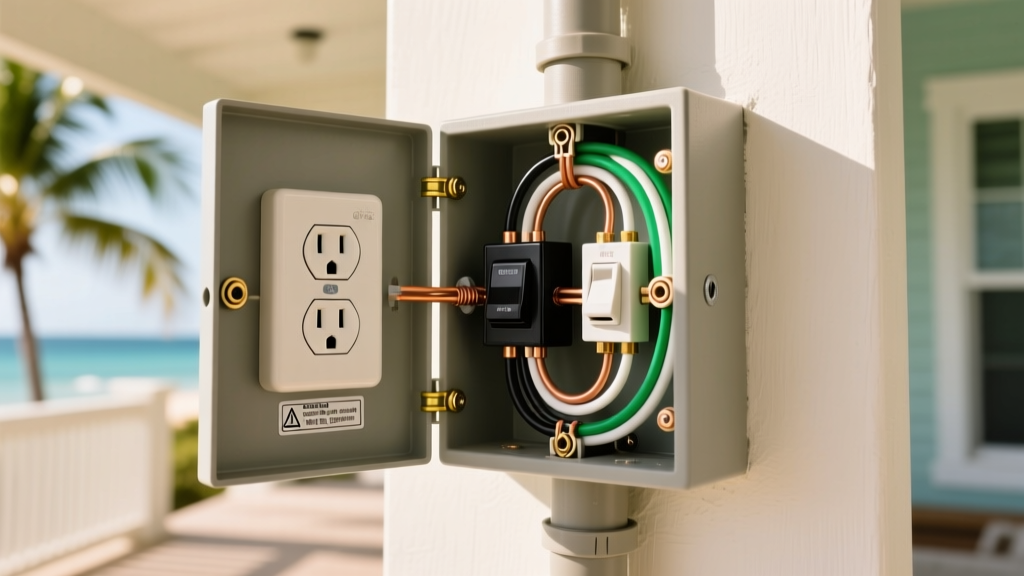
A standard flip-lid weatherproof cover is a massive code violation for a pool electrical outlet. NEC 406.9(B)(1) requires that receptacles installed in wet locations must be enclosed in a weatherproof enclosure that is weatherproof while in use (often referred to as WWIN or 'extra-duty' covers).
This means the cover must remain closed and sealed even when a cord is plugged in. Products like the TayMac MM550W or the Hubbell-Bryant XWW series provide deep, bubble-style polycarbonate enclosures that accommodate large transformer plugs (common for pool lights and robotic pool cleaners) while maintaining a watertight seal via compression gaskets.
Installation Specifics:
- Use silicone caulk around the top and sides of the mounting flange to prevent water ingress behind the box, but leave the bottom uncaulked to allow condensation to weep out.
- Ensure the internal receptacle yoke is torqued to the manufacturer's specification (typically 12-14 in-lbs) to prevent arcing from loose neutral connections.
Underground Wiring and Conduit Constraints
If you are running a new circuit to a pool electrical outlet, you cannot simply bury standard Romex (NM-B) or even standard underground feeder (UF-B) cable. NEC 680.10 strictly regulates underground wiring to prevent accidental severing by pool maintenance tools or shifting soil.
Approved Wiring Methods
Wiring must be installed in a complete raceway system. The approved materials include:
- Rigid Metal Conduit (RMC) or Intermediate Metal Conduit (IMC): Must be buried at least 6 inches deep.
- PVC Schedule 80: Must be buried at least 18 inches deep. Schedule 80 is required over standard Schedule 40 due to its thicker walls, which resist crushing from surface loads and degradation from soil chemicals.
Furthermore, all conductors inside the conduit must be individual insulated THWN/THHN wires. The equipment grounding conductor must be an insulated copper wire (minimum #12 AWG, though #10 AWG is standard for 20A circuits). Bare copper ground wires are strictly prohibited in pool conduit because chlorine and moisture can cause the bare copper to corrode, breaking the ground path.
The Difference Between Grounding and Equipotential Bonding
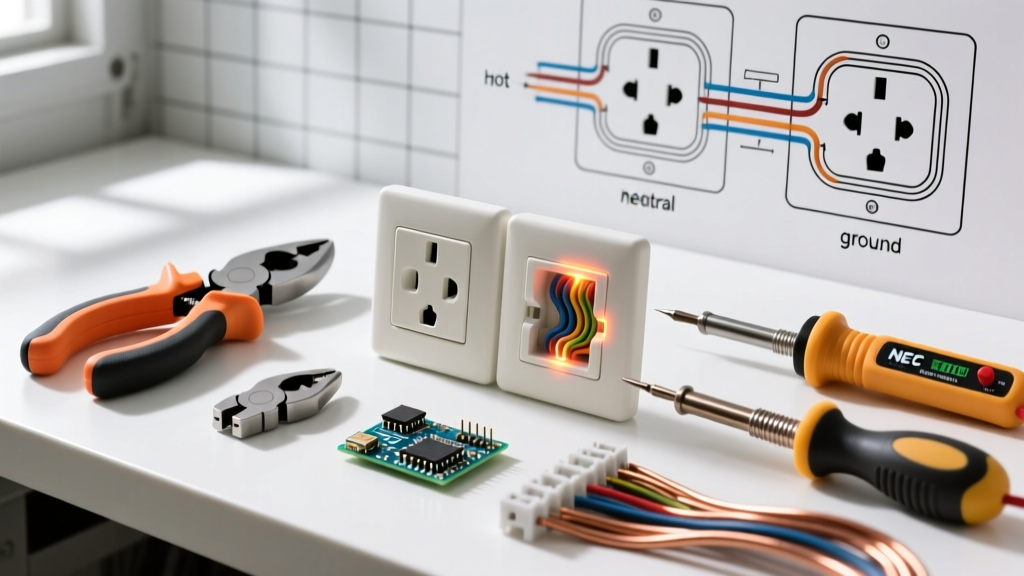
A frequent point of confusion for DIYers and junior electricians is the difference between the outlet's ground wire and the pool's equipotential bonding grid. They serve entirely different purposes, and both are required.
Grounding (The Outlet's Job): The insulated green equipment grounding conductor inside your conduit provides a low-impedance path back to the panel to trip the breaker in the event of a short circuit. It protects the equipment and clears the fault.
Equipotential Bonding (The Pool's Job): Under NEC 680.26, all metal parts within 5 feet of the pool (including rebar, metal ladders, diving stands, and the metal shells of spas) must be tied together using a solid, unspliced #8 AWG bare copper wire. This does not carry fault current; rather, it ensures that all metal surfaces are at the exact same electrical potential. If a voltage gradient occurs in the soil, bonding prevents a person from touching two metal objects at different voltages, eliminating the risk of shock.
As noted by safety advocates at Safe Electricity, failing to bond the pool structure while properly grounding the outlet leaves a deadly blind spot in the safety system. The outlet's ground protects the plugged-in device; the bonding grid protects the human body.
Common Code Violations to Avoid
When inspecting or installing pool electrical outlets, avoid these frequent pitfalls:
- Using Standard Outdoor Covers: Fails the 'in-use' requirement of 406.9(B)(1).
- Bare Ground Wires in Conduit: Violates 680.21(A)(3); grounds must be insulated copper.
- Routing Cords Across the Deck: Extension cords running from a distant outlet across the pool deck to a vacuum or pump violate 680.7 and 680.31.
- Omitting the 20A Maintenance Receptacle: NEC 680.22(A)(2) requires at least one 125V, 15A or 20A GFCI-protected receptacle located 10 to 20 feet from the pool for maintenance equipment.
Frequently Asked Questions
Can I install a pool electrical outlet on a wooden fence?
Yes, provided the fence is outside the required minimum distance (10 feet for general use, 6 feet for pump motors). The box must be securely mounted, and the conduit must be protected from physical damage, typically requiring Schedule 80 PVC or rigid metal conduit up to a height of 8 feet.
Do robotic pool cleaners require a dedicated GFCI outlet?
Robotic pool cleaners operate on low voltage via a transformer plugged into a standard 120V receptacle. That receptacle must be GFCI protected and located at least 10 feet from the water. The transformer itself should be kept in a dry, elevated location, never left directly on the wet pool deck.
What happens if my local jurisdiction hasn't adopted the latest NEC?
Always default to the most restrictive code. If your local Authority Having Jurisdiction (AHJ) is operating on an older NEC cycle (e.g., 2017 or 2020), but the 2023/2026 code introduces stricter GFCI or distance rules, building to the newest standard ensures maximum safety and future-proofs your installation against upcoming municipal adoptions.