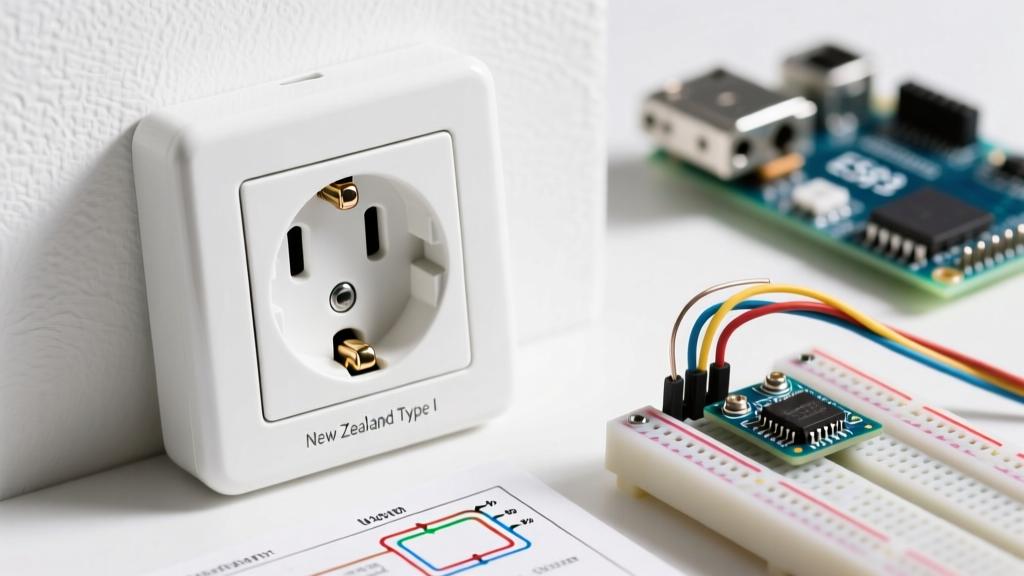

Identifying the Standard: What Type of Electrical Outlet in New Zealand?
If you are asking what type of electrical outlet in New Zealand you are dealing with, the short answer is the Type I outlet, governed by the AS/NZS 3112 standard. Operating on a 230V nominal supply at 50Hz, New Zealand’s electrical infrastructure shares its plug and socket geometry with Australia, Fiji, and Papua New Guinea. However, diagnosing faults in these outlets requires a specific understanding of local wiring regulations, Residual Current Device (RCD) mandates, and the unique aging profile of NZ housing stock.
Whether you are an expat troubleshooting a tripped switchboard, a traveler dealing with a fried appliance, or a homeowner diagnosing a dead socket, this guide provides the deep-dive technical diagnostics required for New Zealand Type I receptacles.
The Anatomy of an AS/NZS 3112 Type I Outlet
Before grabbing a multimeter, you must understand the physical and electrical layout of the NZ socket. The standard features three flat pins: two angled top pins (Active and Neutral) and one vertical bottom pin (Earth).
| Pin Type | Geometry | Standard Rating | Function & Diagnostic Notes |
|---|---|---|---|
| Active (Line) | Angled Flat | 10A / 15A / 20A | Carries 230V AC. Must be verified with a multimeter; never assume left/right polarity in older homes. |
| Neutral | Angled Flat | 10A / 15A / 20A | Return path. Should read near 0V relative to Earth under no-load conditions. |
| Earth (Ground) | Vertical Flat | N/A | Safety ground. Mandatory for all modern NZ sockets. 15A variants feature a noticeably wider Earth pin. |
Expert Note on 15A vs 10A Outlets: In New Zealand, 15A outlets are commonly installed in kitchens, laundries, and outdoor areas to handle high-draw appliances like kettles, microwaves, and power tools. A 10A plug will fit into a 15A socket, but a 15A plug (with its wider earth pin) will not fit into a standard 10A socket. Forcing a 15A plug into a 10A socket is a severe fire hazard and a common cause of melted faceplates.
Common NZ Outlet Faults & Diagnostic Steps
When a Type I outlet fails, the issue usually stems from one of three localized problems: RCD nuisance tripping, degraded earthing in older homes, or polarity reversal. Here is how to diagnose each.
1. RCD (Residual Current Device) Nuisance Tripping
Under current New Zealand wiring rules (AS/NZS 3000), all new socket outlet circuits must be protected by a 30mA RCD. If plugging in an appliance causes the switchboard RCD to trip, the fault is rarely the outlet itself—it is usually the appliance leaking current to earth.
- The Diagnostic Test: Unplug all appliances on the affected circuit. Reset the RCD at the switchboard. Plug appliances back in one by one. Heating elements (kettles, toasters, washing machine heaters) are the most common culprits for earth leakage exceeding the 15mA nuisance threshold.
- Outlet-Specific Fault: If the RCD trips with nothing plugged in, moisture may have ingress into an outdoor Type I socket, or the internal Active wire insulation inside the wall cavity may be degraded and touching the metal mounting bracket (earth).
2. High Earth Loop Impedance (Older Homes)
Many New Zealand homes built before 1990 feature original Type I outlets where the earth wire has corroded, or the earth stake at the switchboard has degraded. This results in high Earth Loop Impedance, meaning the RCD or MCB (Miniature Circuit Breaker) might not trip fast enough during a short circuit.
- Symptom: You measure 230V between Active and Earth on your multimeter, but when you plug in a high-draw appliance (like a 2kW heater), the voltage drops significantly, or the appliance hums and underperforms.
- Diagnosis: This requires an Earth Loop Impedance tester (not a standard multimeter). If the Ze (external loop impedance) plus Zi (internal) exceeds the limits set by AS/NZS 3000 for the specific breaker rating, the earthing system requires professional remediation.
3. Polarity Reversal (Active/Neutral Swapped)
While the AS/NZS 3112 standard dictates specific positioning for Active and Neutral, decades of DIY repairs and non-compliant work in NZ rental properties mean you can never trust visual placement. Reversed polarity leaves appliances 'live' even when their internal switches are turned off.
- Symptom: Touching the metal chassis of an older appliance gives a slight 'tingle' (capacitive coupling), or LED bulbs in desk lamps glow faintly when switched off.
- Diagnosis: Use a multimeter to test the angled pins against the Earth pin to identify which is truly Active.
Step-by-Step Multimeter Testing for NZ Sockets
To safely diagnose a dead or suspect Type I outlet, follow this exact procedure using a Category III (CAT III) rated digital multimeter.
- Set the Dial: Turn your multimeter to AC Voltage (V~) on the 600V range. Never use the current (Amps) setting, or you will create a dead short and blow the multimeter fuse (or worse).
- Test Active to Neutral: Insert probes into the two angled top slots. You should read between 230V and 245V. (New Zealand's nominal voltage is 230V, but network operators frequently supply closer to 240V at the transformer).
- Test Active to Earth: Insert one probe into an angled slot and the other into the bottom vertical Earth slot. Note the voltage. Swap the angled slot and test again. The slot that reads ~230V-245V against Earth is your Active. The slot that reads < 2V against Earth is your Neutral.
- Test Neutral to Earth: Confirm the Neutral and Earth read less than 2V. If you read 50V-100V here, you have an open (broken) Neutral or a floating Earth—a critical safety hazard requiring immediate isolation of the circuit.
Traveler Diagnosis: Adapter vs. Voltage Issues
A frequent troubleshooting scenario in NZ involves international travelers or new expats plugging foreign devices into Type I outlets. According to the International Electrotechnical Commission (IEC), Type I is strictly a 230V/50Hz system.
If a US or Canadian appliance (rated for 110V/60Hz) is plugged into a NZ outlet using only a physical plug adapter, the 230V supply will instantly destroy the appliance's power supply, often tripping the room's MCB. Diagnosis: If an adapter-equipped device smells of ozone, shows scorch marks on the plug pins, or causes the breaker to trip instantly, the internal varistor or fuse has blown due to overvoltage. A physical adapter does not step down voltage; a heavy iron-core step-down transformer (230V to 110V) is mandatory for North American appliances in New Zealand.
Legal & Safety Restrictions in New Zealand
When diagnosing electrical faults, it is vital to understand the legal boundaries of DIY electrical work in New Zealand. Under the Electricity Act 1992 and WorkSafe NZ regulations, it is strictly illegal for an unlicensed person to wire, alter, or replace a fixed socket outlet.
What You CAN Legally Diagnose and Do:
- Test outlets with a multimeter or plug-in RCD tester.
- Replace a damaged plug top on an appliance cord.
- Reset tripped RCDs and MCBs at the switchboard.
- Replace fuses in older rewirable plug tops (though upgrading to modern molded plugs is recommended).
What Requires a Licensed Electrical Inspector:
- Removing the faceplate of a Type I outlet to tighten terminal screws.
- Replacing an old, unswitched socket with a modern switched socket.
- Upgrading a non-RCD protected circuit in an older home.
Summary
Understanding what type of electrical outlet in New Zealand you are interacting with is the first step in safe electrical troubleshooting. The AS/NZS 3112 Type I socket is robust, but its safety relies heavily on proper earthing and modern RCD protection. By utilizing a CAT III multimeter to verify voltage, polarity, and earth continuity, you can accurately isolate whether a fault lies with the appliance, the RCD, or the aging wiring of the home. Always prioritize safety, respect the 230V lethality threshold, and engage a licensed NZ electrician for any physical repairs to fixed wiring.