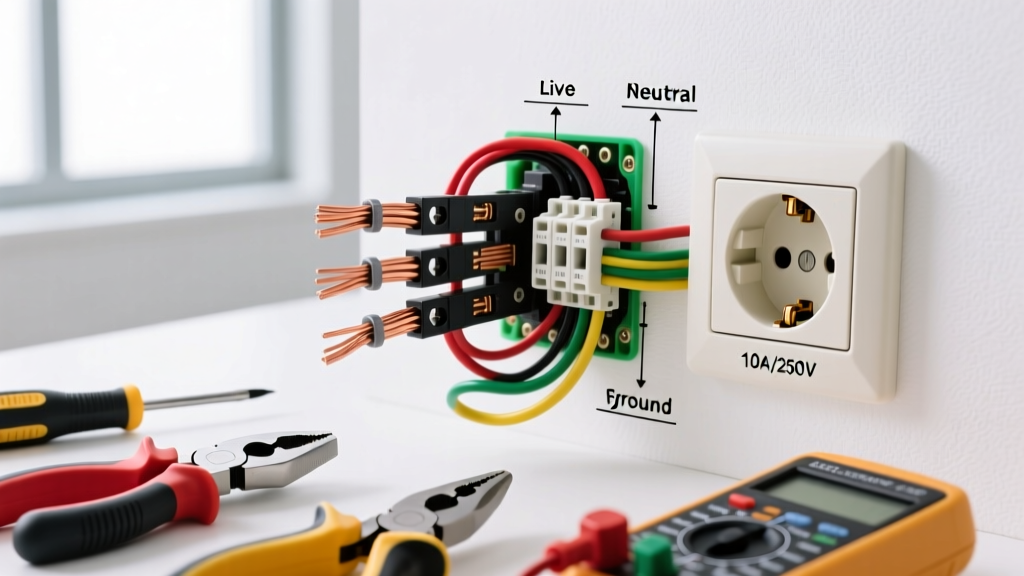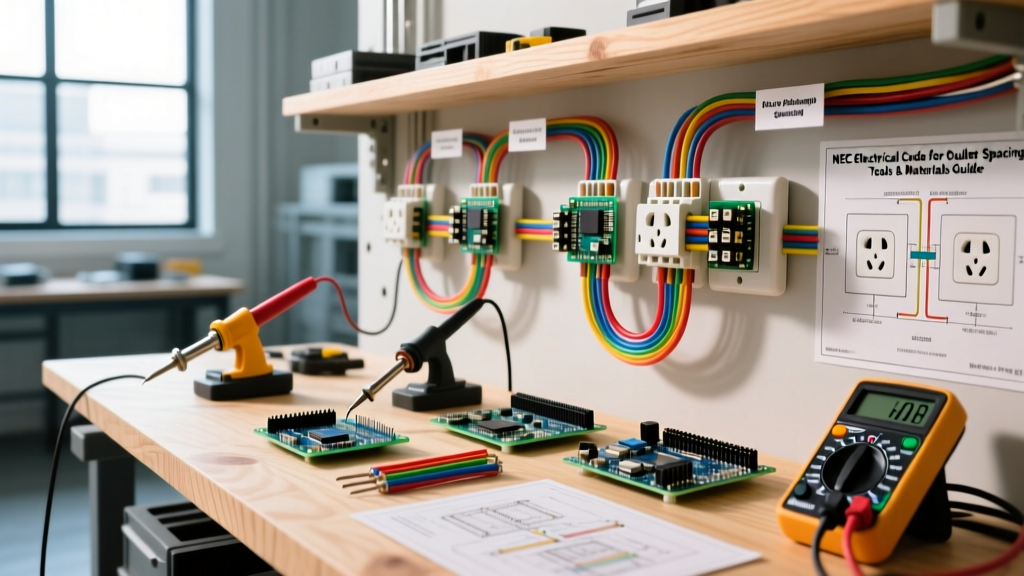

The Foundation: Understanding the NEC Electrical Code for Outlet Spacing
When wiring a new room, finishing a basement, or remodeling a living space, adhering to the electrical code for outlet spacing is not just a matter of convenience—it is a strict safety requirement designed to prevent the use of dangerous extension cords. Entering 2026, the vast majority of US jurisdictions enforce the 2023 edition of the National Electrical Code (NEC), specifically Article 210.52. This section dictates exactly where receptacles must be placed to ensure that no appliance cord is stretched across walkways or doorways.
However, knowing the code is only half the battle. Executing a flawless layout requires precision measuring tools, the correct junction boxes, and code-compliant receptacles. This guide bridges the gap between codebook theory and physical installation, providing a comprehensive tool and material guide to help DIYers and junior electricians meet the electrical code for outlet spacing on the first attempt.
The Core Rule (NEC 210.52(A)(1) & (2)): In any habitable room, no point along the floor line in any wall space can be more than 6 feet from an outlet. Furthermore, outlets must be spaced no more than 12 feet apart. Any wall space measuring 2 feet or wider (including space measured around corners) requires its own dedicated receptacle.
Essential Layout & Measuring Tools
To satisfy the electrical code for outlet spacing, eyeballing distances is a guaranteed way to fail an inspection. You need tools that provide exact measurements and account for wall irregularities. Budget approximately $85 to $120 for this specialized layout kit.
- Bosch GLM 20 Blaze Laser Measure ($28 - $35): While a standard tape measure works for short distances, measuring a 22-foot living room wall with a tape measure often leads to sag and inaccurate readings. The GLM 20 offers 1/8-inch accuracy up to 65 feet, allowing you to verify the 12-foot maximum spacing rule from a single standing position.
- Franklin Sensors M210 Multi-Sense Stud Finder ($40 - $48): The code requires outlets to be placed based on wall space, but physical installation requires you to avoid (or intentionally mount to) wall studs. The M210 detects multiple studs simultaneously, saving hours of mapping and ensuring your old-work boxes won't collide with framing lumber.
- Klein Tools 711 Outlet Box Level ($12 - $15): Inspectors will fail your rough-in if boxes are noticeably crooked. This specialized level features a built-in marker slot that allows you to trace the exact cutout for a single-gang or duplex box while ensuring it is perfectly plumb.
- Milwaukee 48-22-0302 25ft Compact Tape Measure ($18 - $22): For the final 6-foot verification from corners and door casings, a rigid, short-tape is superior to a laser. The 5-point reinforced frame ensures the tape stands out perfectly straight up to 8 feet, crucial for checking the 6-foot rule.
Material Selection: Boxes, Wire, and Receptacles
Meeting the electrical code for outlet spacing means installing the right hardware. The materials you choose dictate the longevity, safety, and code-compliance of the circuit.
1. Junction Boxes: Old-Work vs. New-Work
If you are retrofitting outlets into existing drywall to meet spacing codes, you must use old-work (remodel) boxes. The Carlon B114R 1-Gang 14 cu. in. Old Work Box ($1.45/ea) is the industry standard. Its 14-cubic-inch volume is critical: NEC Section 314.16 mandates strict box fill calculations. A 14 cu. in. box comfortably houses a standard 12/2 NM-B cable (two current-carrying conductors, one ground, and the internal clamps) without violating fill limits, which is a common failure point when using cheaper 12 cu. in. boxes.
2. Conductor Sizing: 14 AWG vs. 12 AWG
While 14 AWG wire is permitted on 15-amp circuits, professional electricians almost exclusively use 12/2 NM-B Romex ($0.75 - $0.95 per foot) for general living space receptacles. Running 12 AWG wire on a 20-amp breaker future-proofs the circuit for high-draw electronics and prevents voltage drop over long 12-foot spacing runs. Southwire and Cerro Wire are the top-tier brands to look for at your local supplier.
3. Receptacles: Tamper-Resistant (TR) Mandate
Under NEC 406.12, all 15-amp and 20-amp, 125-volt and 250-volt non-locking receptacles in habitable rooms must be Tamper-Resistant (TR). The Leviton T5320-W 15A TR Duplex Receptacle ($1.80 - $2.20/ea) features internal shutters that prevent children from inserting foreign objects. Do not buy standard receptacles for living spaces; an inspector will immediately red-tag the installation.
Room-by-Room Spacing Matrix
The electrical code for outlet spacing varies slightly depending on the room's function. Use this matrix to verify your layout before cutting any drywall.
| Room Type | Standard Spacing Rule | Special Code Exceptions (NEC 210.52) | Recommended Box Type |
|---|---|---|---|
| Living / Family Room | 6-ft / 12-ft Rule | Outlets required behind fixed furniture if wall is >2ft wide. | 1-Gang 14 cu.in. Old-Work |
| Kitchen Countertops | 4-ft / 8-ft Rule (210.52(C)) | Receptacles cannot be mounted face-up on countertops. GFCI required. | 2-Gang New-Work (for GFCI) |
| Bathrooms | Within 3 ft of sink edge | Must be GFCI protected. Cannot be the sole source of lighting. | 1-Gang 22 cu.in. (for GFCI bulk) |
| Hallways | 1 outlet if hallway is 10+ ft | Measured from the longest continuous wall path. | 1-Gang 14 cu.in. Old-Work |
Common Inspector Fail Points & Edge Cases
Even experienced DIYers misinterpret the electrical code for outlet spacing. According to data from the International Association of Electrical Inspectors (IAEI), the following edge cases account for the majority of rough-in failures:
- Measuring from the Door Casing: The 6-foot rule applies to the wall space, not the physical corner of the room. You must measure from the edge of the door casing or the edge of a fireplace. If a wall is interrupted by a 4-foot-wide fireplace, the remaining wall spaces on either side are treated as separate walls.
- The 24-Inch Corner Rule: A wall space measuring 2 feet or more requires an outlet. Many fail to realize that this includes space measured around corners. If you have an L-shaped room, the continuous floor line wraps the corner.
- Floor Receptacles: Floor-mounted outlets only count toward the wall spacing requirement if they are located within 18 inches of the wall. Anything further out is considered a convenience outlet and does not satisfy the code.
- Fixed Cabinets: Wall space behind fixed bookcases or built-in cabinets does not require an outlet, but the wall space adjacent to the cabinet still triggers the 2-foot rule if it meets the width threshold.
Step-by-Step Wall Layout Workflow
Follow this sequence to ensure your materials and tools are used efficiently to meet the electrical code for outlet spacing.
- Map the Perimeter: Use the Bosch laser measure to determine the total linear footage of every unbroken wall space, measuring from corner to corner, and from corners to door casings.
- Mark the Centers: Divide walls longer than 12 feet in half. Mark the center point on the drywall. This ensures no point is more than 6 feet from an outlet, satisfying both the 12-foot max spacing and 6-foot reach rules.
- Scan for Studs: Run the Franklin M210 over your marked center points. If a stud is dead-center, shift your outlet location 4 inches left or right to land in the drywall bay (for old-work boxes) or directly on the stud (for new-work brackets).
- Trace and Cut: Place the Klein Tools box level over your mark, verify the bubble is centered, and trace the outline. Cut using a drywall keyhole saw or a multi-tool with a flush-cut wood blade to avoid severing hidden plumbing.
- Pull and Verify: Run your 12/2 NM-B wire. Before calling for inspection, take your tape measure and physically walk the perimeter, verifying that no point along the baseboard exceeds 71 inches (just under 6 feet) from a receptacle center.
Authoritative Code References
Electrical codes are updated every three years. Always verify your local amendments, as some municipalities adopt older versions or add stricter local amendments. For the most accurate and up-to-date interpretations of NEC Article 210.52, consult the National Fire Protection Association (NFPA) official code directory. Additionally, the Occupational Safety and Health Administration (OSHA) provides vital safety guidelines for working with live circuits during retrofit projects.
Frequently Asked Questions
Do built-in USB outlets count toward the spacing requirement?
Yes. As long as the receptacle provides standard 125-volt, 15-amp or 20-amp AC power (in addition to the DC USB ports), it satisfies the NEC spacing requirement. Ensure the USB receptacle is UL-listed and possesses adequate box volume, as these devices are often deeper than standard duplex receptacles.
Can I use a power strip instead of adding a wall outlet to meet code?
No. The electrical code for outlet spacing specifically requires permanently installed, hardwired receptacles. Power strips and extension cords are considered temporary solutions and cannot be used to satisfy the 6-foot/12-foot spacing mandates during a home inspection.