
Understanding the Israel Electrical Outlet Standard (SI 32)
When working on residential or commercial electrical projects in the Middle East, understanding the specific requirements of the Israel electrical outlet is critical for safety and compliance. Israel operates on a 230V / 50Hz electrical grid and utilizes the unique Type H plug and socket standard, officially governed by the SI 32 (Standards Institution of Israel) specification. While it shares similarities with European standards, the Type H configuration has distinct grounding mechanisms and physical dimensions that demand precise wiring techniques.
As of 2026, the Israeli Ministry of Energy and the Standards Institution of Israel (SII) strictly enforce the updated SI 32 standard, which mandates round-pin receptacles with specific recess depths to prevent accidental contact with live terminals. For electricians and DIY enthusiasts, wiring an Israel electrical outlet requires adherence to IEC color codes, precise torque specifications, and mandatory residual current protection.
Expert Note: Never attempt to wire a Type H socket using 1.5mm² wire. While 1.5mm² is standard for lighting circuits in Israel, all receptacle circuits require a minimum of 2.5mm² solid copper wire to safely handle the 16A continuous load typical of modern appliances.
The Evolution: From Flat Pins to Round Pins
Historically, the original Type H design featured three flat pins arranged in a triangular pattern. However, this design was phased out due to poor contact reliability and incompatibility with international appliances. The modern SI 32 standard replaced the flat pins with round pins (4.5mm diameter) while maintaining the exact same triangular spacing. This update allows the Israel electrical outlet to accept the ungrounded Europlug (Type C) natively, though grounding requires the specific Type H third pin or a hybrid socket design.
Technical Specifications & Electrical Parameters
Before pulling wire through conduit, verify that your circuit design aligns with the national grid parameters. The following table outlines the core specifications for a standard Israeli receptacle circuit as of 2026.
| Parameter | Specification | Notes / Tolerances |
|---|---|---|
| Nominal Voltage | 230V AC | +10% / -6% (216V to 253V) |
| Frequency | 50 Hz | Strict grid synchronization |
| Socket Type | Type H (SI 32) | Round pins, 4.5mm diameter |
| Rated Current | 16A | Max continuous load per socket |
| Wire Gauge | 2.5mm² | Solid copper, THHN/THWN equivalent |
| Breaker Sizing | 16A MCB (Curve C) | Must be paired with 30mA RCCB |
Wiring Diagram Reference: Terminal Mapping & Color Codes
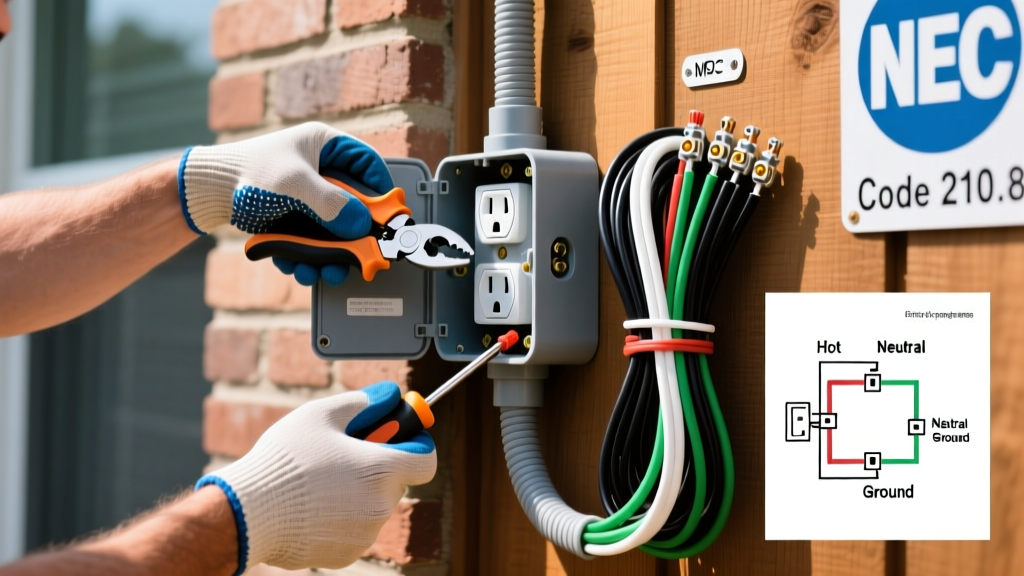
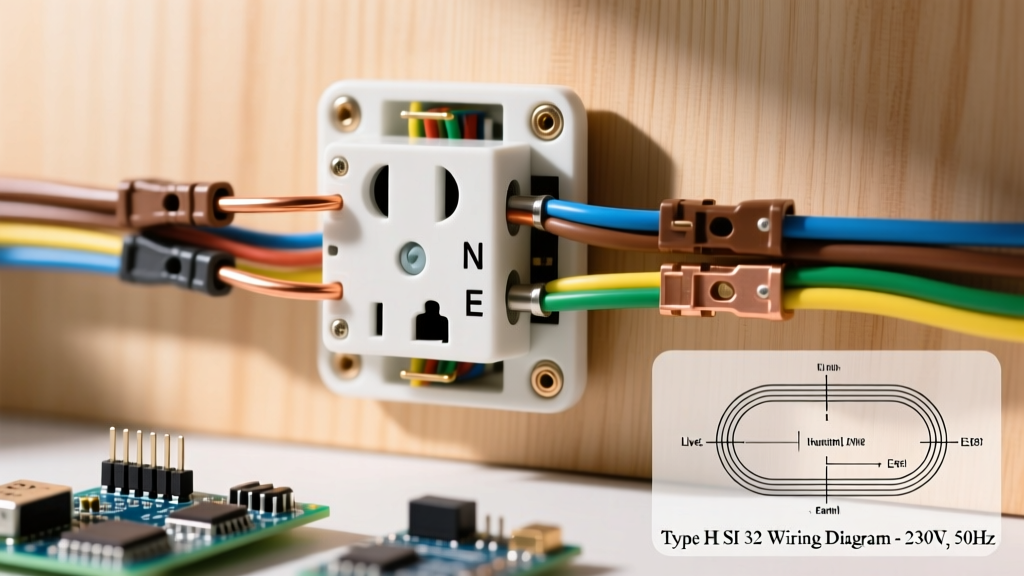
Israel strictly follows the European IEC 60446 / HD 308 S2 color code standard for AC wiring. When terminating an Israel electrical outlet, you will encounter three conductors. Miswiring the phase and neutral will not prevent the socket from functioning, but it creates a severe shock hazard during maintenance, as the single-pole breaker will only disconnect the neutral, leaving the appliance energized.
Conductor Identification
- Phase / Line (L): Brown (In pre-2000 legacy wiring, this may be Black or Red. Always test with a multimeter before touching).
- Neutral (N): Blue (Must be continuous back to the distribution board neutral bar).
- Earth / Ground (E): Yellow/Green striped (Mandatory for all socket circuits; must be bonded to the main earth terminal block).
Terminal Layout on the Receptacle
Unlike the US NEMA 5-15 or the UK BS 1363, the back of a standard SI 32 receptacle typically features three screw terminals arranged in a triangle or a straight line, clearly marked:
- L (Line): Connect the Brown wire. This corresponds to the bottom-right pin when facing the socket with the Earth pin at the top.
- N (Neutral): Connect the Blue wire. This corresponds to the bottom-left pin.
- Earth Symbol (⏚): Connect the Yellow/Green wire. This corresponds to the top pin.
Step-by-Step Wiring Procedure
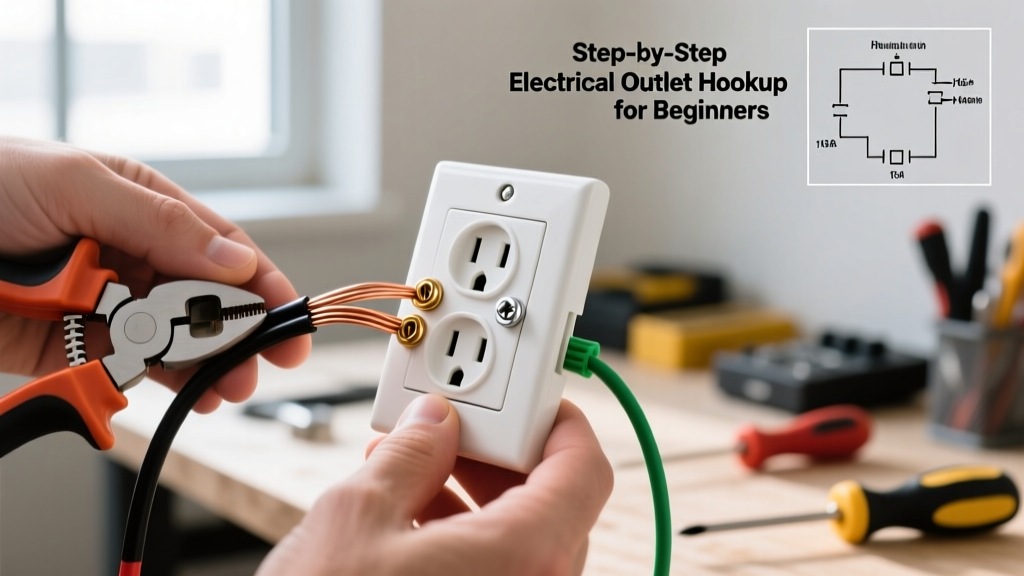
Follow this precise sequence to ensure a safe, code-compliant installation that will pass inspection by a licensed Israeli electrical inspector.
- Isolate the Circuit: Turn off the 16A MCB and the associated 30mA RCCB (Residual Current Circuit Breaker) at the main distribution board (Luach Chashmal). Verify zero voltage using a CAT III rated multimeter or non-contact voltage tester.
- Prepare the Conductors: Strip exactly 12mm to 14mm of insulation from the 2.5mm² solid copper wires. Do not nick the copper conductor, as this creates a weak point that can snap under thermal expansion.
- Termination: Insert the bare copper fully into the terminal blocks. Ensure no bare wire is exposed outside the socket housing, and no insulation is trapped inside the terminal clamp.
- Apply Torque: Tighten the terminal screws to 1.2 Nm. Under-torquing causes high-resistance connections, leading to arcing and melted socket faces—a common failure mode in high-draw appliance circuits (e.g., space heaters or air conditioners).
- Mounting: Secure the socket mechanism into the standard European-style flush-mount box (typically 68mm diameter in Israel) using the provided M3.5 expansion claws or direct screw mounting to the plasterboard box.
- Final Testing: Restore power and test with a digital socket tester to verify correct phase/neutral orientation and earth continuity.
The 'Hybrid' Socket: Type H and Schuko (Type F) Compatibility
One of the most unique aspects of the Israel electrical outlet market is the widespread use of the Hybrid Socket. Because many imported appliances (from Germany, Eastern Europe, and Asia) use the Schuko (Type F) plug, Israeli manufacturers produce sockets that physically accept both Type H and Type F plugs.
How it works: The hybrid socket features the three round holes for Type H, but the faceplate is recessed circularly with metal grounding clips on the top and bottom edges to mate with the Schuko plug's side-grounding strips.
Critical Safety Warning: When wiring a hybrid socket, the internal bonding between the side grounding clips and the main Type H earth terminal must be verified. In cheap, non-certified imported sockets, these clips are sometimes isolated. If a Schuko plug is inserted into an unbonded hybrid socket, the appliance will operate but will have zero ground fault protection. Always purchase SII-certified hybrid sockets from reputable brands like ABB, Schneider Electric, or local manufacturers like Ein-Cohen (E-C).
Circuit Protection: MCB and RCCB Requirements
Wiring the outlet is only half the battle; the upstream protection dictates the safety of the installation. According to Israeli electrical codes, every socket circuit must be protected by a combination of overcurrent and earth-leakage devices.
Breaker Configuration Matrix
| Device Type | Rating | Purpose |
|---|---|---|
| MCB (Miniature Circuit Breaker) | 16A, Curve C | Protects the 2.5mm² wire from short circuits and thermal overload. |
| RCCB (Residual Current Device) | 30mA, Type A or AC | Protects human life from fatal electric shock by detecting earth leakage. |
| RCBO (Combined) | 16A / 30mA | Combines both functions in a single DIN-rail module; increasingly standard in 2026 smart-panels. |
For further reading on international plug configurations and safety standards, refer to the IEC World Plugs Database and the historical breakdown of the Type H standard on World Standards. Always ensure your installation complies with the latest directives from the Standards Institution of Israel.
Common Edge Cases and Troubleshooting
- Tripping RCCB upon Plugging In: If the 30mA breaker trips immediately when an appliance is plugged in, the appliance likely has an internal earth fault, or the socket's neutral and earth wires are swapped or touching inside the wall box.
- Melted Socket Faces: Usually caused by daisy-chaining high-draw appliances (like a 2000W water heater and a 1500W space heater) on a single 16A circuit, or by failing to torque the terminal screws to 1.2 Nm, causing micro-arcing.
- Loose Plugs: Older Type H sockets (pre-2010) often suffer from spring-fatigue in the internal brass contacts. Do not attempt to bend the pins of the plug; replace the receptacle mechanism immediately.
By adhering to these precise wiring diagrams, torque specifications, and protection matrices, you ensure that your Israel electrical outlet installation is safe, durable, and fully compliant with modern 2026 electrical codes.