
Why Does My Electrical Outlet Keep Tripping? The Beginner's Diagnostic Guide
When you plug in a vacuum or hair dryer and the power suddenly cuts out, it is a frustrating experience. If you are asking, 'why does my electrical outlet keep tripping?', the first step is to identify what is actually tripping. Beginners often confuse a tripped GFCI receptacle with a tripped circuit breaker. While both are safety mechanisms designed to prevent electrical fires and fatal shocks, they operate on entirely different principles and require different fixes.
According to the Electrical Safety Foundation International (ESFI), GFCIs have prevented thousands of electrocutions since their introduction. However, like all electromechanical devices, they degrade over time. This tutorial will walk you through diagnosing the exact cause of your tripping outlet and provide a step-by-step beginner installation guide to replace a faulty unit safely.
Phase 1: Identify the Source of the Trip
Before grabbing a screwdriver, you must determine which safety device has interrupted your circuit. Look closely at the outlet and your main electrical panel.
Scenario A: The GFCI Outlet Itself Tripped
If the outlet has 'Test' and 'Reset' buttons (commonly found in kitchens, bathrooms, garages, and outdoors) and the 'Reset' button has popped out, the GFCI receptacle has tripped. GFCIs monitor the current imbalance between the hot and neutral wires. If as little as 4 to 6 milliamps of current leaks to the ground (perhaps through a wet appliance or your body), the internal solenoid trips in under 25 milliseconds.
- Immediate Fix: Press the 'Reset' button firmly until it clicks.
- Persistent Issue: If it immediately pops back out, or refuses to stay reset, you either have an active ground fault downstream or a failed GFCI mechanism.
Scenario B: The Circuit Breaker Tripped
If the outlet looks normal (no buttons, or buttons are flush), but the outlet has no power, the circuit breaker in your main panel has tripped. Breakers protect the wiring inside your walls from melting due to excessive heat.
- Overload: Drawing more current than the wire can handle (e.g., running a space heater and a microwave on the same 15A circuit).
- Short Circuit: A hot wire touching a neutral or ground wire, causing a massive, instantaneous spike in current.
- Arc Fault (AFCI): Modern breakers detect dangerous sparking (arcing) caused by loose connections or damaged cords.
Understanding Circuit Limits: The 80% NEC Rule
If your breaker keeps tripping when using a specific outlet, you are likely violating the National Electrical Code (NEC) continuous load rule. The NEC mandates that a circuit breaker should only be loaded to 80% of its maximum capacity for continuous use (defined as running for 3 hours or more). Refer to the table below to understand your circuit's true limits.
| Breaker Size | Required Copper Wire | Max Continuous Load (80%) | Wattage Limit (120V) | Common Locations |
|---|---|---|---|---|
| 15 Amp | 14 AWG | 12 Amps | 1,440 Watts | Bedrooms, Living Rooms, Lighting |
| 20 Amp | 12 AWG | 16 Amps | 1,920 Watts | Kitchens, Bathrooms, Garages, Outdoors |
Pro Tip: A standard 1500W space heater draws 12.5 Amps. Plugging it into a 15-Amp circuit leaves almost zero capacity for anything else, guaranteeing a trip if a TV or lamp is on the same circuit.
Why GFCI Outlets Fail and Require Replacement
If your GFCI outlet keeps tripping with no appliances plugged in, or it simply will not reset, the internal sensing mechanism has likely failed. The National Fire Protection Association (NFPA) notes in the NEC that GFCI protection is mandatory in all damp and wet locations. Because these environments expose the receptacle to humidity and temperature swings, the internal electronics degrade.
Common Failure Modes
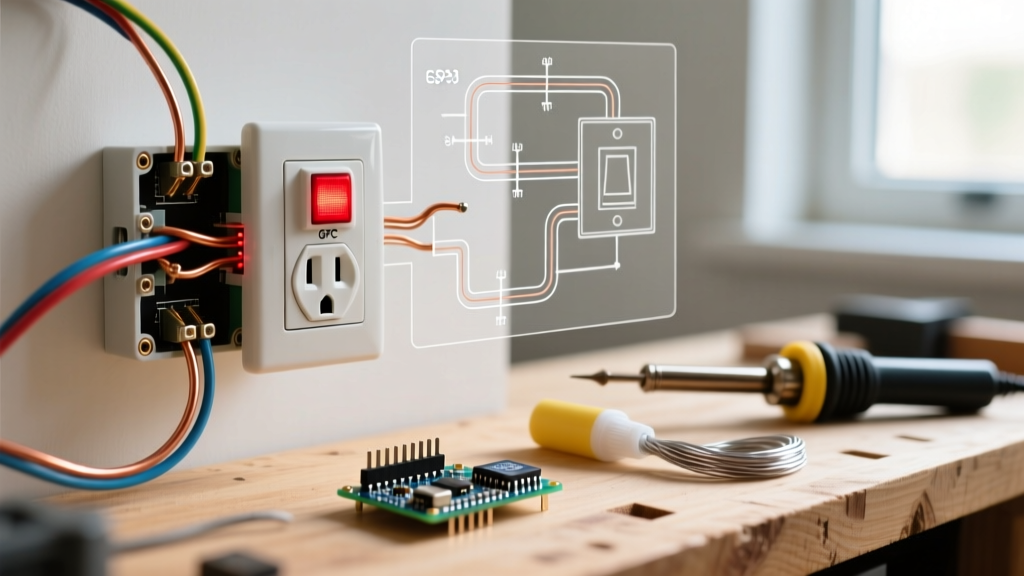
- End of Lifespan: Standard GFCIs last 7 to 10 years. Modern models (like the Leviton SmartlockPro GFNT1-W, approx. $22) feature an auto-test function that blinks a red LED when the internal sensor fails, locking out power so you cannot use a compromised outlet.
- Reverse Wiring (Line vs. Load): If a beginner recently installed a new GFCI and it trips immediately or provides no power to downstream outlets, the 'Line' (power source) and 'Load' (downstream feed) wires are likely swapped.
- Moisture Intrusion: Outdoor outlets without proper in-use weatherproof covers will accumulate condensation, causing micro-faults that trip the 5mA threshold.
Beginner Tutorial: How to Replace a Tripping GFCI Outlet
When resetting fails, replacement is the only safe option. Do not attempt to bypass the GFCI by installing a standard receptacle; this is a severe code violation and a lethal hazard in wet areas.
Tools and Materials Required
- Non-Contact Voltage Tester: Klein Tools NCVT-2 (Approx. $35) - Never rely solely on the breaker switch position.
- Wire Strippers: Klein Tools 11055 (10-20 AWG).
- Screwdrivers: Phillips #2 and a Flathead cabinet tip.
- Replacement GFCI: 20-Amp Tamper-Resistant GFCI (e.g., Leviton GFNT2 or Eaton TRGF20W, approx. $20-$25).
Step-by-Step Installation Guide
Step 1: Kill the Power and Verify
Turn off the corresponding breaker at the main panel. Insert your Klein NCVT-2 into the hot slot (the shorter slot) of the outlet. The tester should remain completely dark and silent. Test the tester on a known live outlet to ensure the battery is working.
Step 2: Remove and Inspect the Old Wiring
Unscrew the faceplate and the top/bottom mounting screws. Pull the outlet out gently. Take a photo of the existing wiring before disconnecting anything. Identify the LINE wires (usually one black and one white, bringing power from the panel) and the LOAD wires (a second black and white pair, feeding power to other outlets down the line).
Step 3: Prep the New GFCI
Look at the back of your new Leviton or Eaton GFCI. You will see brass and silver screws marked 'LINE' and 'LOAD'. Critical Beginner Mistake: Connecting the power source to the 'LOAD' terminals will cause the outlet to trip instantly or fail to protect downstream devices.
Step 4: Make the Connections
Strip exactly 3/4 inch of insulation from your wires. Hook the bare copper ground wire around the green grounding screw. Connect the LINE Black (Hot) to the brass LINE screw, and the LINE White (Neutral) to the silver LINE screw. If you have downstream outlets, connect the LOAD wires to the LOAD screws. Wrap electrical tape around the sides of the outlet to cover the terminal screws—a best practice to prevent accidental shorts in metal boxes.
Step 5: Torque and Mount
Tighten the terminal screws firmly. Leviton specifies a torque of 14 in-lbs for their SmartlockPro series to prevent loose connections that cause arcing. Push the wires neatly into the back of the box, mount the receptacle, and attach the cover plate.
Step 6: Test the Circuit
Restore power at the breaker. The GFCI should power on. Press the 'Test' button—the power should cut, and the 'Reset' button should pop. Press 'Reset' to restore power. If downstream outlets are dead, you have swapped Line and Load; turn the breaker back off and reverse them.
Frequently Asked Questions (FAQ)
Can I replace a 15-Amp GFCI with a 20-Amp GFCI?
No. The receptacle rating must match or exceed the circuit rating, but you cannot upgrade the receptacle amperage without verifying the wire gauge. If your breaker is 15-Amp (14 AWG wire), you must use a 15-Amp GFCI. If your breaker is 20-Amp (12 AWG wire), you can use either a 15-Amp or 20-Amp GFCI, though 20-Amp is standard for kitchens and garages.
Why does my outlet trip only when it rains?
This indicates moisture intrusion. Water is creating a path to ground somewhere on the circuit. Check outdoor receptacles, patio string lights, or landscape lighting transformers. Ensure all outdoor outlets are equipped with 'in-use' bubble covers that allow cords to exit downward while keeping the seal closed.
Is it safe to use a GFCI outlet without a ground wire?
Yes, but with caveats. The NEC allows replacing an ungrounded 2-prong outlet with a GFCI receptacle to provide shock protection, as the GFCI does not require a ground wire to detect current imbalances. However, you must apply the 'No Equipment Ground' sticker provided with the outlet to the faceplate, and you cannot plug in surge protectors, as they require a true ground to divert voltage spikes.
Safety Warning: If your outlet emits a buzzing sound, smells like melting plastic, or shows brown scorch marks, do not attempt to reset it. This indicates a high-resistance short or severe arcing fault. Turn off the breaker immediately and consult a licensed electrician to inspect the wiring inside the wall cavity.