
Navigating NEC Compliance for Light Switch Wiring
When upgrading or installing a house electrical wiring light switch circuit, meeting the National Electrical Code (NEC) is not just about passing inspection—it is the baseline for preventing electrical fires and ensuring long-term system reliability. The National Fire Protection Association (NFPA) updates the NEC every three years, and recent cycles have introduced strict mandates regarding neutral conductors, box fill volumes, and arc-fault protection that catch many DIYers and even seasoned electricians off guard.
This guide breaks down the critical NEC articles governing light switch installations in 2026, providing exact measurements, product specifications, and code-compliant wiring methodologies.
The Mandatory Neutral Conductor Rule (NEC 404.2(C))
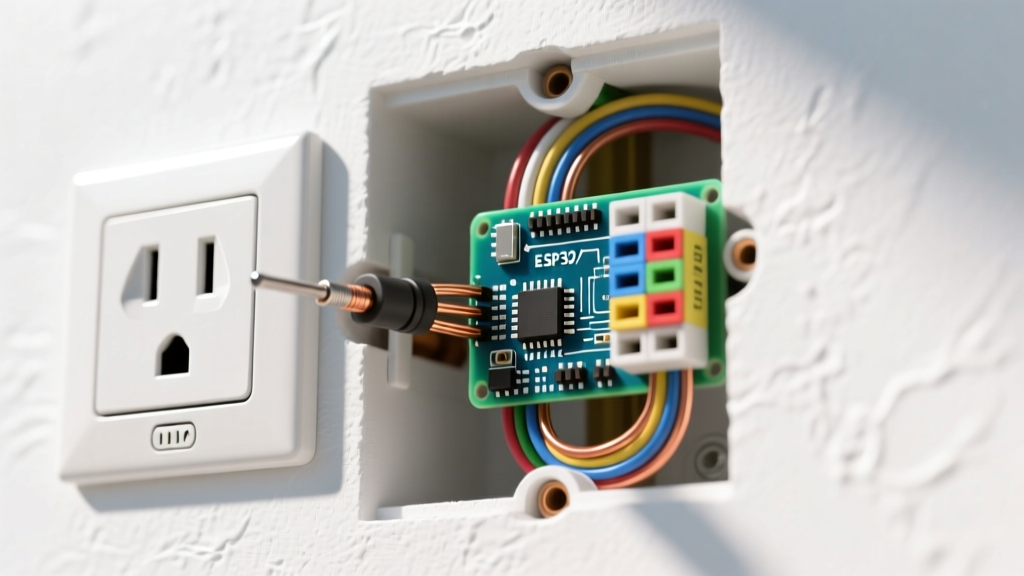
Historically, switch loops only required a hot and a switched hot wire, leaving the neutral at the ceiling fixture. However, the proliferation of smart switches (like the Lutron Caseta or Leviton Decora Smart Wi-Fi series) changed this. These devices require standby power to operate their internal radios and LED indicators.
Under NEC 404.2(C), a neutral conductor must now be present at virtually all switch boxes controlling lighting loads.
Code Exception: A neutral is not required if the wiring method from the switch to the ceiling is a raceway (like EMT conduit) that is large enough to accommodate a neutral wire in the future, or if the switch box is not accessible. However, for standard residential NM-B (Romex) cable installations, you must pull a 14/2 or 12/2 cable to the switch box to provide the neutral, even if you are currently installing a standard mechanical toggle switch.
Box Fill Calculations: Avoiding the 'Overstuffed' Violation (NEC 314.16)
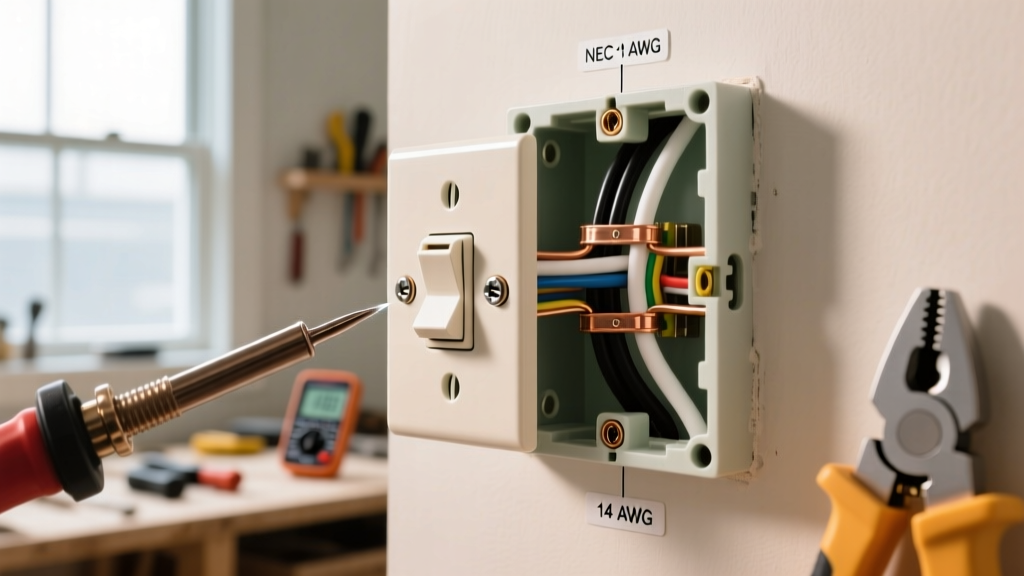
One of the most common inspection failures in house electrical wiring light switch projects is box overcrowding. NEC 314.16 dictates the minimum cubic inch (cu in) volume required for an electrical box based on the number and size of conductors, devices, and clamps inside.
Volume Allowance per Conductor
| Wire Gauge (AWG) | Volume Required per Conductor | Common Cable Type |
|---|---|---|
| 14 AWG | 2.0 cubic inches | 14/2 NM-B, 14/3 NM-B |
| 12 AWG | 2.25 cubic inches | 12/2 NM-B, 12/3 NM-B |
| 10 AWG | 2.5 cubic inches | 10/2 NM-B (Rare for lighting) |
Step-by-Step Box Fill Calculation Example
Imagine you are wiring a standard single-pole light switch using 14 AWG wire. You have one 14/2 cable entering the box (power from the panel) and one 14/2 cable leaving the box (switched hot and neutral to the fixture). The box contains internal cable clamps and a single switch device.
- Hot and Neutral Conductors: 4 wires (2 from each cable) × 2.0 cu in = 8.0 cu in.
- Equipment Grounding Conductors: All bare/green grounds in the box count as a single conductor. 1 × 2.0 cu in = 2.0 cu in.
- Internal Clamps: Count as a single conductor based on the largest wire. 1 × 2.0 cu in = 2.0 cu in.
- The Switch Device: A yoke-mounted device counts as two conductors. 2 × 2.0 cu in = 4.0 cu in.
- Total Required Volume: 8.0 + 2.0 + 2.0 + 4.0 = 16.0 cubic inches.
Expert Tip: A standard Carlon B114R-UPC single-gang box only offers 14 cu in of space. For this setup, you must upgrade to a deeper box, such as the Carlon B120R-UPC (20.5 cu in) or an Arlington FA108 old-work box (22 cu in), to remain code-compliant.
Switch Loops and Re-Identification (NEC 200.7 & 300.20)
When wiring a traditional switch loop where power goes to the ceiling fixture first, and then down to the switch, you must use specific color-coding protocols. Under NEC 200.7(C)(2), if you use a 2-wire cable (like 14/2) for the switch loop, the white wire cannot be used as a neutral. It must be used as the ungrounded (hot) conductor feeding the switch.
- The Rule: You must permanently re-identify the white wire at both ends using black electrical tape, heat shrink, or permanent marker.
- The Modern Approach: To avoid re-identification entirely and comply with the aforementioned neutral mandate, run a 14/3 cable to the switch. Use the black wire for the constant hot, the red wire for the switched hot, and leave the white wire as the dedicated neutral.
Grounding and Bonding Requirements (NEC 404.9 & 250.148)
Proper grounding is non-negotiable. According to ESFI guidelines on electrical safety and grounding, the equipment grounding conductor must be continuous and properly bonded to both the device and the box (if metallic).
Metal vs. Non-Metallic Boxes
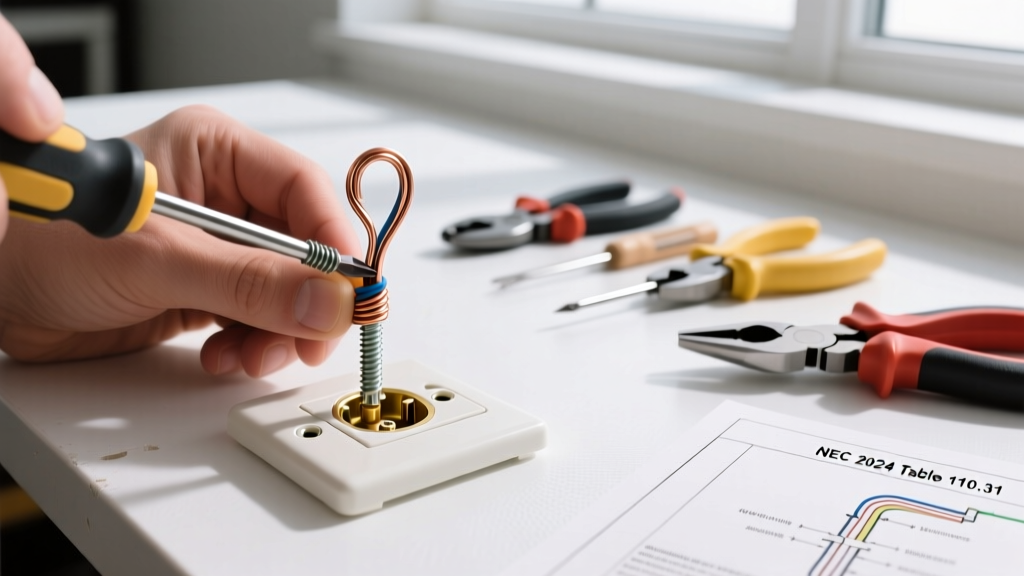
If you are using a steel or aluminum switch box, NEC 250.148 requires the grounding wire to be pigtailed. One pigtail must bond to the metal box via a 10-32 grounding screw, and a second pigtail must connect to the green grounding screw on the light switch. Never daisy-chain the ground wire through the device yoke to ground the metal box. If the switch is removed, the box loses its ground path, creating a severe shock hazard.
For non-metallic (PVC/fiberglass) boxes, the box itself does not require bonding, but the switch device must still be grounded via a continuous pigtail connected with a WAGO 221-413 lever nut or an approved copper crimp sleeve.
AFCI Protection for Switch Branch Circuits (NEC 210.12)
Arc-Fault Circuit Interrupter (AFCI) protection is required for most 120-volt, single-phase, 15- and 20-ampere branch circuits supplying outlets and devices in residential living spaces. As detailed in ESFI's comprehensive AFCI safety documentation, this includes bedrooms, living rooms, hallways, and closets.
When wiring a house electrical wiring light switch circuit in these designated areas, the circuit must be protected by a Combination-Type AFCI breaker at the main panel. Standard thermal-magnetic breakers are no longer code-compliant for new lighting circuits in these rooms. If you are replacing an existing switch in an older home, you are generally not required to retrofit AFCI protection unless you are extending the circuit or performing a major renovation that requires a permit.
Pre-Inspection Checklist for Light Switch Installations
Before closing up the drywall or installing the wall plate, verify these critical code requirements:
- Neutral Present: A white neutral wire is capped and present in the switch box (NEC 404.2(C)).
- Box Fill Verified: The cubic inch capacity of the box exceeds the calculated fill volume for all wires, clamps, and devices (NEC 314.16).
- Grounding Pigtails: Metal boxes are independently bonded to the ground wire; no daisy-chained grounds exist.
- Wire Re-identification: Any white wire used as a hot conductor in a switch loop is marked with black tape at both terminations (NEC 200.7).
- Secure Mounting: The switch yoke is flush against the drywall or plaster, supported by the box ears, with no gaps exceeding 1/8 inch (NEC 300.11).
By adhering strictly to these NEC parameters, your house electrical wiring light switch project will not only pass municipal inspections but will also provide a safe, future-proofed foundation for modern smart home upgrades.