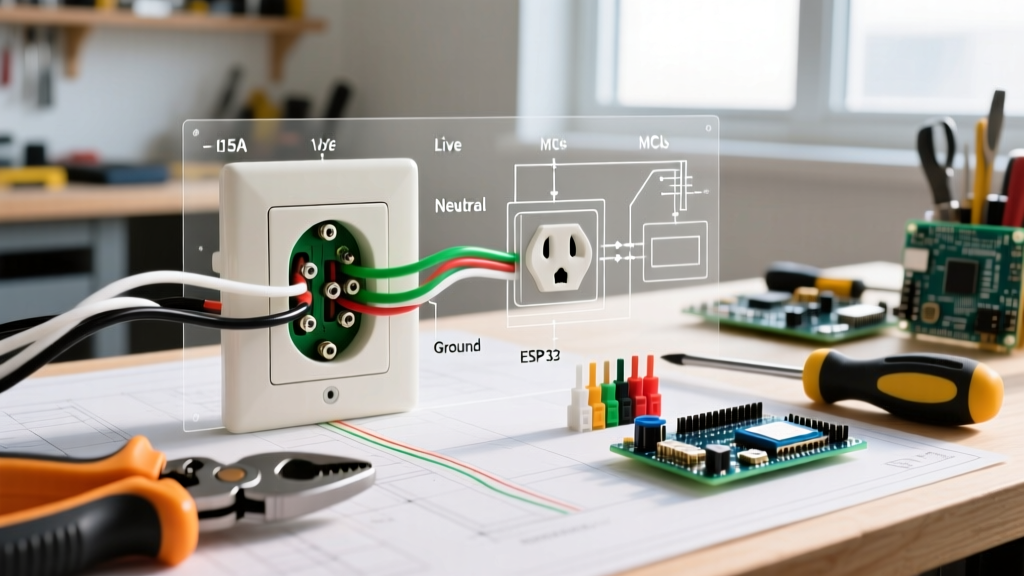

Relocating a receptacle to accommodate new furniture, a kitchen backsplash, or a wall-mounted television seems like a straightforward weekend project. You cut the drywall, run a new piece of Romex, and wire the new location. However, from a regulatory standpoint, moving an electrical outlet is classified as a circuit modification. This triggers a cascade of National Electrical Code (NEC) requirements that many DIYers and even some general contractors overlook. As of the widespread enforcement of the 2023 NEC and early 2026 local amendments, simply extending a wire is no longer a 'grandfathered' free-for-all. Understanding the code requirements for moving an electrical outlet is critical to passing inspection, avoiding fire hazards, and ensuring your home's electrical system remains safe and compliant.
The 'Grandfather Clause' Myth vs. Modification Reality
A common misconception in residential wiring is that existing, older circuits are permanently 'grandfathered' in and exempt from modern codes. While it is true that you do not have to rip open your walls to upgrade a perfectly functioning 1970s circuit, the moment you alter, extend, or modify that circuit—including moving an electrical outlet—the modified portion must comply with the current NEC. Furthermore, depending on the jurisdiction and the nature of the modification, the inspector may require the entire branch circuit to be brought up to current safety standards, particularly regarding arc-fault and ground-fault protection.
Core NEC Code Requirements for Outlet Relocation
When planning your outlet move, you must address four primary code domains: safety device upgrades, box fill volume, junction accessibility, and physical wire protection.
1. AFCI and GFCI Upgrade Mandates (NEC 210.12 & 210.8)
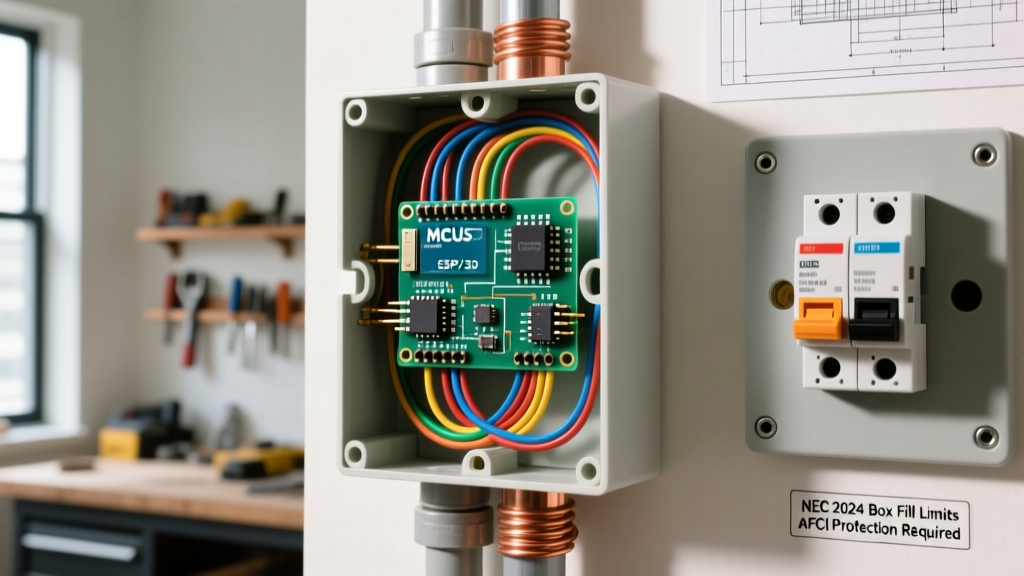
If you are moving an outlet in a living room, bedroom, or hallway, you are extending a branch circuit that now falls under strict Arc-Fault Circuit Interrupter (AFCI) rules. According to National Fire Protection Association (NFPA) guidelines, nearly all 120-volt, 15- and 20-amp branch circuits in living spaces require combination-type AFCI protection. If your existing breaker is a standard thermal-magnetic model, moving the outlet will require you to upgrade the breaker to an AFCI model (such as the Square D QO120CAFIC or Eaton BR120AF), which typically costs between $45 and $60.
Similarly, if you are moving an outlet in a kitchen, bathroom, laundry room, or within 6 feet of a sink, Ground-Fault Circuit Interrupter (GFCI) protection is mandatory per NEC 210.8. You can achieve this either by installing a GFCI receptacle at the new location or by using a GFCI breaker at the panel. The Electrical Safety Foundation International (ESFI) strongly recommends testing these devices monthly, making accessible GFCI receptacles a preferred choice over breakers for localized wet-area protection.
2. Box Fill Calculations (NEC 314.16)
Stuffing too many wires into a shallow electrical box is a severe fire hazard due to heat buildup and damaged insulation. NEC 314.16 dictates strict 'box fill' calculations based on the wire gauge. When moving an outlet, you will likely use an 'old work' (remodel) box. Here is the exact math for a standard 12 AWG circuit (20-amp) where a single 12/2 NM-B cable enters the box and terminates at a receptacle:
- Hot and Neutral Conductors: 2 wires × 2.25 cubic inches = 4.5 cu in.
- Equipment Ground: 1 wire × 0.25 multiplier = 0.56 cu in.
- Internal Clamps: (Old work boxes usually lack these, but if present) = 0.56 cu in.
- Receptacle Device: 2 volume allowances × 2.25 = 4.5 cu in.
- Total Required Volume: 10.12 cubic inches.
A standard single-gang Carlon B114R old work box offers 14 cubic inches, which is sufficient. However, if you are using the new box as a junction point to daisy-chain power to another outlet (meaning two 12/2 cables enter the box), the required volume jumps to over 18 cubic inches. In that scenario, you must use a deep box like the Carlon B120R (20 cu in) to remain code-compliant.
3. Junction Box Accessibility (NEC 314.29)
What happens to the old box when you move the outlet? NEC 314.29 explicitly states that all junction boxes must remain 'accessible without removing any part of the building or structure.' You cannot simply cap the wires with wire nuts, push them into the old box, and drywall over it. You have two legal options:
- Install a Blank Cover Plate: Leave the old box in place, cap the wires safely, and install a flat, paintable blank cover plate. It must remain visible and accessible.
- Remove the Box Entirely: If you want a seamless wall, you must trace the cable back to the previous accessible junction point (like the outlet before it or the panel), disconnect the wire, and pull the abandoned cable completely out of the wall.
4. Wire Routing and Physical Protection (NEC 334.30 & 300.4)
When fishing new NM-B (Romex) cable through finished walls, securing the wire is notoriously difficult. NEC 334.30 requires NM cable to be secured within 12 inches of the box and every 4.5 feet thereafter. In retrofit scenarios where opening the wall is minimized, inspectors often grant exceptions for 'fished' wires in finished walls where securing is impractical. However, NEC 300.4 regarding physical protection is non-negotiable. If you are running the new cable through bored holes in wooden studs, the edge of the hole must be at least 1.25 inches from the nearest edge of the stud. If this setback cannot be maintained, you must install a 1/16-inch thick steel nail plate over the stud to prevent drywall screws from piercing the wire later.
Material Cost & Component Breakdown
Budgeting for a code-compliant outlet relocation requires looking beyond just the receptacle. Below is a realistic cost matrix for moving a single 20-amp kitchen outlet 10 feet, assuming the wall is open or easily fished.
| Component | Specific Model / Type | Estimated Cost (2026) | Code Purpose |
|---|---|---|---|
| Wire | Southwire 12/2 NM-B (15 ft) | $14.50 | 20A Circuit Capacity |
| New Box | Carlon B120R (20 cu in Old Work) | $4.25 | NEC 314.16 Box Fill |
| Receptacle | Leviton T5320-W (15A TR/GFCI) | $18.00 | NEC 210.8 & Tamper Resistant |
| Old Box Cover | Leviton 410 (Single Gang Blank) | $1.50 | NEC 314.29 Accessibility |
| AFCI/GFCI Breaker | Square D HOM120DF (Dual Function) | $62.00 | Required if extending unprotected circuits |
| Permit Fee | Local Municipal Electrical Permit | $50 - $125 | Legal Compliance & Inspection |
Do You Need a Permit to Move an Outlet?
In almost all municipalities, moving an electrical outlet requires a permit. While swapping a broken receptacle for a new one is considered 'maintenance' and usually permit-free, extending the circuit length or altering the permanent wiring infrastructure is classified as 'new work.' Failing to pull a permit (typically costing between $50 and $125 for a minor alteration) can result in fines, failed home inspections during a real estate transaction, and potential denial of homeowner's insurance claims if an electrical fire originates from unpermitted work. Always contact your local Authority Having Jurisdiction (AHJ) before cutting drywall.
Frequently Asked Questions (FAQ)
Can I use 14 AWG wire if I am moving a 15-amp outlet?
Yes, if the branch circuit is protected by a 15-amp breaker, 14 AWG NM-B wire is code-compliant. However, you must verify the breaker size at the panel. If the breaker is 20-amp, you are legally required to use 12 AWG wire for the entire extension. Mixing 14 AWG wire on a 20-amp circuit is a severe fire hazard and an immediate inspection failure.
Are Tamper-Resistant (TR) receptacles required when moving an outlet?
Yes. NEC 406.12 mandates that all 15- and 20-amp, 125-volt receptacles installed in dwelling units must be tamper-resistant. This applies to new installations and modifications, including moving an existing outlet. Standard non-TR receptacles are no longer legal for residential branch circuits, regardless of the home's age.
What if I am moving an exterior outlet?
Exterior outlets require an 'in-use' weatherproof cover (often called a bubble cover) that allows the cover to close while a cord is plugged in, per NEC 406.9. Furthermore, the box must be rated for wet locations, and GFCI protection is strictly mandated. If the outlet is within reach of the ground or a deck, it must also meet specific height and accessibility requirements dictated by local amendments.