
The Korean Electrical Standard: KS C 8305 Explained
Troubleshooting a Korea electrical outlet requires a firm understanding of the nation's unique electrical infrastructure. According to the International Electrotechnical Commission (IEC), South Korea operates on a 220V nominal voltage at 60Hz, utilizing Type C (ungrounded) and Type F (grounded Schuko) receptacles. The national standard, KS C 8305, dictates strict tolerances for receptacle tension and grounding continuity. However, diagnosing faults in the field often reveals a complex web of legacy wiring, adapter incompatibilities, and frequency mismatches that can destroy sensitive electronics or cause severe fire hazards.
Whether you are an expat wiring a new apartment in Seoul, a traveler dealing with a melted universal adapter, or an engineer diagnosing imported machinery, understanding the specific failure modes of Korean receptacles is critical. This guide provides actionable, expert-level diagnostic frameworks for resolving the most common Korea electrical outlet issues encountered in 2026.
Diagnostic Matrix: Common Korea Electrical Outlet Failures
Before pulling out a multimeter, cross-reference your symptoms with this diagnostic matrix to isolate the root cause of the receptacle or adapter failure.
| Symptom | Probable Cause | Multimeter Reading (Fluke 117) | Corrective Action |
|---|---|---|---|
| Appliance instantly blows fuse or varistor pops | Legacy 110V outlet misidentified as 220V, or vice versa | L-N reads 110V or 220V (unexpected) | Verify circuit breaker labeling; replace receptacle to match branch circuit voltage. |
| Universal travel adapter melts or smells like ozone | High-resistance connection on Type F side-clips at 16A load | Voltage drop >5V under load | Discard adapter; use a hardwired KS C 8305 compliant power strip. |
| European 50Hz motor runs hot and loud | Frequency mismatch (Korea is 60Hz) | Frequency reads 60.0 Hz | Install a Variable Frequency Drive (VFD) or replace motor. |
| GFCI/RCD trips immediately upon plugging in | Neutral-Ground bond downstream of the breaker panel | N-G continuity <1 Ohm | Locate and remove the illegal N-G bond at the receptacle. |
The Legacy 110V Trap: Diagnosing Older Korean Apartments
One of the most dangerous scenarios when troubleshooting a Korea electrical outlet is encountering legacy 110V wiring. Prior to the late 1990s, South Korea utilized a split system where 110V (Type A/B) was standard for lighting and small appliances, while 220V was reserved for heavy loads like air conditioners. While the U.S. Department of State notes that South Korea has officially standardized on 220V, thousands of older apartments (particularly those built before 2005 in districts like Gangnam or Haeundae) still contain active 110V receptacles hidden behind furniture or in utility closets.
Diagnosing the Voltage Mismatch
If a traveler from North America plugs a 120V device into what they assume is a standard US-style outlet, but it is actually wired to a 220V step-down transformer that was improperly removed, the device's metal oxide varistor (MOV) will violently short, often tripping the main breaker. Conversely, plugging a 220V Korean appliance into a lingering 110V circuit will result in severe under-voltage, causing compressors and switching power supplies to overheat and fail.
- Step 1: Visually inspect the receptacle. Type A (two flat parallel pins) is almost exclusively 110V. Type C/F (two round pins) is almost exclusively 220V.
- Step 2: Use a True RMS multimeter to measure Line-to-Neutral. A reading of 110V-120V confirms a legacy circuit. A reading of 220V-233V confirms the modern standard.
- Step 3: If you find a 110V outlet, trace it back to the sub-panel. In many older Korean homes, 110V circuits are fed by a bulky, wall-mounted step-down transformer that generates significant phantom heat and wastes energy. Upgrading these circuits to 220V and replacing the receptacles with Type F is highly recommended for safety and efficiency.
Type F (Schuko) Grounding Failures and High-Resistance Faults
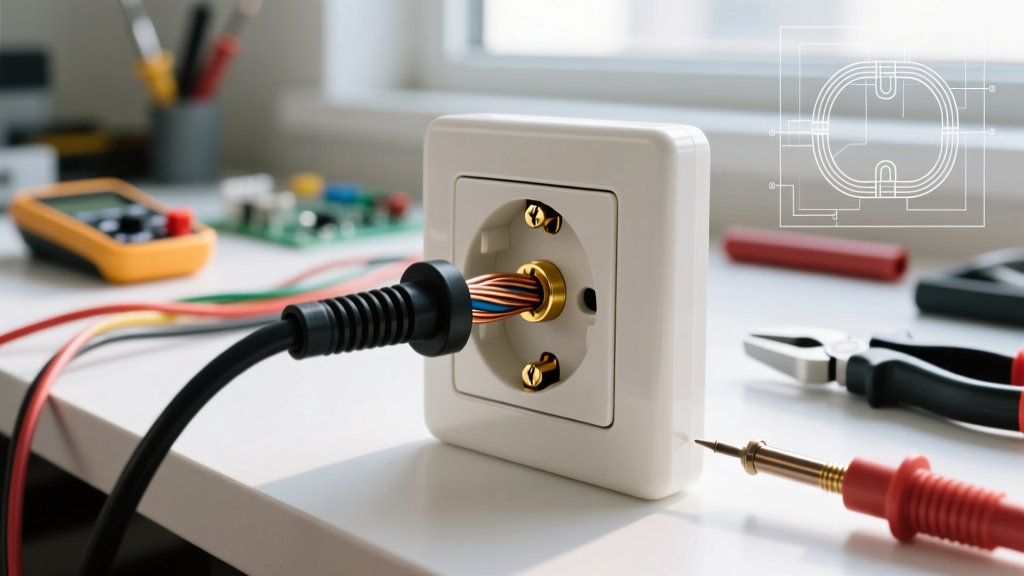
The Type F receptacle (CEE 7/3), commonly known as Schuko, relies on two side-mounted grounding clips rather than a protruding ground pin. While robust, these clips are highly susceptible to mechanical fatigue. When troubleshooting a Korea electrical outlet that trips breakers or causes a tingling sensation on appliance chassis, the grounding clips are the primary suspect.
The Physics of Adapter Melting
Many international travelers use universal adapters (such as those from Ceptics or EPICKA) to bridge US Type B plugs to Korean Type F outlets. These adapters use thin internal brass shunts to connect the US ground pin to the Schuko side clips. At a standard Korean 16A load (roughly 3520W), the resistance of these thin shunts generates immense heat due to $I^2R$ (current squared times resistance) losses. This is a leading cause of electrical fires in short-term rentals.
Expert Safety Warning: Never use a universal travel adapter for high-draw appliances like space heaters, hair dryers, or portable induction cooktops in South Korea. Always use a dedicated, UL or KCS (Korea Certification) approved power strip with a native Type F plug.
Step-by-Step: Testing Ground Continuity on a Type F Receptacle
To properly diagnose ground clip fatigue, you must test under load or use a specialized receptacle tester. Standard US 110V testers (like the Klein Tools RT250) will not work and can be destroyed by 220V. Follow this procedure using a digital multimeter, as recommended by Fluke Corporation testing guidelines:
- Visual Inspection: Shine a flashlight into the recessed Type F socket. Look for black carbon scoring on the side grounding clips, which indicates past arcing.
- No-Load Voltage Test: Set your multimeter to AC Voltage. Measure Line-to-Ground (insert one probe into the live pin hole and press the other probe firmly against the side ground clip). It should read ~220V.
- Load Voltage Drop Test: Plug in a high-draw resistive load (like a 2000W kettle). While the kettle is running, measure the voltage between the appliance chassis (if metal) and a known good ground (like a water pipe). A reading above 2V indicates a high-resistance ground fault in the receptacle clips.
- Corrective Action: If the voltage drop exceeds 2V, the receptacle must be replaced. Do not attempt to bend the clips back into shape; the spring steel has lost its temper and will fail again.
Frequency Mismatch: 60Hz vs. 50Hz Motor Diagnostics
While voltage adapters are common, frequency is often ignored. South Korea operates at 60Hz, aligning with North America and Japan (western), but differing from Europe and most of Asia (50Hz). If you are troubleshooting imported European machinery, HVAC compressors, or analog clocks connected to a Korea electrical outlet, frequency mismatch is a critical diagnostic vector.
The synchronous speed of an AC induction motor is dictated by the formula: $N_s = 120f / P$ (where $f$ is frequency and $P$ is the number of poles). When a 50Hz European motor is connected to a 60Hz Korean grid, its speed increases by exactly 20%. This overspeed condition leads to:
- Increased Centrifugal Force: Bearings wear out prematurely due to the exponential increase in mechanical stress.
- Cooling Fan Overload: The motor's internal cooling fan draws significantly more power, potentially overloading the motor windings despite the voltage being correct via a transformer.
- Transformer Saturation: Conversely, if a 60Hz transformer is used on a 50Hz grid (not applicable inside Korea, but relevant for Korean exports), it will overheat. Inside Korea, 50Hz transformers will run cooler but may suffer from reduced impedance.
The Fix: For sensitive imported equipment, do not rely on a simple step-up/step-down transformer. Install a solid-state Variable Frequency Drive (VFD) or an online double-conversion UPS that can synthesize a clean 50Hz sine wave from the 60Hz Korean grid. Expect to spend between $150 and $400 for a reliable 2kW double-conversion unit.
Frequently Asked Questions
Can I use a Japanese 100V appliance in a Korean 220V outlet?
No. Japanese appliances are designed for 100V (50/60Hz). Plugging them directly into a 220V Korea electrical outlet will cause catastrophic failure. You must use a step-down transformer rated for at least 1.5 times the wattage of the Japanese appliance to handle the initial inrush current.
Why does my US laptop charger spark when I plug it into a Korean outlet?
Modern laptop power supplies (SMPS) feature large input capacitors. When you plug them into a 220V Type F outlet, the initial inrush current to charge these capacitors can cause a visible spark. This is generally normal if it is a brief blue flash. However, if the spark is large, orange, and accompanied by a loud pop, the receptacle's internal brass contacts may be oxidized or loose, requiring immediate replacement.
Are Type C and Type F plugs interchangeable in Korea?
Physically, a Type C plug (the flat, ungrounded Europlug) will fit perfectly into a recessed Type F Korean wall outlet. However, Type C plugs are only rated for 2.5A. Using a Type C plug on a device that draws more current (like a vacuum cleaner) is a severe fire hazard and violates the KS C 8305 safety standard. Always ensure high-draw appliances utilize a grounded Type F plug.