
Understanding the Japan Electrical Outlet Plug: Beyond the Physical Resemblance
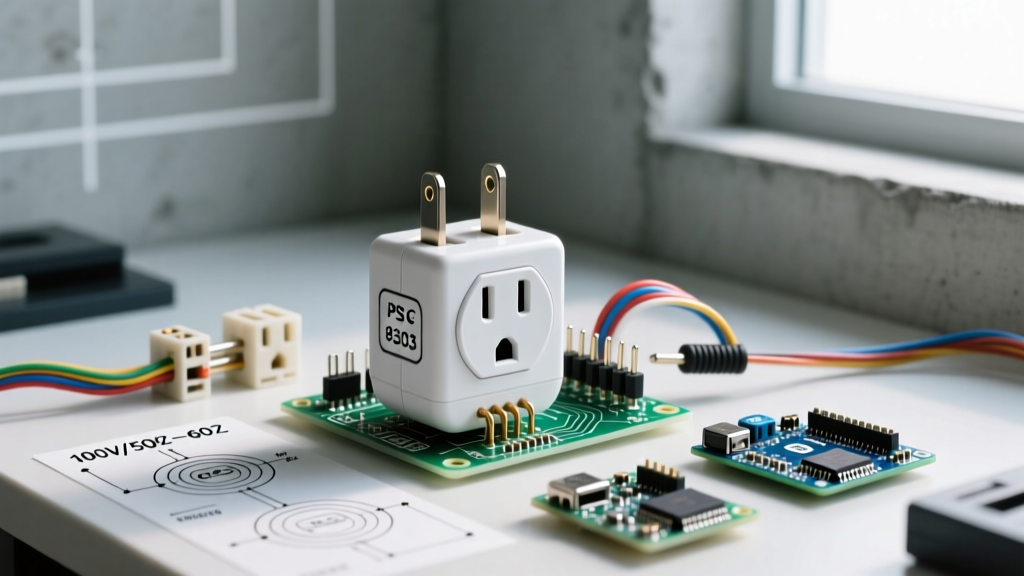
At first glance, the standard japan electrical outlet plug appears identical to the North American NEMA 1-15 ungrounded plug. Both feature two flat, parallel pins. However, treating Japanese electrical components as direct equivalents to US standards is a critical code violation that can lead to failed inspections, fire hazards, and severe legal penalties under Japanese law. Japan operates on a unique 100V grid with a bifurcated frequency system (50Hz in the East, 60Hz in the West), and its receptacles and plugs are strictly governed by the Japanese Industrial Standards (JIS) and the Electrical Appliance and Material Safety Act.
For electrical engineers, importers, and DIY enthusiasts working on international projects or importing Japanese machinery, understanding the precise code requirements of JIS C 8303 (the standard for plugs and receptacles) and the mandatory PSE marking is non-negotiable. This guide breaks down the exact dimensional tolerances, safety mandates, and installation codes that define Japan's electrical infrastructure in 2026.
The Regulatory Backbone: PSE Marking and the Denki Yōhin Anzen Hō
Unlike the United States, where UL or ETL listings are widely accepted by the NEC (National Electrical Code) as proof of safety testing, Japan enforces a strict, government-mandated certification system. The Ministry of Economy, Trade and Industry (METI) oversees the Electrical Appliance and Material Safety Act (Denki Yōhin Anzen Hō). Under this law, no electrical plug, receptacle, or wiring device can be legally sold or installed in Japan without the appropriate PSE (Product Safety Electrical Appliances and Materials) mark.
Code Mandate: The PSE mark is not a voluntary industry certification; it is a statutory requirement. Importers and manufacturers must hold a valid conformity assessment from a Registered Conformity Assessment Body (RCAB) before affixing the mark. Selling unmarked receptacles carries severe fines and potential imprisonment.
Diamond vs. Round PSE Marks
- Diamond PSE (Tokutei Denki Yōhin): Reserved for "Special Specified Electrical Appliances and Materials" that pose a higher risk of shock or fire. This includes specific high-voltage industrial receptacles and certain heavy-duty wiring components.
- Round PSE (Tokutei Igai): Applies to standard residential and commercial plugs, receptacles (like the ubiquitous Panasonic WN1302 duplex receptacle), and extension cords. These require self-verification and testing by the manufacturer or importer against JIS standards, followed by record-keeping subject to METI audits.
JIS C 8303 vs. NEMA 1-15: Dimensional and Safety Tolerances
While a US-manufactured NEMA 1-15 plug will physically fit into a Japanese JIS C 8303 receptacle, the reverse is not always true, and more importantly, the internal safety tolerances differ significantly. According to the International Electrotechnical Commission (IEC), Japan utilizes the Type A plug system, but JIS C 8303 imposes stricter mechanical and thermal testing than older NEMA standards.
| Specification | Japan (JIS C 8303) | North America (NEMA 1-15 / WD-6) |
|---|---|---|
| Blade Dimensions | 1.5mm thick × 6.3mm wide × 15-18mm long | 0.060" (1.52mm) thick × 0.250" (6.35mm) wide |
| Pin Insulation Sleeves | Mandatory on new manufacturing (prevents shock from partially inserted plugs) | Optional / Rare on standard residential plugs |
| Pull-Out Force Test | Strict minimum/maximum Newton (N) thresholds to prevent arcing from loose contacts | UL standard pull-force testing (less stringent on maximum retention) |
| Thermal / Glow Wire | 650°C glow wire test mandatory for receptacle faceplates | Varying UL flammability ratings (typically 850°C for specific enclosures) |
| Voltage Rating | 125V AC (Operated at 100V nominal) | 125V AC (Operated at 120V nominal) |
The Insulation Sleeve Requirement
One of the most critical code differences introduced in recent JIS revisions is the requirement for partial insulation sleeves on the blades of the plug. If a plug is partially pulled out of a Japanese receptacle, exposing the metal prongs, the insulation sleeve prevents a user (or a child) from touching the live metal while it is still energized. Standard US NEMA plugs lack this sleeve, making them technically non-compliant for sale as replacement plugs on Japanese consumer appliances, even if they fit the outlet.
The Grounding Dilemma: 2-Pin Plugs and the "Earth" Terminal
Perhaps the most confusing aspect of Japanese electrical wiring for foreign electricians is the approach to equipment grounding. In North America, the NEC mandates a 3-prong plug (NEMA 5-15) for almost all modern appliances, integrating the ground pin directly into the plug head.
In Japan, standard residential wall outlets remain overwhelmingly ungrounded 2-pin JIS receptacles. However, Japanese electrical codes strictly require grounding for appliances used in wet locations (kitchens, bathrooms, washing machines) or high-draw devices (microwaves, air conditioners). How is this achieved without a third prong?
The "Earth" (アース) Screw Terminal
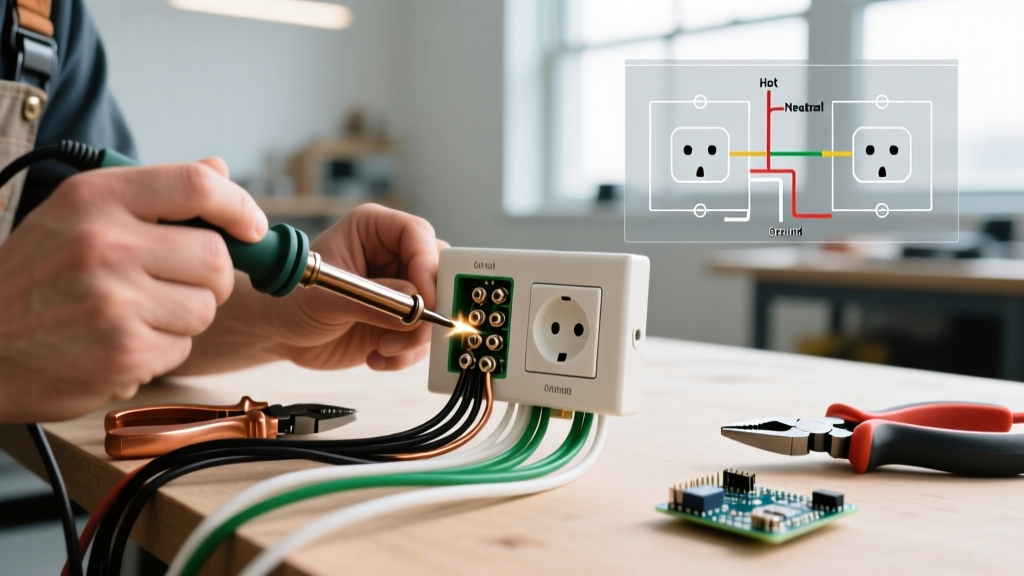
Japanese receptacles designed for wet areas feature a separate, dedicated grounding screw terminal on the faceplate, usually covered by a small green plastic cap and labeled "Earth" or "アース". The wiring workflow is as follows:
- The appliance features a standard 2-pin JIS plug.
- A separate, insulated green grounding wire exits the appliance cord jacket.
- The user or electrician strips the green wire, wraps it around the "Earth" screw on the receptacle faceplate, and tightens it down.
- The 2-pin plug is then inserted into the live/neutral slots.
Note: While 3-prong grounded receptacles (identical to NEMA 5-15) are becoming more common in modern Japanese commercial builds and high-end residential projects (using models like the Panasonic WN1318 Hospital Grade receptacle, priced around ¥1,500 or $10 USD), the 2-pin + Earth screw method remains the dominant code-compliant standard for residential retrofits and standard appliance wiring.
Frequency Divides: 50Hz East vs. 60Hz West
Japan is one of the only countries in the world with a split national grid frequency. The divide runs roughly along the Fuji River and the Itoigawa-Shizuoka Tectonic Line.
- Eastern Japan (Tokyo, Yokohama, Tohoku, Hokkaido): 100V / 50Hz (Historically influenced by German AEG generators).
- Western Japan (Osaka, Kyoto, Nagoya, Kyushu): 100V / 60Hz (Historically influenced by American GE generators).
Code Implications for Appliances and Outlets
While the physical outlet and plug do not change across this border, the appliances plugged into them do. Under the PSE certification process, motor-driven appliances (like older washing machines or industrial fans) must be tested and labeled for the specific frequency of their destination market. Plugging a 50Hz-rated motor into a 60Hz outlet in Osaka will cause the motor to run 20% faster, leading to overheating, bearing failure, and potential fire.
In 2026, the vast majority of modern Japanese appliances (Daikin air conditioners, Panasonic inverter microwaves) utilize high-frequency inverter drives that automatically rectify the 50/60Hz AC into DC before driving the motor, making them "50/60Hz Common" (ヘルツフリー). However, electrical inspectors still require strict adherence to frequency labeling on the appliance nameplate and the corresponding circuit breaker scheduling.
Installation & Import Compliance Checklist (2026 Standards)
If you are sourcing Japanese receptacles for international export, or importing appliances into Japan, follow this compliance matrix to ensure adherence to the Denki Yōhin Anzen Hō and NEMA/JIS cross-compatibility standards.
| Task | Code Requirement / Action | Estimated Cost / Timeframe |
|---|---|---|
| PSE Certification | Submit receptacle samples to an RCAB for JIS C 8303 thermal and mechanical testing. | ¥300,000 - ¥800,000 ($2,000 - $5,500 USD); 8-12 weeks. |
| Plug Modification | Add partial insulation sleeves to NEMA 1-15 plugs if exporting consumer goods to Japan. | $0.15 - $0.30 per plug tooling adjustment. |
| Earth Terminal Install | Install grounded JIS receptacles (with Earth screw) in all kitchen/bathroom circuits. | ¥800 - ¥1,500 per receptacle (Panasonic/MELON brands). |
| Voltage Drop Testing | Ensure branch circuits maintain 100V ±6V at the furthest receptacle under full load. | Standard electrician multimeter testing; 1 hour per circuit. |
Frequently Asked Questions
Can I use a US NEMA 5-15 plug in a Japanese outlet?
Physically, a 3-prong US plug will not fit into a standard 2-pin Japanese residential receptacle. You would need an adapter or a receptacle upgrade. Furthermore, US appliances designed for 120V will run slightly under-voltage on Japan's 100V grid. While resistive loads (heaters) will just produce less heat, motorized or electronic loads may experience premature failure or trigger undervoltage protection circuits.
Are Japanese outlets polarized?
Historically, standard Japanese 2-pin receptacles were unpolarized (both slots identical). However, modern JIS C 8303 codes and newer receptacle designs (like the Panasonic Full Color series) increasingly feature polarization—one slot is slightly wider (neutral) and one is narrower (hot), mirroring the NEMA 1-15P polarized plug design to ensure single-pole switches interrupt the hot conductor.
What is the standard breaker size for a Japanese residential outlet circuit?
Standard residential receptacle circuits in Japan are typically protected by a 20A Miniature Circuit Breaker (MCB) at the distribution board (分電盤 - bundenban). The wiring is usually 2.0mm diameter VVF (Vinyl Insulated Vinyl Sheathed Flat) cable or 14 AWG equivalent, strictly regulated by the Inner Wiring Regulations (Naisen Kitei).