
Understanding the Iceland Electrical Outlet Standard
Iceland operates on a 230V, 50Hz electrical grid, utilizing the Type F (CEE 7/3) 'Schuko' outlet standard. Whether you are wiring a new summer cabin in Akureyri, upgrading a Reykjavik workshop, or installing a dedicated 240V European circuit in North America for imported appliances (like a La Marzocco espresso machine or Festool dust extractor), proper installation of an Iceland electrical outlet requires strict adherence to IEC 60884 standards. Unlike North American NEMA receptacles, the Schuko system relies on lateral grounding clips and deep wall cavities, demanding specific preparation and termination techniques.
| Specification | Iceland / Type F Standard |
|---|---|
| Standard Designation | CEE 7/3 (Type F / Schuko) |
| Nominal Voltage | 230V AC |
| Frequency | 50Hz |
| Current Rating | 16A (Standard Residential) |
| Grounding Mechanism | Dual lateral earth clips |
| Standard Wire Size | 2.5mm² (Copper, solid core) |
Essential Tools and 2026 Material Sourcing
To ensure a code-compliant and safe installation, avoid generic hardware store receptacles. As of 2026, premium European-specification components are readily available globally. Expect to spend between $18 and $35 USD for a high-quality Schuko receptacle, and $65 to $90 for a compliant RCD breaker.
- Receptacle: Schneider Electric Altira or Legrand Valena Life Type F Schuko (features robust ceramic or high-grade thermoplastic internals).
- Circuit Protection: Hager MCN116E 16A Curve C MCB paired with a 30mA Type A RCD (Residual Current Device).
- Wiring: 2.5mm² H07V-U solid copper wire (Brown, Blue, Green/Yellow).
- Wall Box: Minimum 45mm deep, ideally 60mm deep European-standard flush-mounted box.
- Tools: Calibrated torque screwdriver, precision wire strippers (set to 12mm), and a Fluke 1663 FC multifunction loop tester.
Step-by-Step Installation Guide
Step 1: Circuit Breaker and RCD Selection
In Iceland, the Building Authority (Mannvirkjastofnun) mandates strict residual current protection for all general-use socket circuits. You must use a 30mA Type A RCD. Do not use older Type AC RCDs; Type A is required to safely detect and trip on pulsating DC fault currents generated by modern appliance power supplies and inverter-driven compressors. Pair this with a 16A Curve C Miniature Circuit Breaker (MCB) to handle the initial inrush current of heavy appliances without nuisance tripping.
Step 2: Preparing the Wall Box and Cable
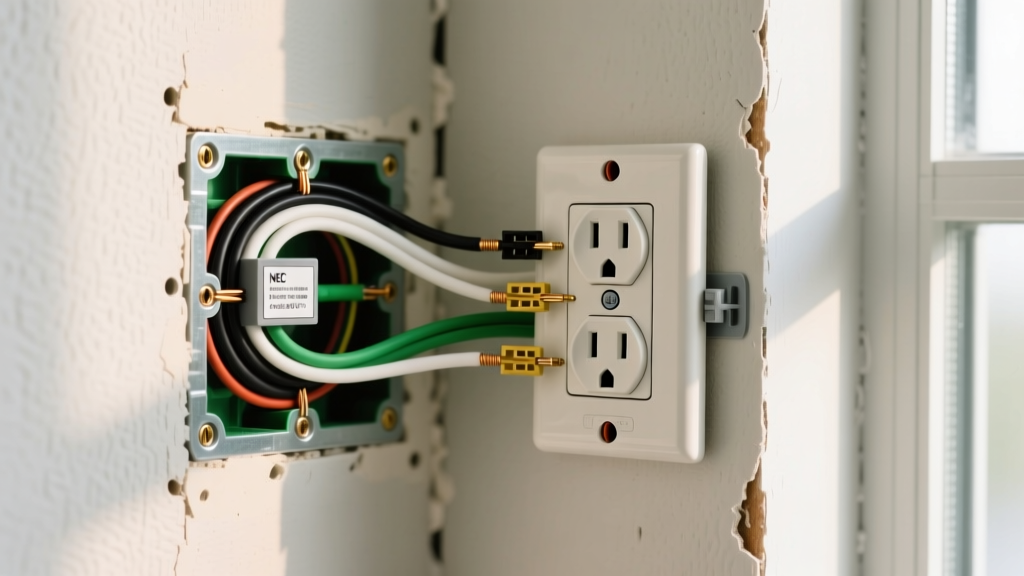
The most common failure point in Type F installations is insufficient wall box depth. The rear chassis of a Schuko outlet protrudes significantly further than a NEMA 5-15 receptacle. If your wall box is shallower than 45mm, the grounding clips will crush the 2.5mm² wires against the backplate, causing insulation failure and short circuits.
- Strip the outer PVC sheath of the 2.5mm² cable, leaving enough slack to form a smooth 'S' curve inside the box.
- Strip exactly 12mm of insulation from the Brown (Line), Blue (Neutral), and Green/Yellow (Earth) conductors. Exposed copper beyond the terminal collar is a severe shock hazard.
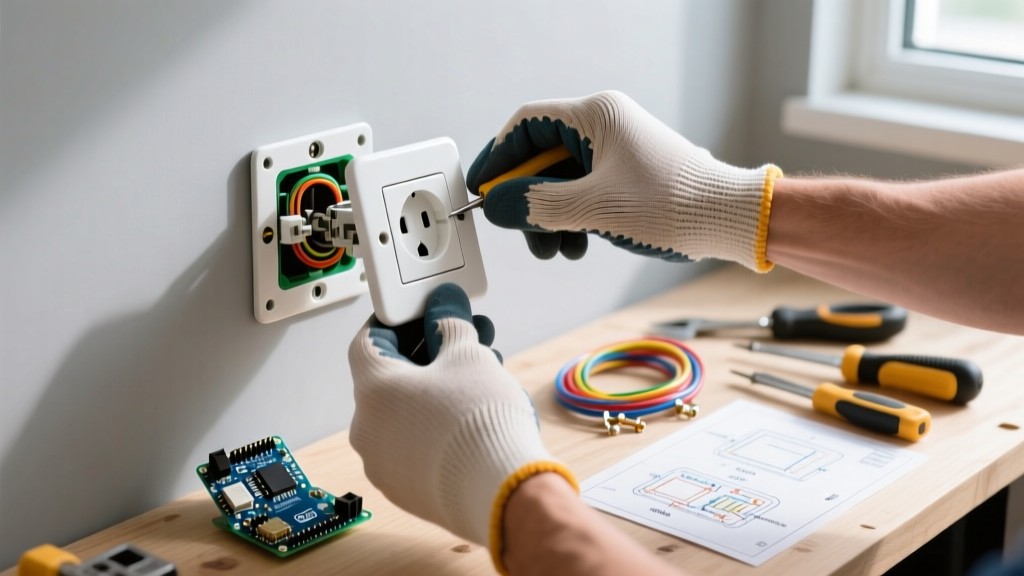
Step 3: Terminating the Type F Schuko Receptacle
While the Type F plug is technically unpolarized (it can be inserted upside down), modern European wiring conventions and Icelandic best practices dictate a specific orientation for consistency and troubleshooting.
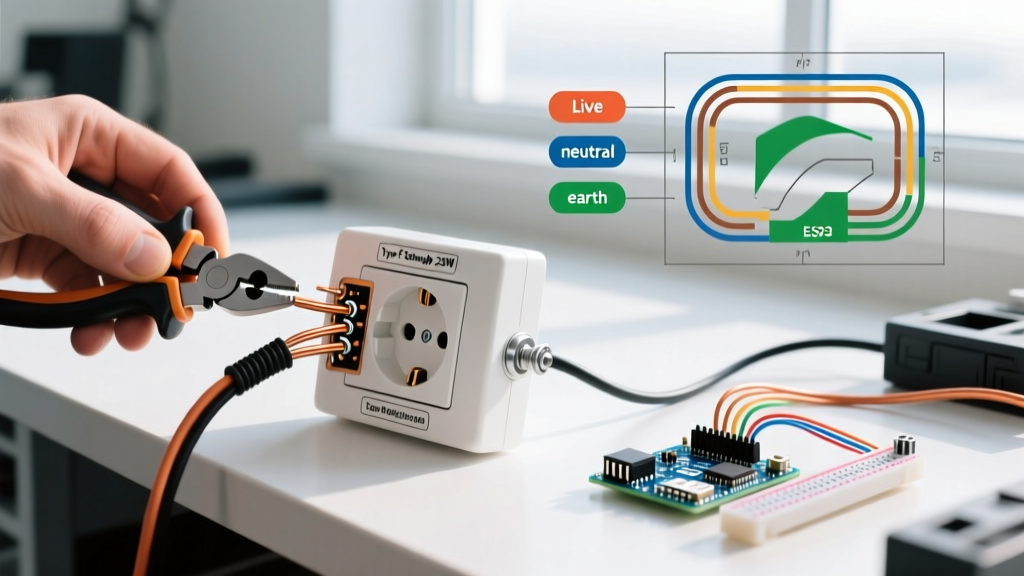
- Line (L): Connect the Brown wire to the left terminal (when facing the socket).
- Neutral (N): Connect the Blue wire to the right terminal.
- Earth (PE): Connect the Green/Yellow wire to the central earth terminal block.
Using your calibrated torque screwdriver, tighten the terminal screws to exactly 0.8 Nm. Under-torquing leads to high-resistance connections and thermal melting; over-torquing can shear the brass screw heads or crush the solid copper core, reducing the wire's ampacity.
Step 4: Earth Loop Impedance Testing
Before energizing the circuit, you must verify the earth loop impedance (Zs). According to the IEC world plugs guide and local adaptations, the impedance must be low enough to allow the 16A MCB to trip within 0.4 seconds during a dead short. For a 16A Type C breaker, the maximum permissible Zs is typically around 1.44 ohms (depending on local voltage tolerances). Use your multifunction tester to inject a test current and verify the reading.
Critical Safety Warning: Never bypass the lateral grounding clips on a Type F receptacle to fit it into a shallow box. The Schuko system relies entirely on these clips for equipment grounding. If they are compromised, a fault in a metal-chassis appliance (like a washing machine) will energize the chassis to 230V, posing a lethal hazard.
Critical Edge Case: 60Hz Grids and Imported Appliances
Many DIYers in North America install an Iceland electrical outlet (Type F) on a 240V split-phase circuit to power imported European tools or espresso machines. While the voltage (240V) is perfectly compatible with 230V European appliances (which typically tolerate ±10%), the frequency (60Hz vs 50Hz) is a major edge case.
If you are wiring this outlet in a 60Hz region, be aware that AC synchronous motors (found in some turntables, timers, and older pumps) will run 20% faster, potentially causing mechanical failure or timing inaccuracies. Furthermore, universal motors and resistive heating elements (like in espresso boilers) will operate perfectly fine. Always check the appliance's data plate for a '50/60Hz' rating before energizing it on a North American grid.
Frequently Asked Questions
What is the difference between Type F and Type E outlets?
While both are common in Europe, the Iceland electrical outlet is strictly Type F (CEE 7/3), which uses two lateral grounding clips on the edges of the socket. Type E (used in France and Belgium) features a protruding male earth pin on the socket face. Modern 'hybrid' Schuko plugs (CEE 7/7) are designed to mate with both, but the receptacles themselves are physically different and not interchangeable.
Can I use Wago lever nuts inside the Type F wall box?
Yes, Wago 221 series lever connectors are fully rated for 2.5mm² solid and stranded wire up to 32A. However, because Type F receptacles are bulky, using Wagos requires a deep wall box (60mm+). If space is tight, use traditional ceramic terminal blocks or push-in wire connectors specifically rated for European 230V standards, as detailed by World Standards.
Do I need a dedicated circuit for an Iceland Type F outlet?
In a standard European/Icelandic ring or radial circuit, multiple 16A sockets can share a single 16A or 20A breaker protected by a 30mA RCD. However, if you are installing this outlet in North America specifically for a high-draw European appliance (e.g., a 2000W+ heater or commercial espresso machine), it must be installed as a dedicated 20A or 30A 240V radial circuit with its own double-pole breaker.