
The Anatomy of Outlet Fasteners: Why Size Matters
When you are midway through a wiring project and drop a crucial fastener into the wall cavity, the immediate question is: what size are electrical outlet screws? A trip to the hardware store reveals thousands of options, but electrical devices adhere to strict dimensional standards governed by the National Electrical Manufacturers Association (NEMA). Using the wrong thread pitch, diameter, or length is not just an aesthetic failure; it can lead to loose connections, arcing, stripped mounting yokes, and severe fire hazards.
Standard 15-amp and 20-amp receptacles (like the Leviton T5262 or Hubbell 5262 series) utilize a unified sizing system. However, the screw that holds the copper wire is vastly different from the screw that mounts the device to the junction box. This guide breaks down the exact metallurgy, thread counts, and lengths required for every screw on a standard electrical outlet.
Quick Reference Matrix: Outlet Screw Specifications
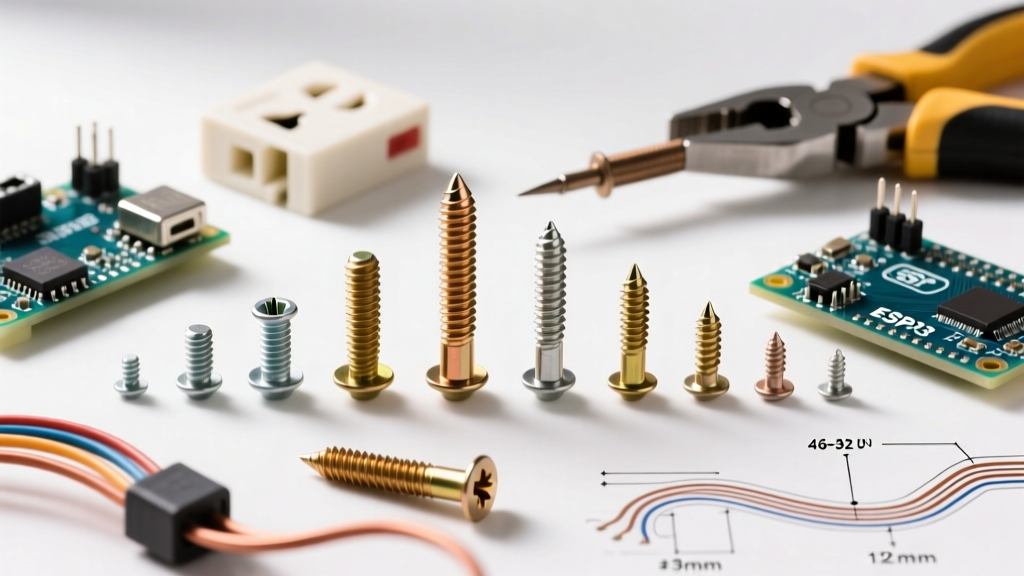
| Application | Thread Size | TPI (Threads Per Inch) | Typical Length | Head Style | Material / Finish |
|---|---|---|---|---|---|
| Terminal (Hot/Neutral) | #6-32 UNC | 32 | 0.25" - 0.35" | Slotted / Phillips / Combo | Brass (Hot) / Nickel-Plated (Neutral) |
| Yoke / Mounting | #6-32 UNC | 32 | 3/4" to 1-1/2" | Fillister / Pan Head | Zinc-Plated Steel |
| Cover Plate | #6-32 UNC | 32 | 5/16" to 1/2" | Oval / Flat Head | Zinc-Plated / Painted |
| Ground (Metal Box) | #10-32 UNC | 32 | 3/8" to 1/2" | Hex Head | Green Zinc-Plated Steel |
Terminal Screws: The #6-32 UNC Standard
The terminal screws are the brass and silver screws located on the sides of the receptacle where your hot and neutral wires terminate. Almost universally, standard residential and commercial 15A and 20A outlets use a #6-32 UNC (Unified National Coarse) screw.
Why Coarse Thread (UNC)?
Electrical terminals utilize coarse threading (32 threads per inch for a #6 gauge) rather than fine threading (UNF). Coarse threads are less likely to cross-thread when driven into the relatively soft brass or steel terminal plates. Furthermore, according to The Engineering Toolbox, coarse threads offer superior resistance to vibration loosening and provide higher pull-out strength in softer metals, which is critical for maintaining low-resistance electrical connections over decades of thermal cycling.
Torque Specifications and Safety
Under the National Electrical Code (NEC) Article 110.14(D), terminations must be torqued to the manufacturer's specifications. For a standard #6-32 terminal screw on a 15A or 20A receptacle, the required torque is typically 14 in-lbs (inch-pounds). Using a calibrated torque screwdriver, such as the Klein Tools 60175, ensures the wire is clamped tightly without stripping the brass threads or snapping the screw head.
Yoke and Mounting Screws: Length Variations
The mounting screws pass through the plaster ears (yoke) of the outlet and thread directly into the junction box. These also use a #6-32 UNC thread. However, the length of these screws varies dramatically based on your wall construction and box type.
- Standard Metal or Plastic Boxes (Flush): The included 3/4" screws are usually perfect.
- 1/2" Drywall with Mud Rings: You will typically need 1" or 1-1/4" screws to reach the threaded holes in the metal mud ring.
- Tile or Thick Plaster: You may require 1-1/2" to 2" screws. Brands like Leviton sell specialized extra-long mounting screws (e.g., Leviton 0201-000) for these exact scenarios.
CRITICAL WARNING: Never force a screw that feels like it is binding before the outlet is flush. If a screw bottoms out inside the junction box hole before the yoke is tight, the outlet will bow outward. When you tighten the cover plate, this tension will crack the plastic plate or warp the internal contacts of the receptacle.
Cover Plate Screws: Aesthetics and Fit
Cover plate screws are also #6-32 UNC, but they are much shorter, typically ranging from 5/16" to 1/2" in length. They feature an oval or flat head designed to sit flush with or slightly recessed into the countersunk holes of the plastic or metal faceplate.
While it is tempting to use a leftover 3/4" mounting screw to hold a cover plate, doing so will cause the screw to bottom out against the internal wiring or the back of the junction box. This creates a dangerous pinch point that can slice into the insulation of a hot wire, energizing the metal cover plate and creating a lethal shock hazard.
Grounding Screws: The #10-32 NEC Mandate
When grounding a metal junction box, you cannot simply use any green screw. The National Fire Protection Association (NFPA) outlines in NEC Article 250.148 that grounding screws used in metal boxes must have a minimum thread size of #10-32.
These screws are easily identifiable by their bright green hexagonal heads. The #10 gauge provides the necessary mechanical strength to maintain a solid ground fault path, while the 32 TPI ensures it mates perfectly with the pre-tapped holes in standard steel boxes. Never use a self-tapping sheet metal screw for grounding unless it is specifically listed for the purpose and meets the thread engagement requirements of the box manufacturer.
Troubleshooting: Stripped Threads and Oversized Taps
A common frustration in older homes or heavily used commercial spaces is a stripped #6-32 threaded hole in a metal junction box. If the mounting yoke won't tighten, do not jam a larger screw into the hole by brute force, as this can crack the box or damage internal wires.
The Professional Fix: Re-Tapping
- Remove the receptacle and ensure all power is off.
- Use a #8-32 tap (such as the Greenlee 7238) to carefully cut new, slightly larger threads into the stripped #6 hole.
- Clean out the metal shavings with a shop vac.
- Install the outlet using an oversized #8-32 mounting screw. This restores full mechanical integrity and meets code requirements for device mounting.
Essential Tools for Outlet Screw Management
Having the right screws is only half the battle. To work efficiently and safely, your tool pouch should include:
- Robertson (Square) #2 Screwdriver: Many modern commercial outlets (like Pass & Seymour spec-grade) use square-drive terminal screws to prevent cam-out and allow for higher torque application.
- Phillips #2 and Slotted 1/4": Essential for standard residential cover plates and older terminal designs.
- 1/4" Nut Driver: The exact size needed for driving #10-32 green hex ground screws quickly.
- Thread-Cutting Screws: Keep a few #6-32 and #8-32 thread-cutting screws in your pouch. These have a specialized tip that can clean out paint-clogged or slightly damaged threads in metal boxes without requiring a separate tap tool.
Frequently Asked Questions
Can I use drywall screws to mount an outlet?
No. Drywall screws are made of brittle, hardened steel. Under the thermal stress of an electrical fault or the mechanical stress of a heavy plug being pulled from the socket, drywall screws can snap (shear) catastrophically. Always use zinc-plated steel machine screws designed for electrical yokes.
What size are the screws on a GFCI outlet?
GFCI outlets (like the Leviton GFNT1) use the exact same #6-32 UNC terminal and mounting screws as standard receptacles. The physical footprint and yoke dimensions are standardized across the industry to ensure compatibility with standard junction boxes and cover plates.
Why are some terminal screws brass and others silver?
The brass screw is for the HOT wire (usually black or red), and the silver screw is for the NEUTRAL wire (usually white). This color coding is mandated by UL and NEMA standards to prevent reverse polarity, which can leave appliances energized even when switched off.