
Understanding the German Electrical Outlet (Type F / Schuko)
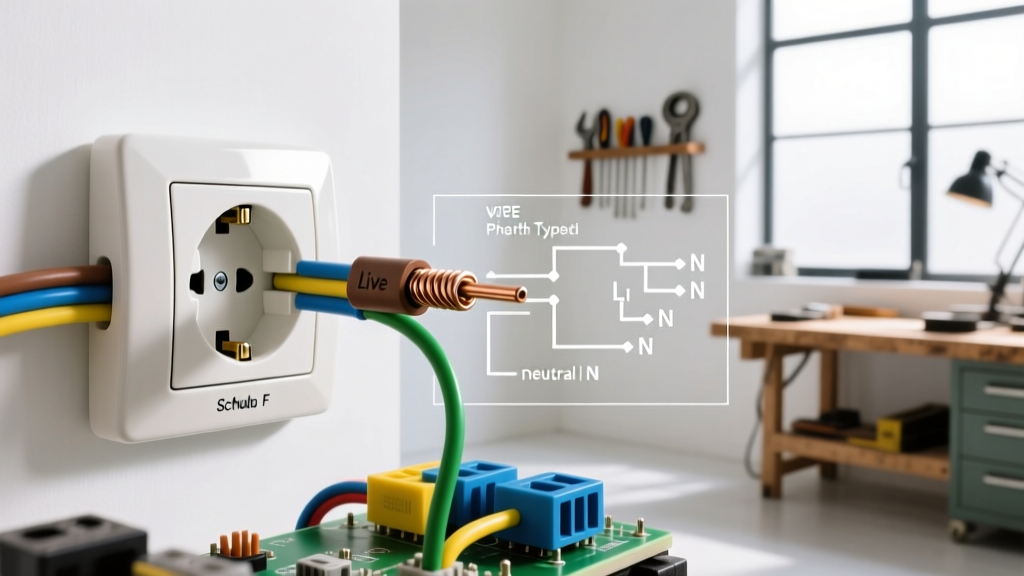
The german electrical outlet, globally recognized as the Type F or "Schuko" (short for Schutzkontakt, meaning protective contact) receptacle, is a cornerstone of European electrical infrastructure. Governed by the CEE 7/3 standard for sockets and CEE 7/4 for plugs, this system delivers 230V AC at 50Hz with a nominal current rating of 16A. Unlike the NEMA 1-15 or NEMA 5-15 standards used in North America, the Schuko system relies on two lateral grounding clips rather than a dedicated third grounding pin. This design ensures that the protective earth (PE) connection is established before the live (L) and neutral (N) pins make contact during insertion, a critical safety mechanism that prevents shock hazards from faulty appliances.
For electricians, DIYers, and facility managers working within Germany or exporting equipment to the DACH region, understanding the stringent safety codes surrounding these receptacles is non-negotiable. The IEC World Plugs Guide classifies Type F as one of the most robust domestic plug systems globally, but its safety is entirely dependent on correct installation and strict adherence to local DIN/VDE regulations.
Mandatory VDE Code Compliance & DIN Standards
In Germany, electrical installations are not merely guided by best practices; they are strictly regulated by the VDE (Verband der Elektrotechnik) standards. When installing or modifying a german electrical outlet, two primary standards dictate compliance:
- DIN VDE 0620-1: This standard specifies the exact mechanical dimensions, temperature rise limits, and endurance requirements for plugs and socket-outlets. It mandates that the socket must withstand 10,000 insertion/withdrawal cycles without compromising the grip force of the grounding clips.
- DIN VDE 0100 (Series): This is the bible for low-voltage electrical installations. Specifically, Part 410 (Protection against electric shock) and Part 520 (Selection and erection of wiring systems) dictate how the outlet must be integrated into the broader circuit.
Safety Warning: Under German law, any electrical work connected to the public grid must be performed or supervised by a certified electrician registered with the local grid operator. Unauthorized modifications that violate DIN VDE standards can void property insurance and result in criminal liability in the event of a fire or injury. Always consult the VDE Association for the latest regulatory updates.
Wiring Color Codes & Terminal Specifications
Germany utilizes the harmonized European HD 308 S2 color code standard. Miswiring a Schuko receptacle is a leading cause of RCD (Residual Current Device) nuisance tripping and severe shock hazards. Below is the definitive terminal mapping for a standard 16A Schuko outlet:
| Terminal Marking | Function | Wire Color (EU/Germany) | Strip Length | Torque Specification |
|---|---|---|---|---|
| L | Line (Phase) | Brown | 12 mm - 14 mm | 0.8 Nm - 1.2 Nm |
| N | Neutral | Blue | 12 mm - 14 mm | 0.8 Nm - 1.2 Nm |
| PE / ⏚ | Protective Earth | Green / Yellow | 14 mm - 16 mm | 0.8 Nm - 1.2 Nm |
Expert Tip: The PE wire should always be cut slightly longer than the L and N conductors. This ensures that if the cable is accidentally yanked from the wall, the grounding connection is the last to break, maintaining a safe discharge path for as long as possible.
Step-by-Step Installation & Mechanical Mounting
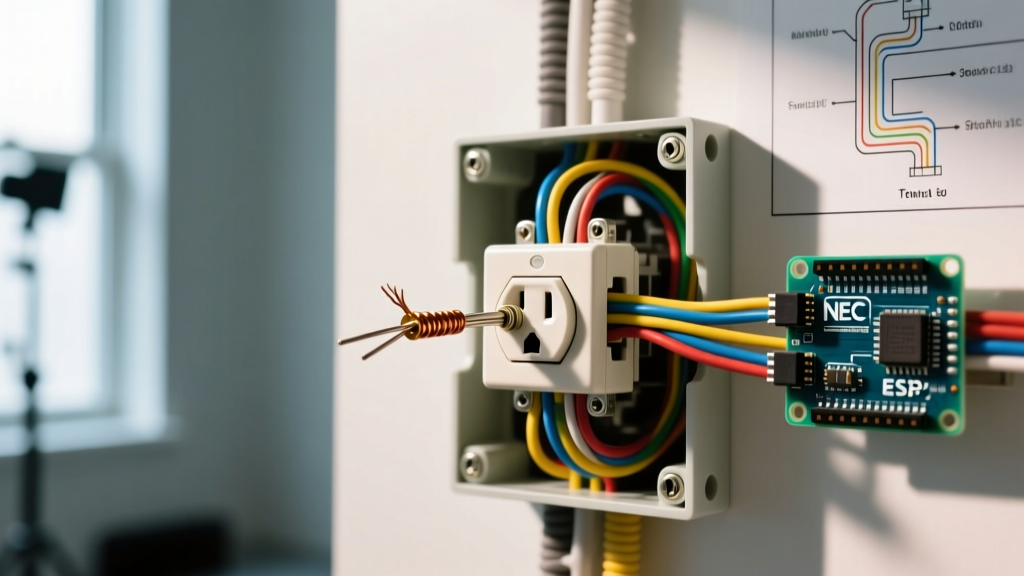
Modern german electrical outlets are installed in flush-mounted junction boxes (Unterputzdosen). The standard cavity depth required by DIN 49073 is 60mm, though 47mm shallow boxes are sometimes found in older concrete walls. When upgrading circuits in 2026, always verify the box depth to accommodate the bulk of modern WAGO connectors and the outlet's rear housing.
1. Preparation and Stripping
Use a calibrated automatic wire stripper (e.g., Knipex MultiStrip 10) to remove the outer sheath, leaving exactly 12-14mm of bare copper for the screw terminals. Never tin the copper wires with solder before inserting them into screw terminals; solder creeps under pressure over time, leading to a loose connection, arcing, and potential fires.
2. Securing the Receptacle
While traditional claw mounting (Krallenbefestigung) is still technically permitted in older plaster walls, modern code compliance and best practices heavily favor direct screw mounting to the junction box. Premium brands like Gira (System 55), Jung (AS 500), and Busch-Jaeger provide dual screw-mounting holes. Use M3.5 x 25mm screws and tighten to a maximum of 0.8 Nm to prevent cracking the polycarbonate mounting ring.
3. Child Safety Shutters
According to current interpretations of DIN VDE 0100, integrated child safety shutters (erhöhter Berührungsschutz) are mandatory for all new socket installations in areas accessible to children. Ensure the replacement outlet features a certified, factory-integrated shutter mechanism rather than relying on aftermarket plastic plug inserts, which are now widely considered a choking hazard and a fire risk.
RCD (FI-Schalter) Mandates for Socket Circuits
A german electrical outlet is only as safe as the protective devices upstream. DIN VDE 0100-410 strictly requires that all socket outlets rated up to 32A, which are intended for use by ordinary persons, must be protected by an RCD (known locally as an FI-Schalter) with a tripping threshold of no more than 30mA.
However, the type of RCD has evolved. While Type A RCDs were the standard for decades, the proliferation of modern electronics, frequency converters, and EV chargers has necessitated upgrades:
- Type A: Detects pulsating DC and AC fault currents. (Minimum baseline for general lighting and basic appliance sockets).
- Type F: Designed to handle composite fault currents from modern single-phase appliances with variable speed drives (e.g., modern washing machines, heat pumps). Highly recommended for kitchen and utility room circuits.
- Type B: Mandatory for circuits dedicated to three-phase EV charging stations or medical equipment, as it can detect smooth DC fault currents that would blind a Type A or F RCD.
The EV Charging Dilemma: Thermal Monitoring Sockets
One of the most critical edge cases in modern German electrical compliance involves charging Electric Vehicles (EVs) via a standard 16A Schuko socket. Drawing a continuous 16A load (approx. 3.6 kW) for 8 to 12 hours pushes standard residential outlets to their absolute thermal limits. Standard outlets are tested for intermittent loads; continuous high-draw scenarios can cause the internal brass contacts to anneal, lose tension, and overheat, leading to melted faceplates.
To mitigate this, the European Committee for Electrotechnical Standardization (CENELEC) and local German regulators now recommend or require the use of specialized heavy-duty Schuko sockets for EV charging areas (like garages or carports). Models such as the Gira Schuko Steckdose mit integriertem Temperaturmonitor feature internal NTC thermistors. If the internal temperature exceeds 90°C due to contact resistance or ambient heat, the socket communicates via a control pilot wire to the EV charger to reduce the charging current or halt the session entirely, preventing a structural fire.
Advanced Troubleshooting & Edge Cases
When testing a newly installed or suspect german electrical outlet, a simple receptacle tester is insufficient. You must use a VDE 0701-0702 compliant installation tester (e.g., Gossen Metrawatt Profitest or Benning IT series) to verify the following parameters:
- Loop Impedance (Zs): Must be low enough to ensure the upstream MCB (Miniature Circuit Breaker) trips within the required time (usually < 0.4 seconds for a 16A Type B breaker). A high loop impedance indicates a poor connection somewhere in the PE path.
- RCD Trip Time: At 1x IΔn (30mA), the RCD must trip in under 300ms. At 5x IΔn (150mA), it must trip in under 40ms. Furthermore, you must test at both 0° and 180° phase angles to ensure the internal toroid transformer is not saturated or defective.
- Polarity Check: While Schuko plugs are reversible, the socket itself must be wired correctly (L on the left, N on the right is the unofficial convention, though strictly speaking, the VDE does not mandate left/right polarity for single-phase Schuko sockets because the plug can be inserted both ways. However, maintaining consistency across a facility is critical for troubleshooting).
Common Failure Mode: The "Bootleg" Ground
In older, unrenovated Altbau (historic) apartments, you may encounter a two-wire system (Classical Nulling or Klassische Nullung) where the N and PE terminals are bridged with a copper jumper wire inside the socket. This is highly dangerous and strictly prohibited in modern installations. If the neutral wire breaks upstream, the entire metal chassis of any plugged-in appliance will become energized at 230V. If you discover this, the circuit must be immediately decommissioned until a dedicated PE conductor can be pulled through the conduit, or the circuit must be protected by a specialized 2-wire RCD (though rewiring is the only code-compliant permanent fix).
Summary of Best Practices
Working with the german electrical outlet requires a meticulous approach to mechanical torque, wire preparation, and upstream protection. By adhering to DIN VDE 0620-1 for component selection, utilizing 60mm deep junction boxes, applying precise 0.8 Nm torque to screw terminals, and ensuring 30mA Type F RCD protection, you guarantee a system that is not only legally compliant but inherently safe for decades of continuous use. Always prioritize direct screw mounting and thermal-monitored receptacles for high-load applications to meet the rigorous demands of modern 2026 electrical consumption.