
The Critical Role of Box Sizing in Electrical Inspections
When conducting a rough-in or final electrical inspection, one of the most frequently cited violations involves the size of electrical outlet box installations. An undersized box is not merely a code technicality; it is a severe fire hazard. Overcrowded wires trap heat, degrade insulation, and create physical stress on terminal screws, leading to arcing and potential ignition. As an inspector or a meticulous DIYer preparing for a municipal review, understanding how to verify box fill calculations according to the National Electrical Code (NEC) is mandatory.
This inspection guide breaks down the exact methodologies for measuring, calculating, and verifying outlet box volumes, ensuring your installations meet the rigorous standards of the 2023 and upcoming 2026 NEC cycles. For authoritative code references, inspectors routinely consult the NFPA 70 National Electrical Code and technical bulletins from the International Association of Electrical Inspectors (IAEI).
The NEC Box Fill Calculation Framework
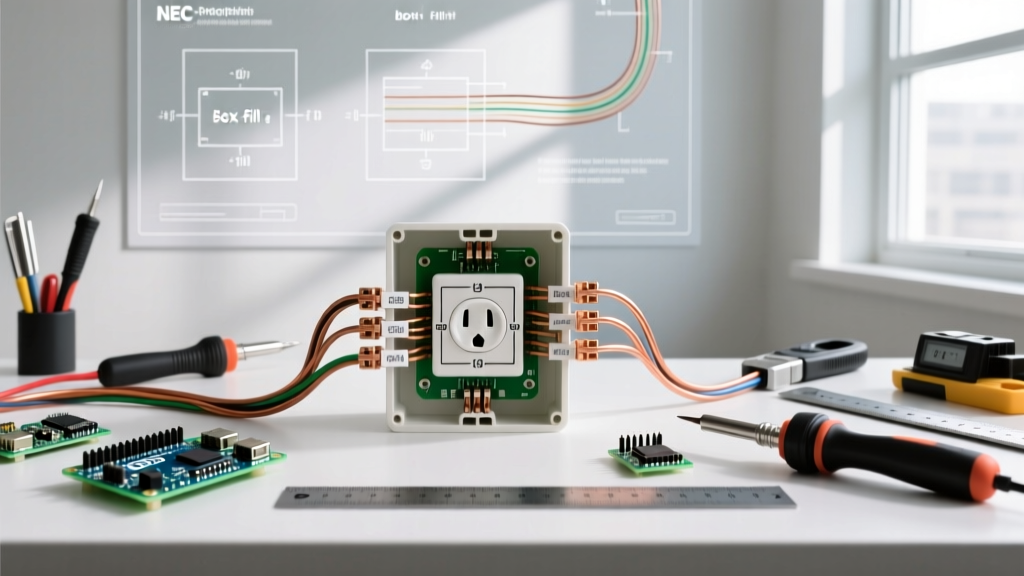
NEC Article 314.16 dictates the minimum volume requirements for outlet boxes. The core principle is simple: every wire, device, clamp, and grounding conductor inside the box consumes a specific volume allowance, measured in cubic inches (cu in). If the sum of these allowances exceeds the stamped volume of the box, the installation fails inspection.
Volume Allowances per Conductor
The multiplier applied to each conductor depends strictly on its American Wire Gauge (AWG). Below is the standard NEC Table 314.16(B) volume allowance chart used during field inspections:
| Conductor Size (AWG) | Volume Allowance per Conductor | Common Application |
|---|---|---|
| 14 AWG | 2.0 cu in | 15-Amp lighting and receptacle circuits |
| 12 AWG | 2.25 cu in | 20-Amp kitchen, bathroom, and general receptacles |
| 10 AWG | 2.5 cu in | 30-Amp dryer, water heater, and HVAC circuits |
| 8 AWG | 3.0 cu in | 40-Amp to 50-Amp heavy appliance feeds |
The Five Box Fill Multipliers
During an inspection, you must account for five distinct categories inside the box. Memorize this framework to perform rapid mental math on the job site:
- Current-Carrying Conductors: Each hot and neutral wire terminating or splicing in the box counts as one allowance. (Wires passing through without a splice count as one; wires originating and terminating inside count as one each).
- Equipment Grounding Conductors: All ground wires combined count as a single allowance based on the largest ground present.
- Internal Cable Clamps: All internal clamps combined count as a single allowance based on the largest conductor. (External NM-B Romex connectors do not count).
- Device Yokes (Switches/Receptacles): Each device (straps/yokes) counts as two allowances based on the largest wire connected to it.
- Isolated Ground Pigtails: If an isolated ground wire originates and terminates within the same box, it counts as an additional single allowance.
Real-World Inspection Scenario: The 12 AWG Pass-Through
To illustrate how easily inspectors catch violations, consider a standard single-gang outlet box on a 20-amp kitchen circuit. A single 12/2 NM-B cable enters the box, and another 12/2 NM-B cable leaves to feed the next receptacle. A standard duplex receptacle is installed, and the box features one internal plastic cable clamp.
The Inspector's Math:
- Hots & Neutrals: 4 wires (2 entering, 2 leaving) = 4 allowances
- Grounds: 2 bare copper wires = 1 allowance
- Clamps: 1 internal clamp = 1 allowance
- Device: 1 duplex receptacle = 2 allowances
- Total Allowances: 8
Because the largest wire is 12 AWG, we multiply the 8 allowances by 2.25 cu in. Total Required Volume = 18.0 cu in.
Inspection Verdict: A standard single-gang shallow box (typically 14.0 cu in, like the Carlon B114R) will FAIL this inspection. The installer must upgrade to a deep single-gang box (20.0 cu in, such as the Carlon B120R, retailing around $2.80) to achieve compliance.
Standard Outlet Box Dimensions and Capacities
When inspecting existing rough-ins or planning a retrofit, recognizing standard box sizes by sight and physical measurement is a core competency. Plastic non-metallic (NM) boxes are stamped with their cubic inch capacity on the interior back wall. Metal boxes require calculation based on dimensions (Length x Width x Depth) or referencing NEC Table 314.16(A).
Single-Gang Box Profiles
- Shallow (1.5" depth): Yields 12.0 to 14.0 cu in. Acceptable only for 14 AWG lighting circuits with a single cable and a toggle switch.
- Standard (2.0" depth): Yields 16.0 to 18.0 cu in. The baseline for most 14 AWG receptacle runs.
- Deep (2.25" to 2.5" depth): Yields 20.0 to 22.5 cu in. Mandatory for 12 AWG circuits, GFCI receptacles, and smart switches.
Multi-Gang and Specialty Boxes
Double-gang boxes typically range from 28.0 cu in to 34.0 cu in. However, inspectors frequently flag double-gang boxes housing two GFCI devices. A single GFCI receptacle (like the Leviton GFNT1) has a massive physical chassis that displaces significant air space, even if the raw wire count math passes. While the NEC calculates fill by wire volume, physical crowding that prevents the device yoke from seating flush against the drywall is grounds for rejection under NEC 110.12 (Mechanical Execution of Work).
Step-by-Step Inspection Protocol for Existing Boxes
When evaluating an existing installation during a remodel or service upgrade, follow this systematic testing and inspection protocol to verify the size of electrical outlet box compliance:
- Power Down and Verify: Shut off the breaker and confirm zero voltage using a CAT III or CAT IV non-contact voltage tester and a digital multimeter.
- Extract the Device: Remove the faceplate and unscrew the device. Gently pull the receptacle or switch out of the box without disconnecting the wires.
- Locate the Stamp: Shine a high-lumen inspection light into the box. Look for the raised cubic inch stamp (e.g., '18 CU IN') on the back or side wall. If painted over or obscured, measure the internal dimensions (L x W x D) and calculate manually.
- Count the Conductors: Physically trace and count every wire entering the box. Do not guess. Separate the grounds, hots, and neutrals visually.
- Check for Hidden Pigtails: Inspect the back of the box for wire nuts and pigtails. A common violation is finding a neutral pigtail added for a smart switch that was never factored into the original box fill calculation.
- Assess Physical Stress: If the wires are bent at extreme angles, or if the insulation shows compression marks from the device yoke, the box is functionally undersized, regardless of what the math says.
Common Box Fill Violations in the Smart Home Era
The proliferation of smart home technology has drastically increased box fill violations. Devices like the Lutron Caseta PD-6WCL dimmer or the GE Cync smart switch feature bulky rear heat sinks and require dedicated neutral pigtails.
Furthermore, AFCI/GFCI combination devices possess deep, blocky chassis designs. When installing a GFCI in a 2-gang bathroom vanity box alongside a standard switch, the physical displacement of the GFCI body often crushes the 12 AWG wires against the metal edges of an old-work box. Inspectors are increasingly citing NEC 300.14 (Length of Free Conductors at Outlets and Switch Points), which mandates at least 6 inches of free wire extending past the face of the box. In a shallow 14 cu in box housing a GFCI, achieving this 6-inch requirement without violating box fill is physically impossible.
Upgrading and Retrofitting Undersized Boxes
If your inspection reveals an undersized box, you must remediate before closing the wall. You have two primary paths:
1. Box Extenders (The Quick Fix)
For existing drywall where replacing the box would cause massive damage, use a listed box extender. The Arlington Industries BE1 (single-gang) or BE2 (double-gang) non-metallic extenders slip over the existing box and bolt to the drywall. While they do not technically increase the internal cubic inch rating stamped on the original box, they provide crucial physical relief for smart switches and GFCIs, satisfying the 'mechanical execution' requirements of inspectors. Cost: ~$2.50 per unit.
2. Full Box Replacement (The Code-Perfect Fix)
For open drywall (rough-in), rip out the shallow box. Upgrade to a Carlon B618R (18 cu in deep single-gang) or the Carlon SC200RR (2-gang 34 cu in). For metal stud commercial construction, upgrade to a 4-inch square, 2-1/8 inch deep metal box (21.0 cu in base) paired with a 1-gang plaster ring, which yields a massive 30+ cu in total volume, easily accommodating complex smart-switch wiring.
Frequently Asked Questions (Inspection Focus)
Do low-voltage wires (Cat6, Coax) count toward box fill?
No. NEC Article 314 box fill calculations apply strictly to power and lighting circuits (Class 1). Class 2 and Class 3 low-voltage data cables do not consume cubic inch allowances, provided they are separated from line-voltage wires by a physical barrier or listed divider.
What if the box is oversized?
There is no maximum limit to the size of electrical outlet box you can use. Oversized boxes are always code-compliant and make for cleaner, cooler, and easier-to-inspect terminations. The only limitation is physical fitment within the wall cavity and the availability of matching faceplates.
For ongoing education regarding code changes and inspection methodologies, professionals should regularly review technical guides provided by Mike Holt Enterprises, a premier resource for NEC training and electrical inspection standards.