
Navigating the Modern Garage Electrical Outlet Code
Upgrading a garage from a simple storage shed to a modern workshop or EV charging hub requires strict adherence to the National Electrical Code (NEC). The garage electrical outlet code has evolved significantly over recent cycles, culminating in stringent safety mandates for the 2026 code year. Whether you are finishing an older detached garage, adding a 240V EV charger, or simply replacing damaged receptacles, understanding these requirements is critical to passing inspection and preventing electrical fires.
According to the National Fire Protection Association (NFPA), garages present unique hazards due to the presence of flammable vapors (gasoline, solvents) and heavy, moisture-prone power tools. This guide breaks down the exact NEC articles, product specifications, and upgrade pathways you need to bring your garage into full compliance.
Core Spacing and Placement Mandates
Under NEC Article 210.52(G), the baseline requirement dictates that at least one receptacle outlet must be installed in each garage, and specifically, at least one receptacle outlet for each car space. However, modern electrical inspectors and practical usage demand more than the bare minimum.
The 'Usable Wall Space' Rule
While the NEC specifically calls out car spaces, local amendments often enforce the general 'usable wall space' rule (NEC 210.52(A)) in finished garages. This means no point along a continuous wall line 24 inches or wider should be more than 6 feet from a receptacle. For a standard two-car garage (typically 20x20 feet), this translates to a minimum of four to six 20-amp receptacles distributed across the walls.
- Height Requirements: Receptacles should be mounted at least 18 inches above the finished floor to prevent physical damage and keep them above minor water intrusion. For EV charging outlets, the U.S. Department of Energy recommends mounting the receptacle or hardwired unit at 48 inches for optimal accessibility and cord management.
- Dedicated Circuits: While general lighting and standard receptacles can share circuits, large appliances (deep freezers) and EV chargers must have dedicated circuits to prevent nuisance tripping.
The GFCI Expansion: A Critical Code Shift
The most significant hurdle for DIYers and seasoned electricians alike in recent code cycles is the expansion of Ground Fault Circuit Interrupter (GFCI) protection. Under NEC 210.8(A)(2) and (F), all 125-volt through 250-volt receptacles supplying single-phase, 15- to 50-ampere circuits in a garage now require GFCI protection.
Inspector Red Flag: Prior to 2020, only 125V, 15A and 20A receptacles required GFCI in garages. If you are installing a 30A RV outlet or a 50A NEMA 14-50 EV charger in 2026, a standard breaker will fail inspection. You must use a GFCI breaker or a GFCI-protected receptacle, which drastically changes your material budget.
Recommended GFCI Hardware
For standard 20A circuits, use a premium grade receptacle like the Leviton SmartLockPro 2091-W2 ($22-$28). It features a self-testing mechanism that automatically cuts power if the GFCI protection is compromised. For 240V/50A circuits, you will need a GFCI breaker at the panel, such as the Square D QO250GFIC ($140-$180), as 50A GFCI receptacles are prohibitively expensive and rare for residential panels.
Garage Receptacle Upgrade Matrix
Use this matrix to plan your material costs and wire sizing for a compliant 2026 garage upgrade.
| Application | NEC Circuit Rating | Wire Gauge (Copper) | Protection Type | Est. Material Cost |
|---|---|---|---|---|
| General Workshop Tools | 120V / 20 Amp | 12 AWG THHN/NM-B | 20A GFCI Receptacle | $25 - $40 |
| Dedicated Freezer | 120V / 20 Amp | 12 AWG THHN/NM-B | 20A GFCI Breaker | $55 - $75 |
| Level 2 EV Charger | 240V / 50 Amp | 6 AWG THHN in Conduit | 50A GFCI Breaker | $160 - $220 |
| Heavy Air Compressor | 240V / 30 Amp | 10 AWG THHN | 30A GFCI Breaker | $90 - $120 |
Exposed Wiring and Conduit Rules
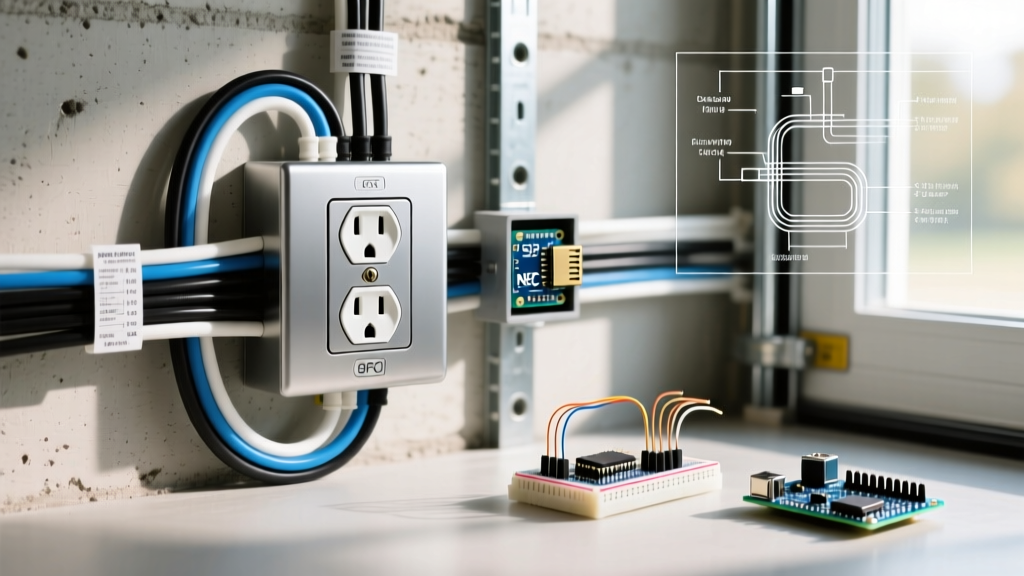
A massive percentage of garage inspection failures stem from improper cable management. NEC Article 334.15 strictly prohibits running exposed Nonmetallic-Sheathed Cable (NM-B, commonly known as Romex) in areas where it is subject to physical damage. In an unfinished garage with exposed studs, running Romex across the face of the studs is a direct code violation.
Compliant Wiring Methods
- EMT Conduit with THHN Wire: The gold standard for exposed garage walls. Run 1/2-inch or 3/4-inch Electrical Metallic Tubing (EMT) and pull individual THHN/THWN-2 wires. This provides maximum physical protection and makes future upgrades easy.
- PVC Schedule 80: Acceptable for areas where metallic conduit might corrode or where physical impact is extreme, though it requires more careful bending and gluing.
- Behind Drywall: If you are finishing the garage with drywall, NM-B cable can be run through bored holes in the center of the studs, safely hidden from physical damage.
Step-by-Step: Upgrading a Standard Duplex to a 20A GFCI
If you are replacing an older, ungrounded, or non-GFCI compliant outlet in your garage, follow this precise workflow to ensure safety and code compliance.
- Kill the Power and Verify: Turn off the breaker and use a non-contact voltage tester (e.g., Klein Tools NCVT-2) to confirm the circuit is dead.
- Inspect the Box: Ensure the existing electrical box has enough volume. A 20A GFCI receptacle requires a minimum of 18 cubic inches of box volume per NEC 314.16. If you have a shallow 12-cubic-inch box, you must replace it with a deep 'old work' box.
- Check Wire Gauge: Verify the existing wiring is 12 AWG copper. If it is 14 AWG, you are legally restricted to a 15A circuit and a 15A GFCI receptacle. Do not put a 20A GFCI on a 14 AWG wire.
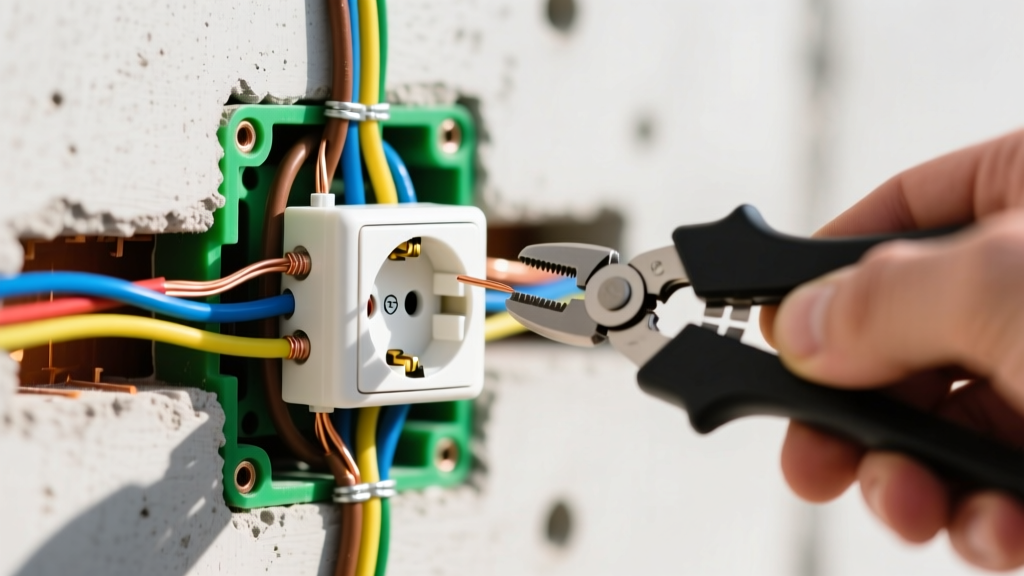
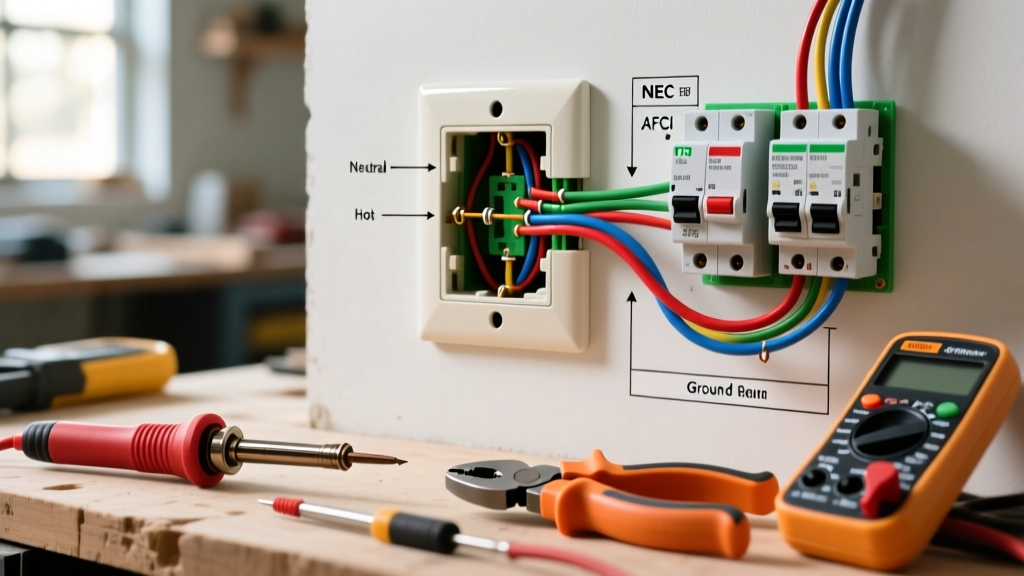
- Pigtail the Ground: Garage circuits must have an equipment grounding conductor. Connect the bare copper ground to the green screw on the GFCI and pigtail it to the metal box if applicable.
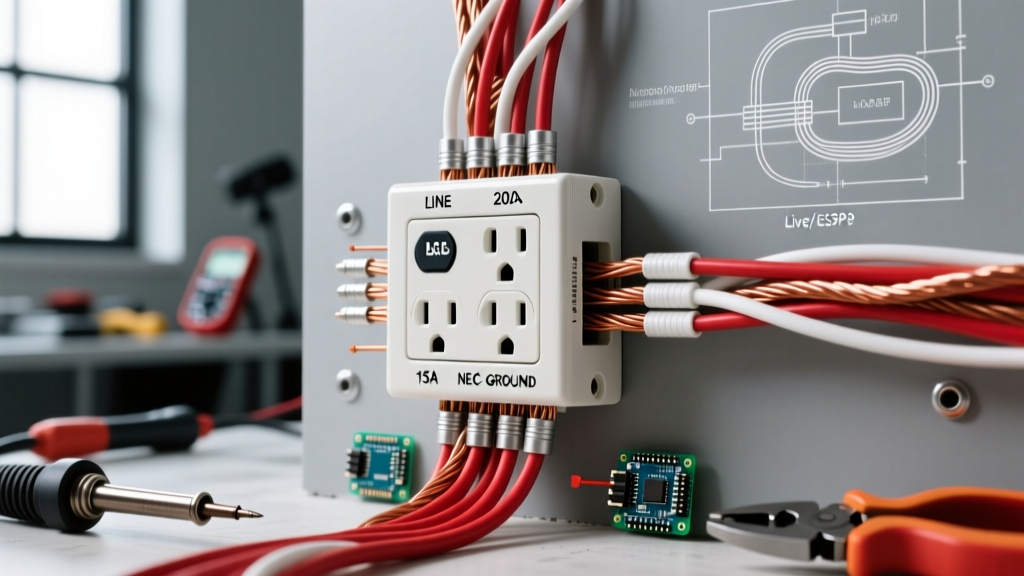
- Wire Line vs. Load: Connect the hot (black) and neutral (white) from the power source to the LINE terminals. Only use the LOAD terminals if you are intentionally protecting downstream receptacles, which is generally discouraged in garages to prevent a single fault from killing power to multiple tool stations.
Common Code Violations to Avoid
- Daisy-Chaining Lighting on GFCI Load: Never wire garage overhead lighting to the LOAD side of a GFCI receptacle. If a power tool trips the GFCI, you will be left in the dark, creating a severe safety hazard.
- Using Indoor-Rated Strips: Standard residential power strips are not rated for the damp, dusty environment of a garage. Use heavy-duty, metal-housed shop strips with built-in 15A/20A circuit breakers.
- Improper EV Charger Grounding: When installing a NEMA 14-50 for an EV, ensure the grounding electrode system is properly bonded. The National Electrical Manufacturers Association (NEMA) emphasizes that high-draw continuous loads (operating for 3+ hours) require the circuit to be derated to 80% of the breaker's capacity (e.g., a 50A breaker can only continuously supply 40A).
Frequently Asked Questions
Does a garage ceiling outlet for a door opener need GFCI?
Yes. Under the current NEC, all 125V, 15A/20A receptacles in a garage require GFCI protection, regardless of height or accessibility. However, because it is difficult to reach, it is best practice to protect this outlet via a GFCI breaker at the main panel rather than a wall-mounted GFCI receptacle.
Can I use 15-amp receptacles on a 20-amp garage circuit?
Yes, NEC 210.21(B)(3) allows 15A duplex receptacles on a 20A circuit, provided there is more than one receptacle on the circuit (a duplex counts as two). However, for heavy shop tools, upgrading to 20A rated receptacles (which accept both 15A and 20A plugs) is highly recommended to prevent overheating the receptacle contacts.