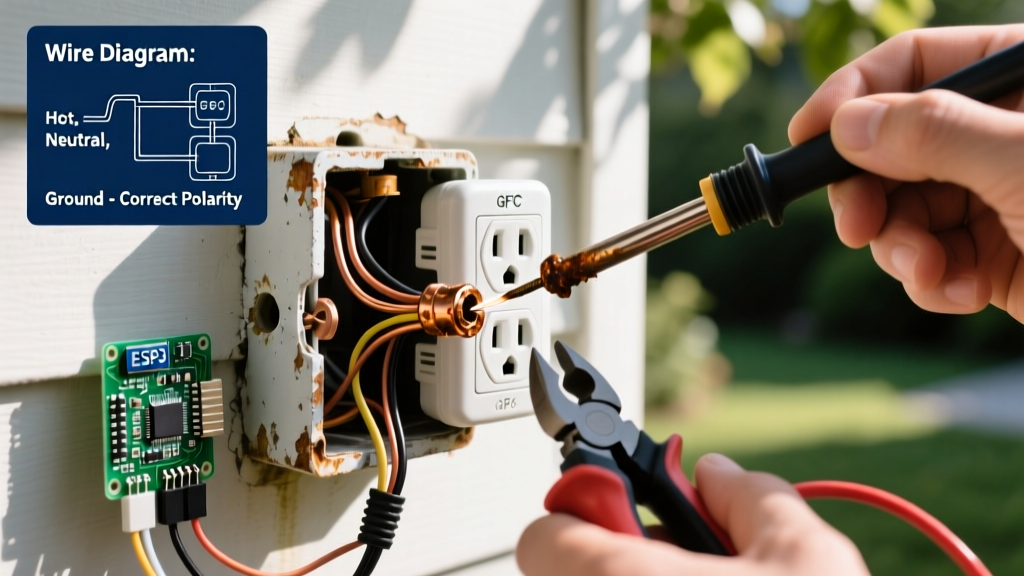

Why Your Outdoor Electrical Outlet Stopped Working
An outdoor electrical outlet is subjected to some of the harshest environmental conditions in any residential or commercial electrical system. Between UV radiation, freezing rain, humidity, and temperature swings, exterior receptacles fail at a significantly higher rate than interior ones. When your patio, garden, or holiday lighting receptacle suddenly goes dead or refuses to reset, the issue usually falls into one of three categories: an upstream GFCI trip, a localized weather-ingress failure, or a concealed wiring fault.
⚠️ CRITICAL SAFETY WARNING: Before removing any cover plates or testing terminals, verify the circuit is de-energized. Outdoor environments present a severe risk of ground-fault shock. Never assume a dead receptacle means the wire is safe to touch; a broken neutral or miswired multi-wire branch circuit can still carry lethal voltage.Phase 1: The Upstream Triage (Don't Replace the Receptacle Yet)
The most common reason an outdoor electrical outlet stops working has nothing to do with the outlet itself. Under the National Electrical Code (NEC), exterior receptacles must be protected by a Ground Fault Circuit Interrupter (GFCI). In many homes, builders wire the outdoor receptacle to the LOAD terminals of an interior GFCI—often located in a garage, basement, or primary bathroom.
Step-by-Step Upstream Verification
- Check Interior GFCIs: Press the 'TEST' and 'RESET' buttons on every GFCI in your garage, kitchen, bathrooms, and laundry room. A tripped garage GFCI is the culprit in over 40% of 'dead' outdoor outlet calls.
- Verify the Breaker: Check your main service panel. Look for a breaker that is slightly off-center (the tripped position). Turn it fully OFF, then snap it ON.
- Use a Non-Contact Voltage Tester: With the circuit supposedly live, use a tool like the Fluke 1AC-II VoltAlert ($35) near the receptacle face. If it beeps, power is reaching the device, meaning the failure is localized to the receptacle or its immediate pigtails.
Phase 2: Diagnosing GFCI Receptacle Failures
If your outdoor electrical outlet is itself a GFCI receptacle (identifiable by the TEST/RESET buttons on the face), it is highly susceptible to internal corrosion and nuisance tripping. Modern Weather-Resistant (WR) GFCIs, such as the Leviton SmartlockPro GFNT1-W ($18–$24), feature UV-stabilized polycarbonate faces and corrosion-resistant nickel-plated brass terminals. However, the internal sensing electronics will permanently lock out the device if a severe ground fault is detected, preventing a reset.
Nuisance Tripping vs. Hard Faults
If the GFCI trips immediately upon resetting, you have a hard fault. If it trips only when it rains or when you plug in a specific tool, you have a localized ground leakage issue.
- The Neutral-to-Ground Fault: This is the most elusive edge case. If a downstream wire has a nicked neutral insulation touching the metal box or ground wire, the GFCI will sense an imbalance and trip, even if nothing is plugged in. You must disconnect the LOAD wires to isolate whether the fault is in the receptacle or the downstream wiring.
- Moisture in the LINE Terminals: If water bypasses the weatherproof cover and pools at the bottom of the electrical box, it can bridge the gap between the LINE neutral and the ground screw, causing an immediate trip.
Diagnostic Matrix: Symptoms and Solutions
| Symptom | Probable Root Cause | Diagnostic Action | Est. Fix Cost |
|---|---|---|---|
| Dead, no power, no trip | Upstream GFCI tripped or breaker off | Locate and reset interior GFCIs; check panel | $0 |
| Refuses to stay reset | Internal GFCI lockout or downstream ground fault | Disconnect LOAD wires; test LINE only | $18 - $150 |
| Trips only during rain | In-use cover gasket failure or missing hub seal | Inspect polycarbonate bubble and foam gasket | $14 - $22 |
| Physical face degradation | UV damage to standard (non-WR) receptacle | Replace with NEC-compliant WR/TR model | $18 - $25 |
Phase 3: Weatherproof Cover and Ingress Diagnostics
According to the Consumer Product Safety Commission (CPSC), proper GFCI protection and weatherproof enclosures are vital for preventing outdoor electrocution hazards. The NEC mandates that outdoor receptacles in damp or wet locations be equipped with an 'in-use' weatherproof cover. These covers allow a cord to be plugged in while the protective bubble remains closed.
Common Enclosure Failures
- The Silicone Trap: Many DIYers caulk the perimeter of the weatherproof box to the siding to prevent water intrusion. While sealing the top and sides is correct, never seal the bottom edge. Condensation and minor leaks must have a weep path to drain. Sealing the bottom traps water inside the box, accelerating terminal corrosion.
- Hinge and Gasket Fatigue: The foam gaskets on covers like the Taymac MM540 ($14–$18) degrade after 3 to 5 years of direct sunlight. If the foam is crumbling or the polycarbonate hinge is cracked, water will wick directly onto the receptacle face during wind-driven rain.
- Missing Conduit Hub Seals: If your outlet is mounted on a metal or PVC conduit, the threaded hub connector must have a neoprene sealing ring. A missing seal allows water to travel down the conduit threads and pool inside the junction box.
Phase 4: Edge Cases – Conduit Condensation and Corrosion
When the receptacle and cover test fine, the problem often lies in the wiring method. Underground PVC conduit runs are notorious for 'sweating.' As the ground cools at night, warm, moist air inside the conduit condenses into liquid water, eventually filling the conduit and submerging the wire splices.
Galvanic Corrosion on Pigtails
If your home was wired with aluminum branch wiring (common in the late 1960s and 1970s) and an electrician used standard copper pigtails without an antioxidant compound like Noalox, galvanic corrosion will occur. This creates a high-resistance connection that generates heat, eventually melting the wire insulation and causing a ground fault. If you pull the receptacle out and see a white, powdery substance on the wires or blackened insulation, the circuit must be cut back to clean metal and repaired using AL/CU rated wire nuts (such as the ideal Purple WingNut) or a Wago Alu-Plus connector.
Essential Tools for Outdoor Receptacle Troubleshooting
To accurately diagnose these issues without guessing, professionals rely on specific diagnostic tools:
- Klein Tools RT250 GFCI Receptacle Tester ($30): Unlike basic $10 testers, the RT250 can trip the GFCI from the load side and features a digital display that confirms proper wiring and ground continuity, crucial for verifying outdoor ground rods and bonding.
- Insulation Resistance Tester (Megger): For tripping circuits where the fault isn't visible, a Megger applies a high-voltage, low-current pulse to the wire to detect microscopic breaks in the insulation hidden inside wet underground conduits.
- Wire Pulling Compound: When replacing wires in a wet conduit, always use a non-conductive pulling lubricant to prevent micro-tears in the new THWN-2 insulation.
When to Call a Licensed Electrician
If you have verified the upstream GFCI, replaced the outdoor WR receptacle, installed a new in-use cover, and the circuit still trips or fails to deliver power, you likely have a severed neutral or a degraded underground splice. Diagnosing underground faults requires specialized time-domain reflectometers (TDR) and trenching equipment. Expect to pay a diagnostic fee of $125–$175, with total repair costs ranging from $250 to $600 depending on the length of the underground run and local landscaping restoration requirements. Always ensure your exterior circuits comply with the latest NEC mandates for tamper-resistant (TR) and weather-resistant (WR) markings to guarantee long-term safety and reliability.