
Navigating the Spanish Electrical Grid: A Guide for Expats and Professionals
Wiring an electrical outlet Spain compliant requires a fundamental shift in thinking for anyone accustomed to North American NEC standards or British BS 7671 regulations. Spain operates on a 230V/50Hz single-phase system, governed by a stringent, highly specific national code known as the REBT (Reglamento Electrotécnico para Baja Tensión). Whether you are renovating a rustic finca in Andalusia, upgrading an apartment in Madrid, or simply replacing a damaged receptacle, understanding the local wiring scenarios is critical for safety and legal compliance.
In this comprehensive guide, we break down the exact specifications, common edge cases, and component sourcing strategies for Spanish electrical installations in 2026. We will focus heavily on ITC-21, the specific technical instruction within the REBT that dictates socket circuit requirements.
The Core Framework: REBT and ITC-21 Explained
The REBT (established by Real Decreto 842/2002 and updated continuously) is the bible for Spanish electricians. Unlike the NEC, which offers broad guidelines adapted by local municipalities, the REBT is a rigid national standard. For socket outlets, ITC-21 (Instrucción Técnica Complementaria 21) is the governing chapter. It dictates not just how an outlet is wired, but how many circuits a dwelling must have based on its square footage and anticipated load.
Expert Insight: Under ITC-21, a standard Spanish apartment requires a minimum of five distinct circuits. You cannot simply daisy-chain an entire floor's worth of sockets onto a single 16A breaker as is sometimes seen in older, non-compliant DIY setups. Lighting, general sockets, heavy kitchen appliances, and bathroom auxiliary sockets must all be segregated.
For authoritative reference, the complete REBT documentation is maintained by the Spanish Official State Gazette (BOE - Reglamento Electrotécnico para Baja Tensión). Always consult the latest consolidated version before beginning any structural rewiring.
Spain vs. North America: A Quick-Reference Matrix
Before stripping any wires, it is vital to understand the physical and regulatory differences between Spanish and North American systems. Using AWG wire or NEMA receptacles in a Spanish wall box is not only illegal but poses severe fire and shock hazards.
| Feature | Spain (REBT / IEC) | North America (NEC) |
|---|---|---|
| Standard Voltage | 230V AC (Single Phase) | 120V AC (Single Phase) |
| Frequency | 50 Hz | 60 Hz |
| Standard Socket | Type F (Schuko / CEE 7/3) | Type A/B (NEMA 1-15 / 5-15) |
| Wire Sizing Standard | Metric (mm²) | AWG (American Wire Gauge) |
| Standard Socket Wire | 2.5 mm² (approx. 13 AWG) | 12 AWG or 14 AWG |
| Standard Breaker Size | 16A (for 2.5 mm² circuits) | 15A or 20A |
| Wire Color Code (IEC 60446) | Brown (L), Blue (N), Green/Yellow (PE) | Black (L), White (N), Bare/Green (G) |
Standard Wiring Scenario: Installing a 16A Type F Schuko Outlet
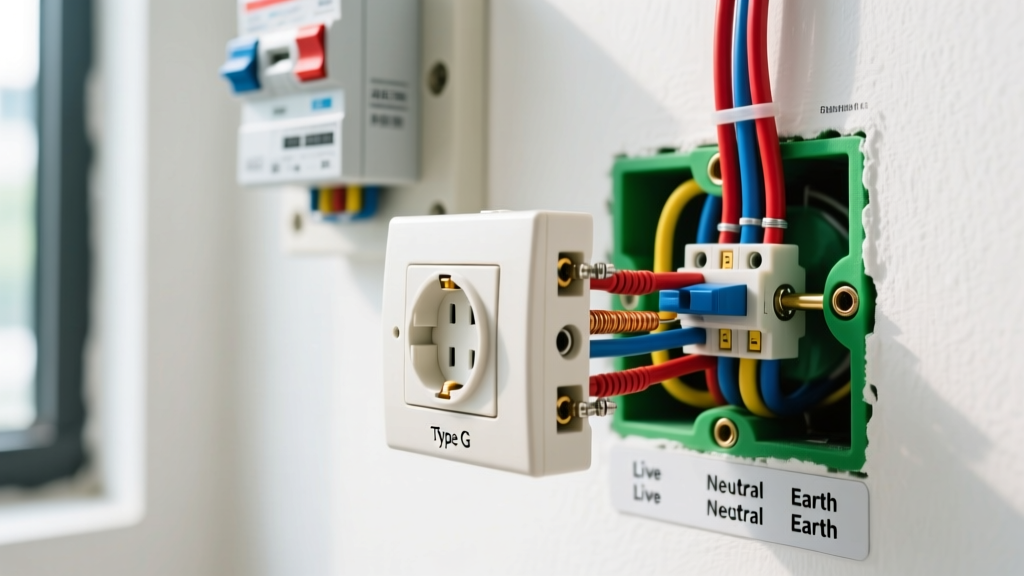
The standard Spanish receptacle is the Type F Schuko (CEE 7/3), characterized by its round, recessed design with two grounding clips on the top and bottom edges rather than a protruding ground pin. According to the IEC World Plugs database, this design ensures that the ground connection is made before the live pins engage, offering superior shock protection.
Step-by-Step Installation Guide
- Isolate the Circuit: Turn off the specific 16A PIA (Pequeño Interruptor Automático) in the CMP (breaker box). Verify zero voltage with a CAT III multimeter.
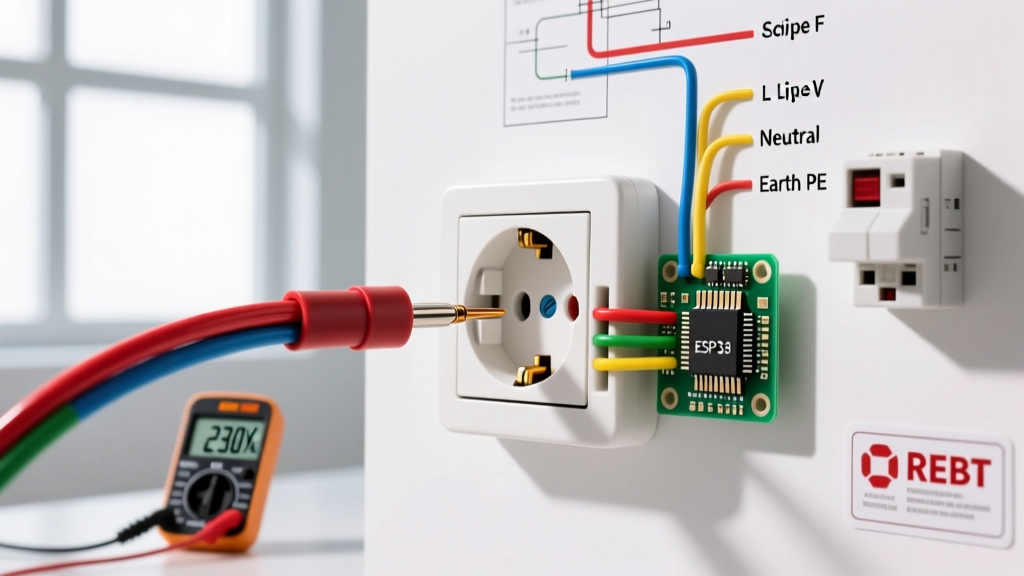
- Prepare the Wires: Spanish walls typically use corrugated conduit (tubo corrugado) with H07V-K (stranded) or H07V-U (solid) copper wire. Strip exactly 12mm of insulation from the 2.5 mm² Brown (Line), Blue (Neutral), and Green/Yellow (Earth) wires.
- Ferrule Stranded Wire: If your installation uses H07V-K stranded wire, you must crimp 12mm insulated bootlace ferrules onto the ends before inserting them into the screw terminals. This prevents strand splaying and ensures a high-torque, fire-safe connection.
- Terminal Assignment: Connect Green/Yellow to the central Earth terminal. Connect Brown to Line (L) and Blue to Neutral (N). While Spanish AC is technically unpolarized regarding the appliance plug, maintaining L/N consistency across the dwelling is a hallmark of professional craftsmanship.
- Secure the Mechanism: Use M4 machine screws to mount the mechanism to the standard 65mm Spanish flush box (caja de mecanismos). Snap on the trim plate (e.g., Simon 27 or Legrand Valena).
Edge Case 1: Upgrading Pre-1973 Ungrounded 'Clavija' Sockets
A highly common scenario in Spain involves older properties built before the 1973 REBT update. These homes often feature the obsolete Type C 'Clavija' sockets—flat, ungrounded, two-pin receptacles wired with outdated 1.5 mm² or even aluminum cloth-covered wiring.
The Illegal (and Dangerous) Shortcut
Many amateur DIYers attempt to upgrade these to modern Schuko sockets by installing a jumper wire between the Neutral terminal and the Earth terminal (bootleg ground). This is strictly prohibited and lethal. If the neutral wire breaks or is reversed at the panel, the metal chassis of any plugged-in appliance becomes energized at 230V.
The Compliant Solution
To legally upgrade to a grounded electrical outlet Spain compliant, you must pull a new 2.5 mm² Green/Yellow earth wire through the existing conduit back to the nearest earth bar in the CMP. If the conduit is blocked or too narrow (common in 1960s masonry), you must either surface-mount a new PVC trunking system (canalización vista) or chase the wall to lay new 20mm corrugated conduit containing a full new 3-wire set.
Edge Case 2: High-Load Kitchen Circuits (Electrodomésticos)
The Spanish kitchen is heavily regulated under ITC-21 due to the simultaneous use of high-draw appliances. A standard 16A socket circuit is limited to roughly 3,680W. Plugging an oven, induction hob, and dishwasher into a shared circuit will instantly trip the breaker.
- Oven / Induction Hob: Requires a dedicated circuit using 6 mm² copper wire protected by a 25A breaker. These often terminate in a hardwired junction box (caja de derivación) rather than a standard wall socket.
- Washing Machine / Dishwasher / Water Heater: Each requires its own dedicated 4 mm² circuit protected by a 20A or 25A breaker, terminating in a dedicated 16A or 20A Schuko socket.
- General Kitchen Sockets: Countertop sockets for blenders and microwaves require a dedicated 2.5 mm² circuit on a 16A breaker, completely separate from the major appliances.
The CMP: Breakers and Differential Switches
Understanding the Spanish breaker box—the Cuadro de Mando y Protección (CMP)—is essential for troubleshooting outlet scenarios. A compliant Spanish CMP contains two vital layers of protection:
1. The Interruptor Diferencial (ID)
This is the RCD/GFCI equivalent. Spanish code mandates a minimum of one 30mA sensitivity differential switch for all socket and lighting circuits. If an outlet develops a ground fault (e.g., a frayed wire touches a metal backbox), the ID detects the imbalance between Line and Neutral current and trips within milliseconds, preventing electrocution. In larger 2026 smart homes, it is common to see multiple IDs segregating floors or specific high-risk zones like bathrooms.
2. Pequeños Interruptores Automáticos (PIAs)
These are the standard MCBs (Miniature Circuit Breakers) that protect the wiring from overloads and short circuits. They are rated in Amperes (10A, 16A, 20A, 25A). Crucial Rule: The PIA rating must never exceed the ampacity of the wire. A 16A PIA requires a minimum of 2.5 mm² wire. Installing a 20A PIA on a 2.5 mm² wire is a severe fire hazard and an automatic fail on an inspección eléctrica.
Sourcing Components in the 2026 Spanish Market
When sourcing materials for your electrical outlet Spain project, you will encounter a market dominated by high-quality European manufacturers. Avoid importing cheap, non-CE-marked receptacles from overseas marketplaces; they will not fit standard Spanish 65mm flush boxes and lack the necessary VDE or AENOR certifications.
Top Tier Brands and Pricing (2026 Estimates)
- Simon (Series 27 Play & Series 100): A domestic Spanish powerhouse. The Simon 27 Play is ubiquitous, offering robust Schuko mechanisms with child-safe shutters. Expect to pay €7 to €12 per complete socket set.
- Legrand (Valena Life & Niloe): French engineering with massive Spanish market penetration. The Valena Life series offers excellent screwless terminal options for fast wiring. Pricing ranges from €9 to €15 per unit.
- Schneider Electric (New Unica): Premium modular systems favored in high-end 2026 renovations. Excellent for integrating USB-C PD (Power Delivery) charging modules directly into the Schuko faceplate. Budget €18 to €30 per assembled unit.
For bulk wire, brands like Top Cable or Prysmian supply the standard H07V-K flexible copper wire, typically costing around €0.45 to €0.65 per meter for 2.5 mm² at local electrical wholesalers (material eléctrico).
Final Safety and Compliance Warnings
Working with 230V systems leaves zero margin for error. An arc flash at 230V is significantly more violent and sustained than at 120V. Furthermore, if you are selling a property in Spain, you will need a Boletín Eléctrico (CIE - Certificado de Instalación Eléctrica) issued by a licensed instalador autorizado. Any unpermitted DIY outlet wiring that violates ITC-21 will result in a failed inspection, denying the new owner their utility connection from Endesa or Iberdrola. When in doubt, use this guide to understand the scope of your project, but always contract a certified professional for the final terminations and CMP modifications.
For further reading on European plug standards and safety mechanisms, consult the World Standards Type F Guide.