
Decoding the Bathroom Electrical Outlet Code
Water and electricity are a notoriously lethal combination, which is why the National Electrical Code (NEC) enforces some of its strictest regulations in the bathroom. Whether you are remodeling a master suite, finishing a basement half-bath, or simply replacing an aging receptacle, understanding the bathroom electrical outlet code is non-negotiable for safety and passing municipal inspections. As we navigate the widespread adoption of the NEC 2023 standards and look toward upcoming 2026 local amendments, compliance has become more nuanced than simply swapping out an old two-prong plug.
This comprehensive guide breaks down the exact NEC articles governing bathroom receptacles, from dedicated circuit mandates to precise placement measurements, ensuring your DIY project or professional install meets the highest safety benchmarks.
The 20-Amp Dedicated Circuit Mandate (NEC 210.11)
One of the most frequently misunderstood aspects of bathroom wiring is the circuit load requirement. According to NEC Article 210.11(C)(3), you must provide at least one 20-amp branch circuit to supply bathroom receptacle outlets. This is a significant upgrade from the 15-amp circuits used in general living spaces, designed specifically to handle the high-draw appliances common in bathrooms, such as 1875-watt hair dryers, heated styling tools, and portable space heaters.
Wiring Specifications and Breaker Selection
To meet this code requirement, your wiring and overcurrent protection must be correctly sized:
- Wire Gauge: You must use a minimum of 12 AWG copper wire (typically 12/2 NM-B Romex for standard residential dry locations). Using 14 AWG wire on a 20-amp breaker is a severe fire hazard and an automatic inspection failure.
- Breaker Size: A standard 20-amp single-pole breaker is required. However, if your local Authority Having Jurisdiction (AHJ) has adopted amendments requiring Arc-Fault Circuit Interrupter (AFCI) protection for bathrooms (often the case if the bathroom is accessed through a bedroom), you should use a Dual-Function breaker like the Eaton BR220GF (approx. $55), which combines both AFCI and GFCI protection at the panel.
- The 'No Other Outlets' Rule: The 20-amp bathroom circuit cannot supply outlets in other rooms. It can, however, supply the lighting and exhaust fan within that same single bathroom, provided no other rooms are tapped into the circuit.
GFCI Protection: The Ultimate Safety Net (NEC 210.8)
Ground Fault Circuit Interrupter (GFCI) protection is the cornerstone of bathroom electrical safety. NEC Article 210.8(A)(1) mandates that all 125-volt, single-phase, 15- and 20-ampere receptacles installed in bathrooms must have GFCI protection. This device monitors the current balance between the hot and neutral wires; if it detects a leakage as small as 4 to 6 milliamps (indicating current is escaping, possibly through a person to ground), it trips the circuit in milliseconds.
Pro Tip for 2026 Installations: Standard GFCIs require manual monthly testing. We strongly recommend upgrading to Self-Testing GFCIs, such as the Leviton GFNT2-W SmartLockPro (approx. $24). These devices automatically test the ground-fault circuit every 3 seconds and will lock out power if the internal protection mechanism fails, ensuring you are never unknowingly unprotected.
Exact Placement Rules: The 3-Foot Sink Mandate (NEC 210.52)
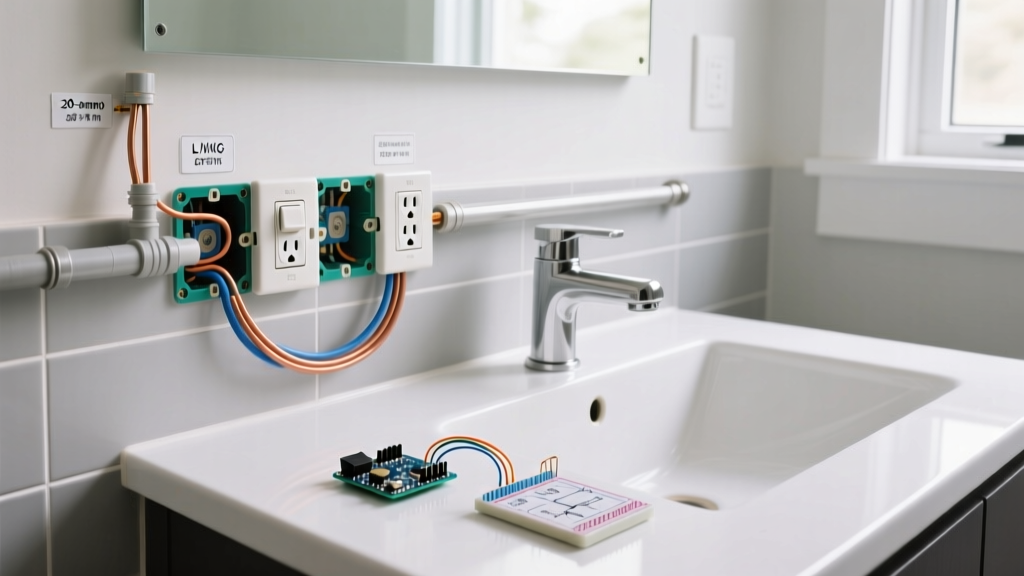
The code doesn't just dictate how the outlet is wired, but exactly where it must be placed. Under NEC 210.52(D), at least one receptacle outlet must be installed within 3 feet (900 mm) of the outside edge of each bathroom basin.
Acceptable vs. Prohibited Placement Zones
Where you place the outlet within that 3-foot radius is heavily regulated to prevent cords from draping over sinks or into water sources.
- Acceptable: On the wall adjacent to the basin, on the side or face of the basin cabinet, or on the countertop (provided it is not face-up).
- Prohibited: Receptacles cannot be installed inside a shower or bathtub zone (NEC 411.4). They also cannot be placed in a face-up position on a countertop (NEC 406.4(E)), as this allows water to pool directly into the live electrical slots.
NEC Bathroom Receptacle Quick Reference Matrix
Use the following table to verify your bathroom electrical outlet code compliance before calling for a rough-in or final inspection.
| Code Requirement | NEC Article | Specification / Measurement | Common DIY Mistake |
|---|---|---|---|
| Circuit Amperage | 210.11(C)(3) | 20-Amp dedicated branch circuit | Using a 15A breaker or sharing with hallway lights |
| Wire Gauge | 240.4(D) | 12 AWG Copper minimum | Pulling 14 AWG wire from existing bedroom circuits |
| Shock Protection | 210.8(A)(1) | GFCI required for all 15A/20A 125V receptacles | Installing standard duplex outlets near the vanity |
| Sink Proximity | 210.52(D) | Within 36 inches of basin outside edge | Placing the outlet 4 feet away on an adjacent wall |
| Tamper Resistance | 406.12 | TR (Tamper-Resistant) shutters required | Reusing old non-TR receptacles from a demolition pile |
| Countertop Orientation | 406.4(E) | Cannot be installed face-up on horizontal surfaces | Mounting standard outlets flat on a granite vanity top |
Tamper-Resistant (TR) and Weather-Resistant (WR) Specs
Since the 2008 NEC cycle, Article 406.12 has required all 15- and 20-amp receptacles in dwelling unit bathrooms to be Tamper-Resistant (TR). TR receptacles feature internal spring-loaded shutters that only open when equal pressure is applied to both slots simultaneously (like a standard plug). This prevents children from inserting foreign objects like hairpins or keys into the hot slot.
Additionally, if your bathroom features a window near the vanity, or if the receptacle is located in a damp zone (such as an outdoor-access mudroom bathroom), NEC 406.9(A) requires the use of Weather-Resistant (WR) rated receptacles. WR devices are constructed with UV-resistant thermoplastics and nickel-plated brass contacts to resist corrosion from high humidity and condensation.
Pop-Up and Smart Outlets: Navigating Modern Trends
As bathroom designs evolve toward massive quartz vanities and integrated technology, homeowners are requesting alternatives to standard wall duplexes. Pop-up countertop outlets (like the Doug Mockett PCS77 series) are highly popular. However, to meet the bathroom electrical outlet code, these pop-up assemblies must be UL/ETL listed specifically for wet/damp countertop locations and must incorporate GFCI and TR protection natively within the unit.
For smart home enthusiasts, Wi-Fi enabled GFCIs (such as the Leviton DW15R paired with a Decora Smart Wi-Fi system) are emerging. While smart features allow for energy monitoring and remote resetting via smartphone, the primary GFCI protection must remain a localized, hardware-level fail-safe that does not rely on an internet connection to trip during a ground fault event.
Common Inspector Fail Points & How to Avoid Them
According to data from the International Association of Electrical Inspectors (IAEI), bathroom circuits are among the top three most frequently failed residential inspections. Avoid these common pitfalls:
- The 'Daisy-Chain' Error: Wiring the bathroom GFCI to protect downstream outlets in an adjacent bedroom or hallway. The bathroom GFCI should only protect downstream bathroom outlets.
- Missing Blank Faceplates: Leaving junction boxes exposed in the vanity cabinet where plumbing access panels are located. All splices must be covered.
- Overloaded Vanity Lighting: Tapping high-draw LED vanity mirrors with built-in defoggers into the 20-amp receptacle circuit without calculating the continuous load, which can cause nuisance tripping when a hair dryer is used simultaneously.
Final Thoughts on Safety and Compliance
Adhering to the bathroom electrical outlet code is not just about satisfying a municipal inspector; it is about preventing fatal electrocution and electrical fires in the most water-heavy room in your home. Always verify your local AHJ's specific amendments, as some municipalities adopt the National Fire Protection Association (NFPA) codes with regional delays or stricter local modifications. When in doubt, consult a licensed electrician and refer to OSHA Electrical Safety Guidelines for best practices in residential wiring safety.