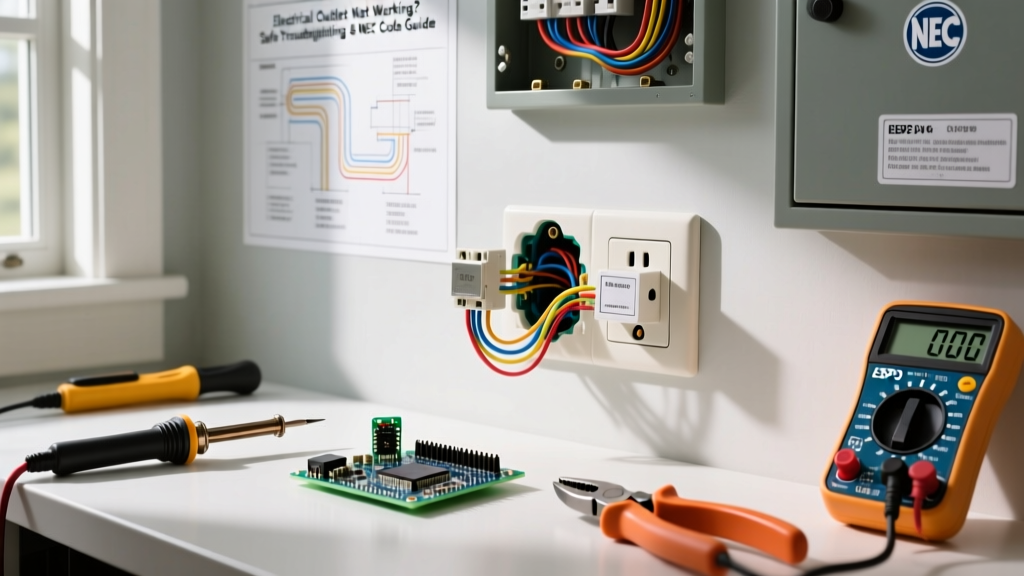

Why Is Your Electrical Outlet Not Working? A Safety-First Diagnostic Guide
When you plug in a device and nothing happens, the immediate thought is often a tripped breaker or a bad cord. However, an electrical outlet not working can be a symptom of a much deeper, potentially hazardous wiring fault. According to the National Fire Protection Association (NFPA), electrical distribution and lighting equipment are consistently among the leading causes of home structure fires. Ignoring a dead receptacle or attempting a quick, non-compliant fix can violate the National Electrical Code (NEC) and introduce severe shock or arc-fault risks.
This guide moves beyond basic 'flip the breaker' advice. We will systematically diagnose dead receptacles using professional-grade testing methods, identify hidden code violations like backstabbed terminations, and outline the exact NEC-compliant repairs required to restore safe power to your home.
CRITICAL SAFETY WARNING: Never assume a circuit is de-energized just because an outlet is dead. A severed neutral or miswired multi-wire branch circuit (MWBC) can leave the hot conductor live even if the connected device lacks a return path. Always verify with a True-RMS multimeter before touching any bare conductors.
Phase 1: Establishing a Residential LOTO Protocol
In commercial settings, electricians use Lockout/Tagout (LOTO) procedures to prevent accidental re-energization. In a residential DIY scenario, you must adapt this. An electrical outlet not working requires you to open the panel or junction boxes, meaning someone else in the home could accidentally flip a breaker back on while you are working.
- Invest in a LOTO Kit: A basic residential breaker lockout kit costs between $15 and $25. It clamps over the breaker toggle and accepts a small padlock.
- Keep the Key on Your Person: Never leave the lockout key on the workbench or in the panel. Keep it in your pocket.
- Notify the Household: Communicate clearly that the panel is locked and work is in progress.
Phase 2: The Downstream GFCI Trap
Before pulling off the faceplate, rule out the most common culprit for a dead outlet: a tripped Ground Fault Circuit Interrupter (GFCI) located upstream. Under NEC Article 210.8, GFCI protection is mandated in wet and damp locations. However, many homeowners do not realize that a single GFCI receptacle in a master bathroom, garage, or kitchen often protects downstream standard receptacles in other rooms or outdoors.
Tracing the Downstream Feed
- Locate all GFCI receptacles in the home, including the garage, exterior walls, and bathrooms.
- Press the 'TEST' button, then press 'RESET' firmly until you hear a distinct click.
- Use a plug-in tester like the Klein Tools RT105 (approx. $25) to verify if power has been restored to the dead outlet.
- If the GFCI immediately trips again upon resetting, you have a ground fault downstream. Do not force it; this indicates a damaged wire or moisture intrusion that requires professional tracing.
Phase 3: Multimeter Diagnostics & Failure Modes
If the breaker is on and no GFCIs are tripped, the fault lies within the branch circuit wiring or the receptacle itself. You will need a True-RMS multimeter, such as the Fluke 117 (approx. $190), to accurately read voltages and detect phantom voltages caused by induced currents.
Remove the faceplate, verify the circuit is dead using a non-contact voltage tester (NCVT), and then carefully pull the receptacle out of the electrical box to expose the side terminals.
The 3-Point Voltage Test
With the circuit energized (exercise extreme caution), measure the following three points:
- Hot to Neutral (Brass to Silver screw): Should read 120V (±5%).
- Hot to Ground (Brass to Green screw): Should read 120V (±5%).
- Neutral to Ground (Silver to Green screw): Should read 0V to 2V.
Diagnostic Matrix: Reading the Results
| Symptom | Multimeter Readings (H-N / H-G / N-G) | Root Cause | NEC-Compliant Fix |
|---|---|---|---|
| Outlet completely dead | 0V / 0V / 0V | Open Hot (broken wire or tripped AFCI breaker) | Check AFCI breaker; inspect upstream wire nuts. |
| Intermittent power, warm faceplate | 115-120V (fluctuating) / 120V / 0V | Backstabbed push-in terminal failure (thermal creep) | Move wires to screw terminals; torque to 12 in-lbs. |
| Devices hum, shock hazard | 120V / 0V / 120V | Open Ground (EGC disconnected) | Reconnect bare copper/green wire to grounding screw. |
| Voltage reads 90V or 140V | 90-140V / 120V / 30-50V | Lost/Shared Neutral on Multiwire Branch Circuit | Fix neutral splice; handle-tie MWBC breakers (NEC 210.4). |
Phase 4: The Backstabbing Epidemic & Box Fill Violations
If your multimeter indicates fluctuating voltage or you notice a faint smell of melting PVC (often described as a 'fishy' or acrid odor), you have likely found a failed push-in termination. For decades, manufacturers included spring-loaded 'backstab' holes on the rear of 15A receptacles. While UL-listed, these connections are notorious for failing under continuous 12A+ loads due to thermal expansion and contraction, which eventually loosens the spring grip.
NEC Article 110.14(B) requires terminations to be made using methods identified for the specific conductor. Best practice—and the standard for professional electricians in 2026—is to use the side screw terminals or create pigtails using wire nuts. Furthermore, use a torque screwdriver set to the manufacturer's specification (typically 12 to 14 inch-pounds for standard 15A/20A Leviton or Eaton receptacles) to prevent under-tightening (arcing) or over-tightening (stripped threads).
Checking Box Fill (NEC Article 314.16)
An electrical outlet not working might be the result of a crowded electrical box. When too many conductors are shoved into a standard single-gang box, the physical stress can pull wires loose from wire nuts or damage insulation, creating short circuits. NEC Article 314.16 dictates strict box fill calculations based on wire gauge. For 12 AWG wire, each conductor counts as 2.25 cubic inches. If your box is overfilled, you must upgrade to a deep box or an old-work box with a larger volume capacity before making your repairs.
Phase 5: Upgrading to Current Code Standards
When repairing a dead outlet, you are often required by the local Authority Having Jurisdiction (AHJ) to bring the receptacle up to current code, even if the original installation was grandfathered. The Electrical Safety Foundation International (ESFI) strongly advocates for modernizing receptacles to prevent childhood injuries and electrical fires.
- Tamper-Resistant (TR) Receptacles: Under NEC 406.4(D), all 15A and 20A receptacles in dwelling units must be TR. These feature internal shutters that only open when equal pressure is applied to both slots simultaneously. A standard 15A TR receptacle (e.g., Leviton Decora T5320-W) costs roughly $2.80, a minimal premium over the $0.90 non-TR versions, but it is a mandatory safety upgrade.
- AFCI/GFCI Dual Protection: If the dead outlet is in a kitchen, laundry area, or within 6 feet of a sink, it requires GFCI protection. If it is in a bedroom or living room, it requires Arc-Fault Circuit Interrupter (AFCI) protection. In 2026, replacing a standard breaker with a Dual-Function AFCI/GFCI breaker (approx. $55) at the panel is often the cleanest way to protect an entire downstream branch circuit without cramming bulky GFCI receptacles into small electrical boxes.
When to Call a Licensed Electrician
While replacing a standard receptacle or resetting a GFCI is a manageable DIY task, certain symptoms indicate systemic wiring failures that require a licensed professional. If you discover aluminum wiring (common in homes built between 1965 and 1973), evidence of scorch marks inside the electrical box, or if your multimeter reads 240V on a standard 120V circuit (indicating a lost service neutral at the main transformer), stop immediately. Contact a licensed electrician and your utility provider, as a lost service neutral can destroy appliances and cause catastrophic electrical fires.
For more information on maintaining a safe home electrical system, consult the U.S. Consumer Product Safety Commission (CPSC) home electrical safety guidelines. By approaching a dead outlet with a methodical, code-compliant mindset, you ensure your home remains safe, functional, and up to modern electrical standards.