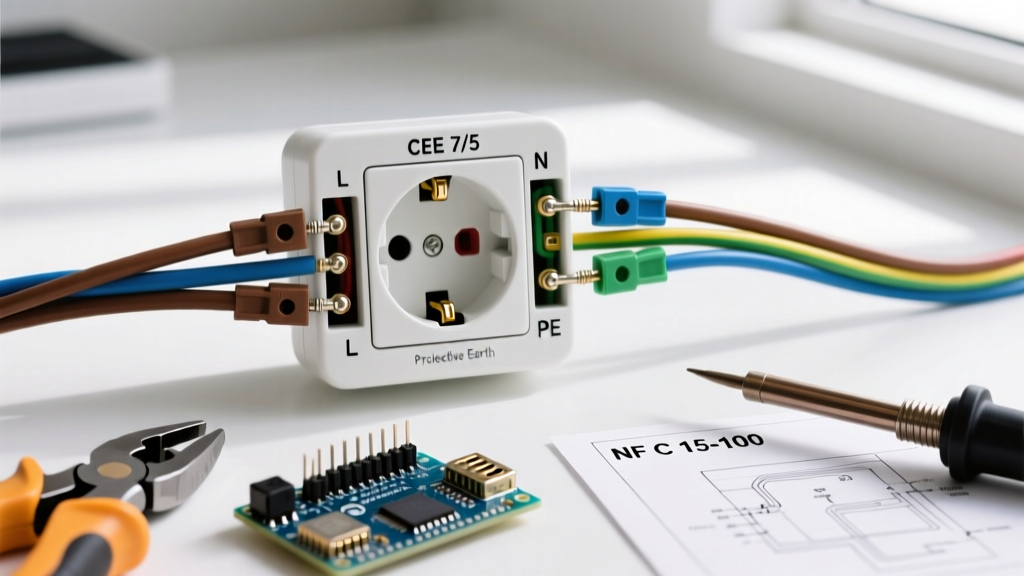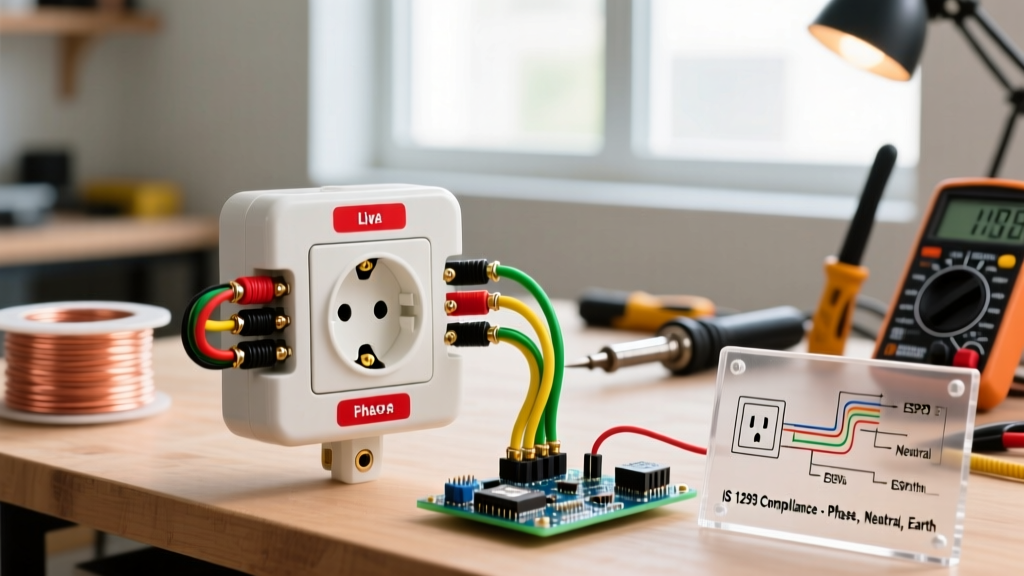

Understanding the Indian Electrical Outlet Standard (IS 1293)
When working with electrical infrastructure in India, understanding the specific regulatory and physical standards is non-negotiable for safety. The standard Indian electrical outlet operates on a 230V / 50Hz alternating current (AC) supply. Historically referred to by their amperage ratings (5A and 15A), modern Indian sockets are now standardized under the Bureau of Indian Standards (BIS) as 6A and 16A configurations.
The governing standard for sockets is IS 1293 (Part 1):1993, while plugs are governed by IS 1294. These standards dictate pin dimensions, spacing, shutter mechanisms, and thermal endurance. Using an unverified or counterfeit outlet bypasses critical safety shutters and uses substandard brass alloys that suffer from thermal runaway when subjected to continuous loads near their rated capacity.
Safety Mandate: As of recent BIS enforcement directives, all Indian electrical outlets sold in the retail market must bear the ISI mark. Procuring outlets without this certification violates the National Building Code and voids property insurance in the event of an electrical fire.
National Building Code (NBC) & NECI Compliance for Outlets
Placement, ingress protection (IP), and circuit segregation are strictly outlined in the National Building Code of India. According to the National Building Code of India (NBC), electrical outlets must be segregated by load type and protected against environmental hazards specific to their installation zone.
| Installation Zone | Minimum IP Rating | Min. Height from Floor | Wire Gauge & Breaker Spec |
|---|---|---|---|
| Living / Bedrooms (General) | IP20 | 0.45 meters | 2.5 sq mm / 16A MCB (Type C) |
| Kitchen Counters (Above 1.0m) | IP44 (Splash-proof) | 1.05 meters | 2.5 sq mm / 16A RCBO (30mA) |
| Bathrooms (Zone 2 & 3 only) | IP55 or higher | 1.20 meters | 2.5 sq mm / 16A RCBO (30mA) |
| Outdoor / Balcony | IP65 (Weatherproof) | 1.50 meters | 2.5 sq mm / 16A RCBO (30mA) |
| Heavy Appliance (AC / Geyser) | IP20 (Indoor) | 1.80 - 2.10 meters | 4.0 sq mm / 20A MCB (Type C) |
Step-by-Step Wiring Guide for 16A (Type M) Heavy-Duty Outlets
The 16A Indian electrical outlet (often referred to as the 3-pin large socket) is designed for high-draw appliances like space heaters, microwave ovens, and water purifiers. Improper termination is the leading cause of localized melting and arcing.
Materials & Tools Required
- Socket: Schneider Electric Livia or Legrand Arteor 16A IS 1293 compliant module (Approx. ₹180–₹300 / $2.15–$3.60 USD).
- Wire: 2.5 sq mm FRLS (Fire Retardant Low Smoke) stranded copper wire.
- Tools: Wire stripper (calibrated to 12mm), insulated torque screwdriver, digital multimeter.
Installation Procedure
- Isolate & Verify: Turn off the main distribution board (DB) MCB. Use a non-contact voltage tester (NCVT) and a multimeter to confirm 0V across Line, Neutral, and Earth.
- Strip & Prep: Strip exactly 12mm
- Terminate Line (Phase): Insert the Red/Brown wire into the right-hand terminal (marked 'L' or 'P'). Tighten the terminal screw to 0.5 Nm of torque. Overtightening crushes stranded copper; undertightening causes micro-arcing.
- Terminate Neutral: Insert the Black/Blue wire into the left-hand terminal (marked 'N'). Apply the same 0.5 Nm torque.
- Terminate Earth: Insert the Green/Yellow wire into the top, larger terminal (marked 'E' or the earth symbol). This pin is physically longer and thicker to ensure the earth connection makes first and breaks last.
- Pull Test: Apply a firm 3 kg pull test on each wire to ensure the terminal clamp is fully seated.
Earthing Standards & CEA Regulations
An Indian electrical outlet is only as safe as its earth connection. The Central Electricity Authority (CEA) mandates strict earthing parameters to ensure that in the event of a line-to-chassis fault, the protective device (MCB/RCBO) trips instantaneously.
Under Rule 61 of the Indian Electricity Rules, the earth pit resistance must ideally be maintained below 1 ohm, and absolutely no higher than 5 ohms. In modern residential construction, copper-bonded earth rods (typically 2 to 3 meters deep, 17.2mm diameter) treated with bentonite clay or earth enhancement material (BFC) are required to achieve this low impedance, especially in arid regions like Rajasthan or during dry summer months where soil resistivity spikes.
Common Safety Failures & Edge Cases in Indian Installations
When troubleshooting or auditing existing installations, electricians frequently encounter dangerous deviations from IS codes. Recognizing these edge cases prevents catastrophic failures.
- The Floating Neutral Hazard: In older 3-phase residential setups, a broken neutral wire at the main panel can cause the voltage at a standard 230V Indian electrical outlet to fluctuate wildly, sometimes spiking to 400V (line-to-line voltage). This instantly destroys appliance PCBs and causes outlet fires. Solution: Install a 3-phase under/over voltage relay at the main DB.
- Reverse Polarity: Swapping Line and Neutral. While the appliance may still function, the internal single-pole switch of the appliance only disconnects the neutral, leaving the internal components live at 230V. Solution: Always test with a dedicated socket tester before commissioning.
- False Earthing (Neutral-to-Earth Jumper): A dangerous, illegal shortcut where installers bridge the Neutral and Earth terminals inside the socket. If the neutral wire breaks upstream, the metal chassis of the connected appliance becomes energized at 230V. Solution: Ensure Earth and Neutral are bonded ONLY at the main service entrance panel, never at the outlet.
Adapter vs. Hardwired: Upgrading Legacy 5A to 16A
Many older Indian homes feature only 5A (Type D) sockets. Homeowners often use 5A-to-16A step-up adapters to plug in heavy appliances like 1.5-ton inverter ACs or 2000W room heaters. This is a severe fire hazard.
A 5A socket is wired with 1.5 sq mm wire and protected by a 10A or 16A breaker. Drawing 14A continuously through a 5A brass contact and 1.5 sq mm wire will cause the insulation to melt within 20 to 40 minutes, leading to a short circuit. Always replace the wall plate, upgrade the branch wiring to 2.5 sq mm or 4.0 sq mm, and install a dedicated 16A or 20A MCB for heavy loads. You can verify the authenticity of replacement parts via the Bureau of Indian Standards (BIS) online portal using the product's CM/L license number.
Frequently Asked Questions (FAQ)
Can I use a US/Japanese 110V appliance in an Indian electrical outlet?
No. India operates at 230V/50Hz. Plugging a 110V appliance directly into an Indian outlet will result in immediate catastrophic failure and potential fire. You must use a high-quality step-down transformer rated for at least 1.5 times the appliance's wattage.
Are universal multi-plug sockets legal in India?
Universal sockets (which attempt to accept US, EU, UK, and Indian pins simultaneously) generally do not meet IS 1293 standards because they lack proper internal shutter mechanisms and do not provide adequate contact pressure for all pin shapes. BIS strongly discourages them, and they are banned in commercial and government construction projects.
How often should I test the earth resistance of my home's outlets?
For residential properties, earth pit resistance should be tested annually, ideally at the end of summer when the soil is driest and resistance is at its highest. Commercial properties must test every 6 months as per CEA safety audit requirements.