
The Unique Landscape of Israeli Electrical Standards
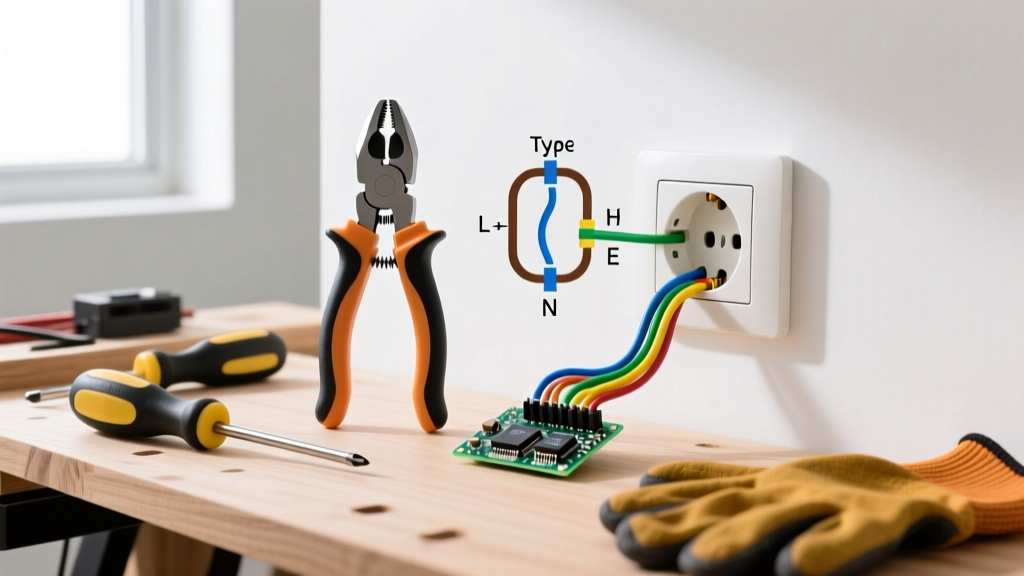
Working with an electrical outlet Israel configuration requires a fundamental shift in perspective for electricians, expats, and DIYers accustomed to North American (NEMA) or standard British (BS 1363) systems. Israel operates on a 230V, 50Hz alternating current supply and utilizes the unique Type H plug and socket standard, officially governed by Israeli Standard SI 32. While Type C (Europlug) devices are universally compatible with Type H sockets, the physical installation, rough-in materials, and termination tools demand specific regional knowledge to ensure safety and code compliance.
Standard Snapshot: Israel's SI 32 (Type H) features three 4.5mm round pins in a triangular pattern. It is rated for 16A (approx. 3,680W max load). Notably, Type H sockets manufactured after 2015 feature hybrid holes designed to accept both the newer round-pin Type H plugs and the older flat-pin Type M plugs, though the flat pins are now entirely obsolete in modern manufacturing. (Source: World Standards)
Whether you are retrofitting an apartment in Tel Aviv or wiring a new workshop in Haifa, using the correct tools and materials is non-negotiable. This guide breaks down the exact specifications, edge cases, and professional-grade equipment required for Israeli outlet installations in 2026.
Essential Tools for Israeli Outlet Installation
Standard US or UK toolkits will fall short when tackling Israeli electrical rough-ins and terminations. The metric system dominates, and terminal screw profiles differ significantly from North American standards.
- Non-Contact Voltage Tester (NCVT): The Fluke 1AC-II or Klein NCVT-2 is mandatory. Because Israel's 230V systems can induce phantom voltages in dense conduit runs, a dual-range CAT III 1000V / CAT IV 600V rated tester is required to accurately verify dead circuits before touching any conductors. Cheap pen testers frequently yield false positives in older multi-wire branch circuits.
- Precision Wire Strippers: Israeli socket circuits universally rely on 2.5mm² solid copper wire. Standard US strippers calibrated for AWG 12 or 14 will often nick the copper conductor, creating a high-resistance hot spot that can melt the terminal block over time. The Knipex 12 62 180 automatic stripper is calibrated specifically for metric wire gauges (0.2 to 6.0 mm²) and guarantees a flush strip without scoring the copper.
- Pozidriv Screwdrivers: This is the most common point of failure for foreign electricians. Terminal screws on premium Israeli-market receptacles (such as Schneider Electric Odace or Legrand Galion) predominantly use Pozidriv (PZ2) profiles, not Phillips (PH2). Using a Phillips driver will cause cam-out, stripping the screw head and preventing you from achieving the required 1.2 Nm torque. Always carry a dedicated Wera Pozidriv PZ2 insulated driver.
- Torque Screwdriver: The Israeli Electrical Installation Regulations mandate specific torque values for terminal connections to prevent arcing. A calibrated torque screwdriver set to 1.2 Nm (for standard 16A socket terminal blocks) ensures the wire is clamped securely without crushing the solid copper core.
Material Specifications and Sourcing Guide
Sourcing materials locally requires familiarity with Israeli Standard (SI) designations and European (IEC) cable nomenclatures, as the local market heavily imports from European manufacturers alongside domestic producers like Odeon and Radion.
| Material Type | Specification / Model | Metric Rating | Primary Use Case | Est. 2026 Cost |
|---|---|---|---|---|
| Socket Cable | NYM-J 3G2.5mm² | 2.5mm² Solid Copper | 16A Receptacle Circuits (Standard) | ~4.00 ILS ($1.10) / meter |
| Lighting Cable | NYM-J 3G1.5mm² | 1.5mm² Solid Copper | 10A Lighting Circuits | ~2.80 ILS ($0.75) / meter |
| Flush Backbox | Standard 68mm Round | 68mm Dia x 45mm Depth | Single Gang Type H Sockets | ~3.50 ILS ($0.95) / unit |
| Receptacle | Schneider Odace SI 32 | 16A / 230V Type H | Modern Hybrid Round/Flat Pin | ~45.00 ILS ($12.50) / unit |
| Conduit | Flexible Corrugated (Red) | 20mm OD | In-wall Concrete / Block Routing | ~1.20 ILS ($0.35) / meter |
Pro-Tip on Backboxes: Unlike the US standard single-gang rectangular box, Israel primarily uses 68mm round flush boxes for single sockets, and specialized rectangular multi-gang boxes for double or triple clusters. When cutting into aerated autoclaved concrete (AAC) blocks—common in modern Israeli construction—use a 68mm diamond-tipped hole saw and vacuum shroud to prevent structural crumbling and silica dust inhalation.
Navigating Legacy Wiring: Color Code Edge Cases
One of the most dangerous aspects of upgrading an electrical outlet Israel infrastructure is dealing with legacy color codes. Israel transitioned to the international IEC 60446 standard in the early 2000s, meaning any building constructed before roughly 2005 may feature drastically different wire insulation colors.
Modern IEC Standard (Post-2005)
- Phase (Line): Brown (or Black/Gray for multi-phase)
- Neutral: Blue
- Earth (Ground): Green/Yellow striped
Legacy Israeli Standard (Pre-2000s)
- Phase (Line): Red (sometimes Yellow or White)
- Neutral: Black
- Earth (Ground): Solid Green
Critical Safety Warning: Never trust insulation colors in buildings older than 25 years. Previous DIYers or unlicensed contractors may have used whatever wire was available. Always use a digital multimeter (DMM) to verify Phase-to-Neutral (230V), Phase-to-Earth (230V), and Neutral-to-Earth (~0V) before terminating a new Type H receptacle.
Step-by-Step Termination Workflow
Follow this precise workflow to ensure your SI 32 outlet installation passes inspection and operates safely under heavy continuous loads (such as Israeli air conditioning units or heavy kitchen appliances).
- Isolate and Verify: Turn off the 16A MCB (Miniature Circuit Breaker) at the main distribution board. Use your Fluke NCVT and a DMM to confirm zero voltage across all conductors.
- Strip and Prep: Use the Knipex 12 62 180 to strip exactly 12mm of insulation from the 2.5mm² solid copper wires. Do not exceed 12mm, or you will expose bare copper outside the terminal block, creating a severe shock hazard.
- Dress the Wires: Bend the wires to match the natural curve of the 68mm backbox. Avoid sharp 90-degree kinks, which can cause work-hardening and eventual snapping of the solid copper core when the socket faceplate is pushed into the box.
- Terminate: Insert the Phase (Brown/Red) into the 'L' terminal, Neutral (Blue/Black) into the 'N' terminal, and Earth (Green-Yellow/Green) into the central Earth terminal. Tighten using your Wera PZ2 driver and torque screwdriver set to 1.2 Nm.
- Pull Test: Give each wire a firm, sharp tug (approx. 5kg of force) to ensure the terminal clamp has fully bitten into the copper.
- Mount and Level: Secure the socket chassis to the flush box using the provided M3.5 machine screws. Use a small torpedo level to ensure the faceplate is perfectly horizontal before snapping on the decorative cover.
Troubleshooting Matrix: Common Installation Failures
Even experienced electricians encounter issues when adapting to local grid quirks. Use this matrix to diagnose common post-installation faults.
| Symptom | Probable Cause | Expert Solution |
|---|---|---|
| RCD (Residual Current Device) trips immediately upon plugging in a load. | Neutral and Earth wires are touching downstream of the RCD, or Neutral is connected to the Earth terminal. | Inspect the backbox for stray copper strands bridging N and PE. Verify terminal assignments. Ensure the neutral bar in the DB is isolated from the earth bar. |
| Socket faceplate feels warm to the touch under a 2,000W load. | Under-torqued terminal screws or stripped PZ2 heads causing high contact resistance. | De-energize, remove faceplate, and inspect terminals for arcing marks. Re-strip wire if damaged, and re-torque to exactly 1.2 Nm. |
| Voltage reads 180V-200V instead of 230V at the socket. | Severe voltage drop due to using 1.5mm² wire on a long circuit run intended for 16A loads. | Upgrade the branch circuit wiring to 2.5mm² NYM-J. For runs exceeding 30 meters from the DB, consider 4.0mm² to maintain IEC voltage drop limits (under 3%). |
| Plug feels loose or falls out of the Type H socket. | Use of a cheap, non-compliant receptacle lacking proper internal phosphor-bronze tension springs. | Replace with a premium SI 32 certified model (e.g., Legrand Galion or Schneider Odace). Ensure the internal shutters are not jammed by drywall dust. |
Final Thoughts on Compliance and Safety
Installing an electrical outlet Israel standard receptacle is not merely about making the power flow; it is about integrating safely with a unique national grid governed by strict SI standards. According to the International Electrotechnical Commission (IEC), Israel's Type H system is entirely unique to the region, meaning off-the-shelf international adapters and foreign-spec materials will compromise your installation's integrity.
Always verify that your chosen receptacles carry the official Standards Institution of Israel (SII) certification mark. In 2026, the market is flooded with uncertified, cheap imports sold through online marketplaces that lack proper internal thermal shielding and child-proof shutters. By investing in metric-specific tools, adhering to IEC color codes, and respecting the 1.2 Nm torque requirement, you ensure a robust, fire-safe electrical infrastructure that will last for decades.