
Navigating Electrical Outlet Installation in Dayton, OH
Performing a successful electrical outlet installation Dayton OH homeowners and contractors can rely on requires more than just connecting black to brass and white to silver. Dayton’s unique architectural landscape—ranging from newly constructed builds in Miami Township to century-old Victorian homes in the Oregon District and South Park—demands a deep understanding of both modern National Electrical Code (NEC) standards and legacy wiring systems. Furthermore, local utility requirements from AES Ohio Electrical Safety Guidelines dictate specific grounding and service panel protocols that out-of-town electricians often miss.
This comprehensive wiring diagram reference and code guide provides actionable schematics, torque specifications, and Montgomery County permitting insights for 2026. Whether you are upgrading a kitchen small-appliance branch circuit or retrofitting ungrounded receptacles in a historic property, these diagrams ensure your installation is safe, legal, and built to last.
Ohio Residential Code & NEC 2023/2026 Compliance
Ohio adopts the NEC with state-specific amendments through the Ohio Department of Commerce Division of Industrial Compliance. As of 2026, Dayton enforces strict AFCI (Arc-Fault Circuit Interrupter) and GFCI (Ground-Fault Circuit Interrupter) mandates. A common failure mode during Dayton inspections is the omission of Tamper-Resistant (TR) receptacles in habitable rooms, or failing to install AFCI protection on bedroom and living room circuits.
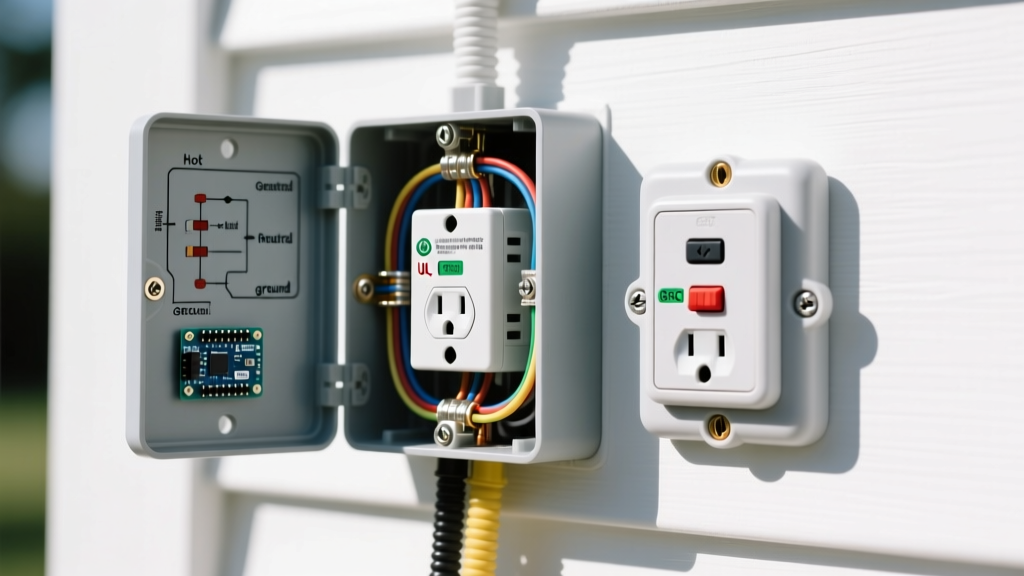
Inspector Note: Montgomery County building inspectors frequently reject installations where the ‘No Equipment Ground’ sticker is missing on GFCI-protected ungrounded circuits in historic zones. Always apply the UL-listed sticker provided in the receptacle box.
Core Wiring Diagrams for Dayton Homes
Diagram 1: Standard 20A Small-Appliance Branch Circuit (Modern Builds)
For new construction in areas like Beavercreek or Centerville, kitchens require at least two 20-amp small-appliance branch circuits. These must be wired with 12 AWG copper ROMEX® and protected by a 20A breaker.
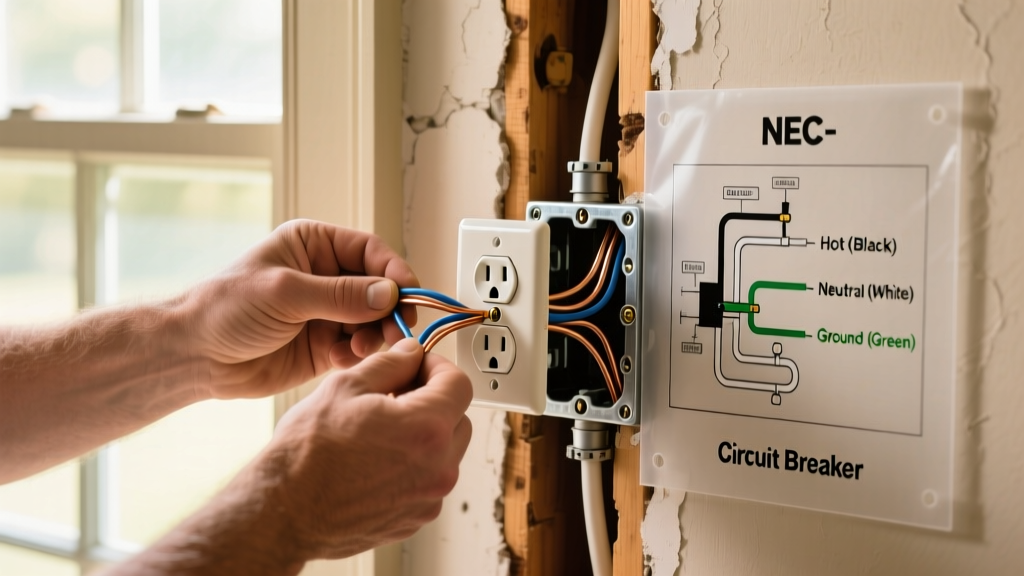
- Line (Hot): Black 12 AWG wire connects to the Brass terminal screw.
- Neutral: White 12 AWG wire connects to the Silver terminal screw.
- Ground: Bare copper wire connects to the Green grounding screw and bonds to the metal junction box via a green grounding pigtail.
- Device Model: Leviton T5262-W (20A Tamper-Resistant Duplex).
- Strip Gauge: Use the built-in strip gauge on the back of the device; typically 5/8 inch for side-wiring.
Diagram 2: Historic Oregon District Ungrounded GFCI Retrofit
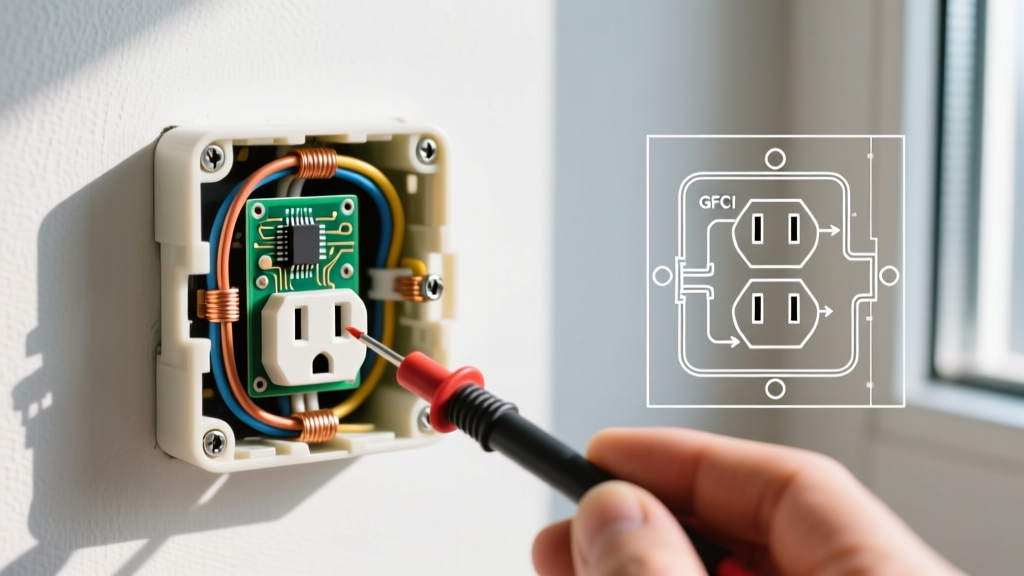
Many homes built before 1960 in Dayton’s historic districts feature ungrounded 2-wire systems (often cloth-sheathed or early NM cable). You cannot legally install a standard grounded 3-prong outlet here. Instead, you must use a GFCI receptacle to provide shock protection, per NEC 406.4(D)(2)(b).
- Line (Hot): Black wire to the Brass ‘LINE’ terminal.
- Neutral: White wire to the Silver ‘LINE’ terminal.
- Ground: Leave the green grounding screw empty. Do not connect a ground wire to a metal box or water pipe.
- Load Terminals: Cap off with wire nuts if not feeding downstream devices.
- Labeling: Apply the ‘GFCI Protected’ and ‘No Equipment Ground’ labels to the faceplate.
Dayton-Specific Outlet Requirements by Room
The following matrix outlines the specific protection required for electrical outlet installation in Dayton, OH, based on current Ohio residential code amendments.
| Room / Area | Receptacle Type | Circuit Rating | Protection Required |
|---|---|---|---|
| Kitchen Countertops | 20A TR Duplex | 20A (12 AWG) | GFCI & AFCI |
| Bathrooms | 20A TR Duplex | 20A (12 AWG) | GFCI |
| Bedrooms & Living Rooms | 15A TR Duplex | 15A or 20A | AFCI |
| Garages & Outdoors | 20A Weather-Resistant | 20A (12 AWG) | GFCI |
| Laundry Room | 20A TR Duplex | 20A (12 AWG) | GFCI & AFCI |
| Basements (Unfinished) | 15A/20A TR | 15A or 20A | GFCI |
Historic Dayton Homes: Edge Cases & Shared Neutrals
When performing an electrical outlet installation in Dayton OH properties built between 1940 and 1970, electricians frequently encounter Multi-Wire Branch Circuits (MWBC) with shared neutrals. If you are replacing a standard duplex receptacle in a kitchen or dining room of a South Park home, you must check for a shared neutral.
The 240V Failure Mode
If two hot wires (from different phases) share a single neutral wire, and you break the neutral tab on the silver side of a duplex receptacle without also breaking the hot brass tab (or if the circuits are not on a double-pole breaker), you can inadvertently place 240 volts across a 120-volt appliance. This will instantly destroy electronics and pose a severe fire hazard.
Correction Protocol: Always verify MWBC configurations with a non-contact voltage tester and a multimeter. If an MWBC is present, NEC 210.4 requires a simultaneous disconnect (a 2-pole breaker or approved handle tie) at the panel. If replacing the receptacle, ensure the hot-side break-off tab is removed and each half of the duplex is fed by a separate hot wire, while keeping the neutral tab intact to carry the unbalanced load.
Step-by-Step Installation & Torque Specifications
To pass inspection and ensure longevity, follow these precise installation steps. In 2026, Dayton inspectors are increasingly strict about NEC 110.14(D), which requires the use of calibrated torque tools for terminal connections.
- De-energize & Verify: Turn off the breaker at the main panel (often a Square D QO or Homeline panel in Dayton homes). Verify zero voltage using a CAT III or CAT IV multimeter.
- Prepare the Wires: Strip exactly 5/8 inch of insulation using a precision wire stripper. Do not nick the copper conductor, which creates a weak point that can snap under thermal expansion.
- Form the Hook: Using needle-nose pliers, form a smooth, clockwise hook on the solid copper wire. The hook should wrap around the screw terminal so that tightening the screw pulls the wire tighter, not pushes it out.
- Apply Precise Torque: Use a calibrated inch-pound torque screwdriver. For standard Leviton 15A/20A residential receptacles, the manufacturer specifies a tightening torque of 0.4 to 0.6 in-lbs. Over-torquing strips the brass threads; under-torquing causes arcing and melted faceplates.
- Box Make-Up: Fold the wires neatly into the back of the junction box. Push the ground wires to the back, followed by the neutrals, then the hots. Mount the receptacle using the provided #6-32 mounting screws.
Cost Expectations for Dayton Electricians (2026)
If you are hiring a licensed Montgomery County electrician rather than DIY-ing, here is what you should expect to pay for professional electrical outlet installation in Dayton, OH:
- Standard 15A/20A Replacement: $125 – $175 per receptacle (includes TR upgrade and labor).
- Ungrounded GFCI Retrofit (Historic Homes): $225 – $350 per circuit, depending on accessibility and panel labeling requirements.
- New Circuit Run (Kitchen/Garage): $450 – $850, factoring in 12 AWG ROMEX, a new 20A breaker, drywall patching, and AES Ohio utility coordination if a service upgrade is triggered.
Permitting in Montgomery County
Any electrical outlet installation in Dayton OH that involves running new wire, adding a new circuit, or upgrading the service panel requires a permit from the Montgomery County Department of Development or the specific municipality (e.g., City of Dayton Building Safety Division). Simple like-for-like receptacle replacements generally do not require a permit, but upgrading an ungrounded 2-prong outlet to a GFCI 3-prong outlet technically requires inspection to verify the ‘No Equipment Ground’ labeling and proper line/load wiring. Always consult the NFPA 70 National Electrical Code for the most current baseline standards before pulling wire.
Frequently Asked Questions
Can I use a GFCI outlet to ground my 3-prong appliances in an older Dayton home?
No. A GFCI provides shock protection by monitoring current imbalance, but it does not provide an equipment grounding path. Sensitive electronics (like desktop PCs or audio equipment) that rely on a true ground for noise filtering or surge protection will not function optimally on a GFCI-protected ungrounded circuit.
Does AES Ohio require special outlets for EV chargers?
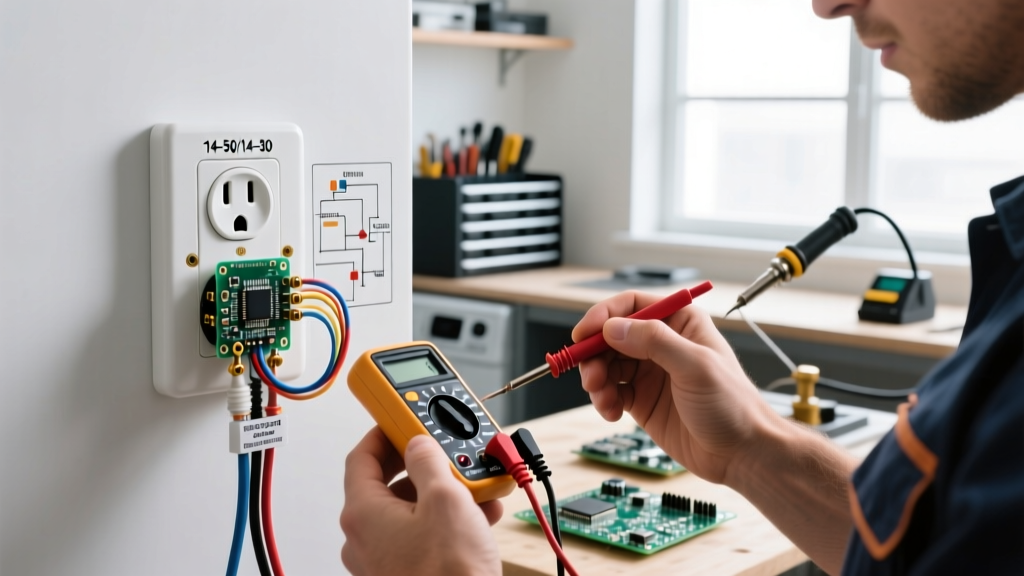
Yes. If your outlet installation is for a Level 2 EV charger, AES Ohio recommends a dedicated 50-amp 240V circuit using a NEMA 14-50 receptacle, wired with 6 AWG copper or 4 AWG aluminum, and hardwired connections are increasingly preferred over receptacles to prevent thermal degradation at the plug interface.