
The Evolution of Outlet Diagnostics: Why Your Tester Matters
Whether you are troubleshooting a dead receptacle in a 1970s ranch home or commissioning a smart-home build, selecting the right tester for electrical outlet verification is the difference between a quick fix and a catastrophic arc fault. In 2026, the National Electrical Code (NEC) has expanded Arc-Fault Circuit Interrupter (AFCI) and Ground-Fault Circuit Interrupter (GFCI) mandates to nearly every 15A and 20A branch circuit in residential dwellings. This means the $10 plug-in cube you bought a decade ago is no longer sufficient for comprehensive diagnostics.
According to the National Fire Protection Association (NFPA), electrical failures and malfunctions remain a leading cause of home fires. Properly verifying ground paths, neutral integrity, and AFCI trip thresholds requires a tiered approach to testing tools. This guide breaks down the exact models, pricing, and diagnostic edge cases you need to master outlet testing this year.
The 3-Tier Approach to Outlet Testing
Professional electricians and advanced DIYers do not rely on a single device. A robust diagnostic kit includes tools from three distinct tiers, each designed to expose specific wiring faults that others might miss.
Tier 1: Basic 3-Light Receptacle Testers (The First Responder)
The 3-light tester is the universal starting point. It uses a simple matrix of neon lamps to indicate common wiring errors: open ground, reverse polarity, open neutral, and hot/ground reverse.
- Top Pick: Sperry Instruments ET64220
- Average Cost: $12 - $16
- Best For: Rapid sweep of an entire house to identify gross wiring errors.
The Limitation: Basic testers cannot verify the *quality* of the ground, only its presence. They also cannot test GFCI trip thresholds accurately if the GFCI mechanism itself is degraded. Furthermore, they are notoriously susceptible to "bootleg ground" false positives, a dangerous edge case we will cover later.
Tier 2: Advanced GFCI & AFCI Diagnostic Testers (The Code Enforcer)
Modern combination AFCI (CAFCI) breakers require specific load signatures to trip. Older testers simply injected a high-frequency burst, which modern breakers often ignore or misinterpret. The Consumer Product Safety Commission (CPSC) heavily emphasizes the need for verified AFCI protection in bedrooms, kitchens, and living areas to prevent parallel and series arc faults.
- Top Pick: Klein Tools RT250 GFCI/AFCI Receptacle Tester
- Average Cost: $45 - $55
- Best For: Verifying that both GFCI and AFCI protection mechanisms trip within the required UL 943 timeframes (under 25 milliseconds for GFCI).
The Klein RT250 features a digital LCD that provides exact trip times and line voltage readings. Crucially, it simulates an arc fault signature that forces the CAFCI breaker to trip without requiring you to walk back and forth to the panel to press the mechanical test button.
Tier 3: True-RMS Digital Multimeters (The Deep Dive)
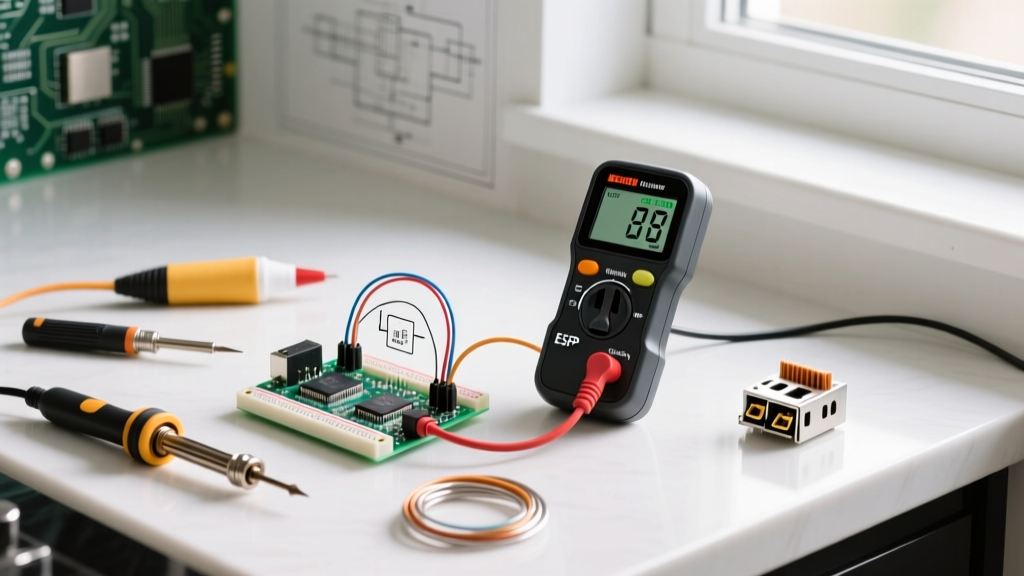
When a receptacle tester indicates a fault, or when a circuit behaves erratically under load, you need absolute numerical data. A True-RMS multimeter measures the exact voltage potential between Hot-Neutral, Hot-Ground, and Neutral-Ground.
- Top Pick: Fluke 117 True RMS Multimeter
- Average Cost: $210 - $230
- Best For: Identifying voltage drop, shared neutral issues, phantom voltages, and bootleg grounds.
The Fluke 117 includes VoltAlert™ non-contact voltage detection and AutoVolt, which automatically switches between AC and DC. For outlet testing, its low-impedance (LoZ) mode is critical for eliminating "ghost voltages" caused by capacitive coupling in long wire runs.
2026 Comparison Matrix: Which Tester Do You Need?
| Tester Type | Model Example | Price Range | Detects Bootleg Grounds? | Tests AFCI Breakers? | Primary Use Case |
|---|---|---|---|---|---|
| 3-Light Cube | Sperry ET64220 | $12 - $16 | No | No | Quick visual sweeps, basic polarity checks |
| GFCI/AFCI Pro | Klein RT250 | $45 - $55 | Partial (via LCD data) | Yes (Simulates arc signature) | Code compliance, GFCI/AFCI trip-time verification |
| True-RMS Multimeter | Fluke 117 | $210 - $230 | Yes (Definitive) | N/A (Measures voltage only) | Deep troubleshooting, voltage drop, phantom voltage |
| Circuit Tracer | Amprobe AT-3500 | $140 - $160 | N/A | N/A | Identifying which breaker controls a specific outlet |
Critical Edge Cases: When Testers Lie to You
Blindly trusting a simple tester for electrical outlet verification can lead to severe shock hazards. Here are the three most common diagnostic traps and how to defeat them.
1. The Bootleg Ground (The Deadly False Positive)
In older homes with ungrounded 2-prong wiring, a previous homeowner may have illegally installed a 3-prong receptacle and connected a jumper wire between the neutral terminal and the ground screw. This is called a "bootleg ground."
The Trap: A standard 3-light tester will read "Correct" because it sees continuity between neutral and ground. However, if a hot wire shorts to the appliance chassis, the chassis becomes energized at 120V, and the breaker will not trip because there is no true ground path back to the panel.
The Fix: Use your Fluke 117. Measure Hot-to-Neutral (should be ~120V). Then measure Hot-to-Ground. If the Hot-to-Ground reading is exactly the same as Hot-to-Neutral, but Neutral-to-Ground reads 0.0V, you likely have a bootleg ground. A true ground will usually show a slight voltage differential (0.5V - 2V) between Neutral and Ground due to normal voltage drop on the neutral conductor.
2. Phantom (Ghost) Voltages
When testing a switched outlet or a wire running parallel to a live hot wire, a high-impedance digital multimeter might read 40V to 90V on a disconnected wire. This is capacitive coupling.
The Fix: Engage the LoZ (Low Impedance) mode on your multimeter. This places a resistive load across the probes, bleeding off the phantom capacitive charge and dropping the reading to a true 0.0V.
3. Shared Neutrals (Multi-Wire Branch Circuits)
If you are testing an outlet and find that turning off the breaker kills the hot wire, but the neutral wire still shows voltage when disconnected, you have a shared neutral (MWBC). The Occupational Safety and Health Administration (OSHA) strictly warns against working on energized neutrals, as they can carry return current from an adjacent hot leg.
The Fix: Always use a non-contact voltage tester on the neutral pigtail before untwisting wire nuts, and ensure both poles of the MWBC are locked out at the panel.
Step-by-Step Diagnostic Workflow for Suspect Outlets
Follow this standardized workflow when an outlet is reported as "dead" or "behaving strangely" to ensure maximum safety and diagnostic accuracy.
- Visual Inspection: Remove the faceplate. Look for melted plastic, scorch marks, or backstabbed wire connections (which are prone to thermal failure).
- Non-Contact Voltage (NCV) Sweep: Use the VoltAlert feature on your multimeter to confirm the presence of AC voltage before making physical contact with the terminals.
- Basic Topology Check: Plug in the Sperry 3-light tester. Note the light pattern. If it shows "Open Neutral," proceed to step 4.
- Precision Voltage Measurement: Insert the Fluke 117 probes into the receptacle slots. Measure Hot-Neutral, Hot-Ground, and Neutral-Ground. Compare against the ANSI C84.1 standard, which dictates a nominal 120V range of 114V to 126V.
- Load Testing: If voltage reads correctly but devices fail to operate, plug in a solenoid voltage tester or a high-draw load (like a heat gun). If the voltage immediately drops below 110V under load, you have a high-resistance connection upstream, likely a failed backstab or a loose wire nut.
- GFCI/AFCI Verification: Plug in the Klein RT250. Press and hold the GFCI test button. The LCD should confirm a trip in under 25ms. For AFCI, press the AFCI test button and verify the breaker trips at the panel.
Safety Directive: Never assume a circuit is de-energized based solely on a wall switch position or a tripped GFCI receptacle. Always verify zero energy state with a calibrated True-RMS multimeter before removing receptacle mounting screws. Adherence to NFPA 70E electrical safety standards is mandatory for all diagnostic work.
Final Verdict: Building Your 2026 Testing Arsenal
There is no single "magic bullet" tester for electrical outlet diagnostics. The 3-light cube remains a vital tool for rapid, whole-home sweeps, but it must be treated as a preliminary indicator, not a definitive safety certification. For modern homes governed by strict AFCI and GFCI codes, the Klein RT250 is an indispensable investment that pays for itself on the first complex troubleshooting call. Finally, the True-RMS multimeter remains the ultimate source of truth, exposing hidden faults like bootleg grounds and voltage drops that simpler tools simply cannot see. Equip your tool belt with all three tiers, and you will be prepared for any wiring anomaly the modern grid throws your way.