
The Hidden Hazard in Your Drawer: Unlisted Travel Adapters
As cross-border e-commerce platforms continue to dominate global retail in 2026, the influx of direct-from-manufacturer electronics has skyrocketed. Alongside these devices comes a ubiquitous accessory: the Chinese electrical outlet adapter. Whether you are importing a specialized 3D printer, a high-end rice cooker, or simply returning from a trip to Shenzhen with a Type I plug device, you have likely relied on a small, inexpensive plastic adapter to bridge the gap between Chinese GB 2099.1 pins and North American NEMA 5-15R receptacles.
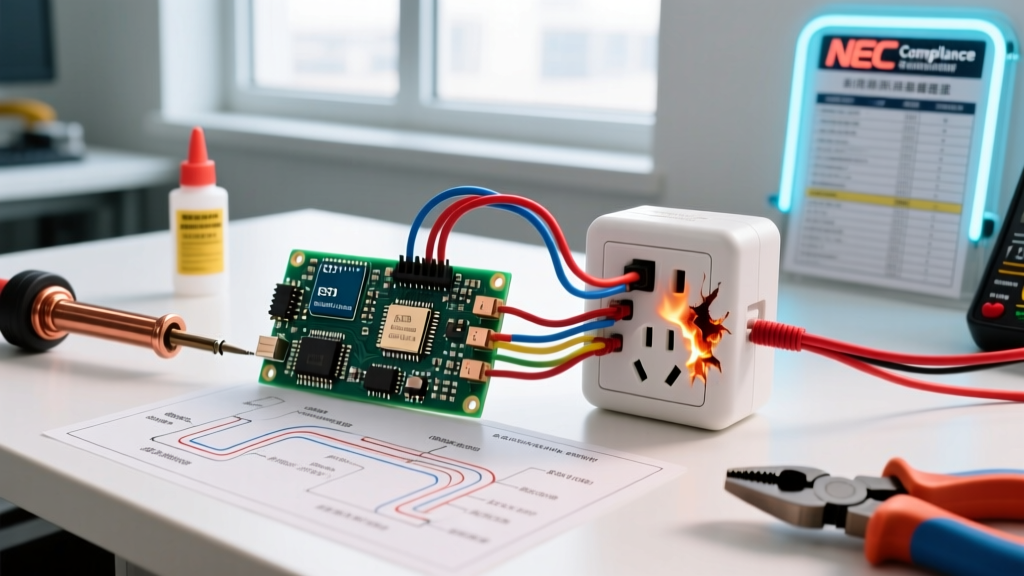
However, from an electrical safety and code compliance perspective, the vast majority of these generic, unbranded adapters represent a severe fire hazard. They routinely bypass the rigorous testing required by Nationally Recognized Testing Laboratories (NRTLs) like UL or ETL. This guide breaks down the exact failure modes of these adapters, the National Electrical Code (NEC) violations they trigger, and how to safely adapt Chinese appliances to North American infrastructure.
NEC Code Compliance: Why Unlisted Adapters Violate the Law
Using an unlisted adapter is not just a bad idea; in commercial, industrial, and multi-family residential settings, it is a direct violation of the National Electrical Code (NFPA 70). Understanding the specific code articles helps electricians and facility managers enforce safety standards.
NEC Article 110.3(B): Installation and Use
NEC 110.3(B) states that "Listed or labeled equipment shall be installed and used in accordance with any instructions included in the listing or labeling." Furthermore, equipment must be evaluated by an NRTL. A generic Chinese electrical outlet adapter purchased from a third-party marketplace rarely carries a valid UL or ETL mark. Using unlisted equipment to connect an appliance to the building's wiring system voids the safety certification of the entire circuit and can invalidate commercial property insurance in the event of a fire.
NEC Article 406.7: Receptacles and Attachment Plugs
Article 406 governs the physical connection points in an electrical system. Adapters that do not maintain proper grounding continuity, or those that allow the insertion of a 15A/20A NEMA plug into a 10A-rated internal shunt without overcurrent protection, violate the fundamental safety principles of Article 406. The NFPA's electrical safety guidelines explicitly warn against using unlisted, temporary adapters as permanent wiring solutions.
Inspector's Note: In commercial environments, OSHA inspectors routinely cite facilities under 29 CFR 1910.303(b)(1) for using unlisted electrical adapters. Fines can exceed $15,000 per violation, making that $2 travel adapter an incredibly expensive liability.
Anatomy of a Thermal Failure: Inside the $2 Adapter
To understand why these adapters fail, we must look at the metallurgy and mechanical tolerances inside the housing. A Chinese Type I plug features three flat pins (one vertical grounding pin, two angled current-carrying pins) rated for 10A or 16A at 250V. A North American NEMA 5-15R receptacle expects two parallel flat blades and a U-shaped ground pin.
The Contact Tension Problem
Inside a UL-listed adapter, the internal leaf springs that grip the Type I pins are made from 0.8mm thick phosphor bronze or beryllium copper. These alloys maintain high spring tension and excellent conductivity even after hundreds of insertion cycles. In a generic, unlisted adapter, manufacturers use 0.3mm stamped steel with a microscopic flash of brass plating.
When you draw 12 Amps (typical for a 1400W appliance) through these thin steel shunts, the electrical resistance increases dramatically. According to Joule's First Law ($P = I^2R$), even a minor increase in contact resistance generates massive amounts of localized heat.
Thermal Runaway and Plastic Deformation
Unlisted adapters are typically molded from cheap ABS (Acrylonitrile Butadiene Styrene) plastic, which begins to soften and deform at approximately 85°C to 105°C. As the internal steel shunts heat up to 90°C under load, the ABS housing softens. This causes the internal leaf springs to lose their mechanical tension, which in turn increases the contact resistance further, generating more heat. This thermal runaway loop ends in one of two ways: the adapter melts into the receptacle, or it arcs, igniting the surrounding plastic and drywall.
Comparison Matrix: Generic Import vs. UL-Listed Adapter
Not all adapters are created equal. If you must use a physical adapter, you must source one that carries a legitimate NRTL mark. Below is a technical comparison of what you are actually buying.
| Specification | Generic Unlisted Adapter (Direct Import) | UL-Listed Adapter (e.g., Ceptics, BESTEK) |
|---|---|---|
| Average Cost | $1.50 - $3.00 | $9.00 - $16.00 |
| Internal Shunt Material | Stamped steel, brass-plated | 0.8mm Phosphor Bronze / Beryllium Copper |
| Housing Material | ABS Plastic (Flammable, low melt point) | Polycarbonate / Nylon (UL94 V-0 Flame Retardant) |
| Max Continuous Load | Unreliable (Often fails >5A) | 10A to 15A (Verified by thermal testing) |
| Grounding Continuity | Frequently disconnected or high-resistance | Low-resistance continuous path to NEMA ground |
| NRTL Certification | None (Often fake CE/RoHS marks) | UL, ETL, or CSA Listed |
The Voltage Mismatch: 220V vs. 120V Reality Check
A physical Chinese electrical outlet adapter only changes the shape of the pins; it does absolutely nothing to change the voltage or frequency. China operates on a 220V / 50Hz electrical grid. North America operates on 120V / 60Hz.
- Dual-Voltage Appliances (100-240V, 50/60Hz): Modern switching power supplies (laptops, phone chargers, camera battery docks) will work perfectly fine with just a physical adapter.
- Single-Voltage Resistive Loads (220V Only): Plugging a 220V Chinese hair dryer or toaster into a 120V US outlet will result in 1/4th the expected power output. It will barely get warm.
- Single-Voltage Motor/Compressor Loads (220V Only): This is highly dangerous. Plugging a 220V air conditioner, refrigerator, or heavy-duty pump into 120V will cause the motor to stall, draw locked-rotor current, overheat, and potentially catch fire unless protected by a highly sensitive thermal overload switch.
The Code-Compliant Solution: Rewiring the Plug
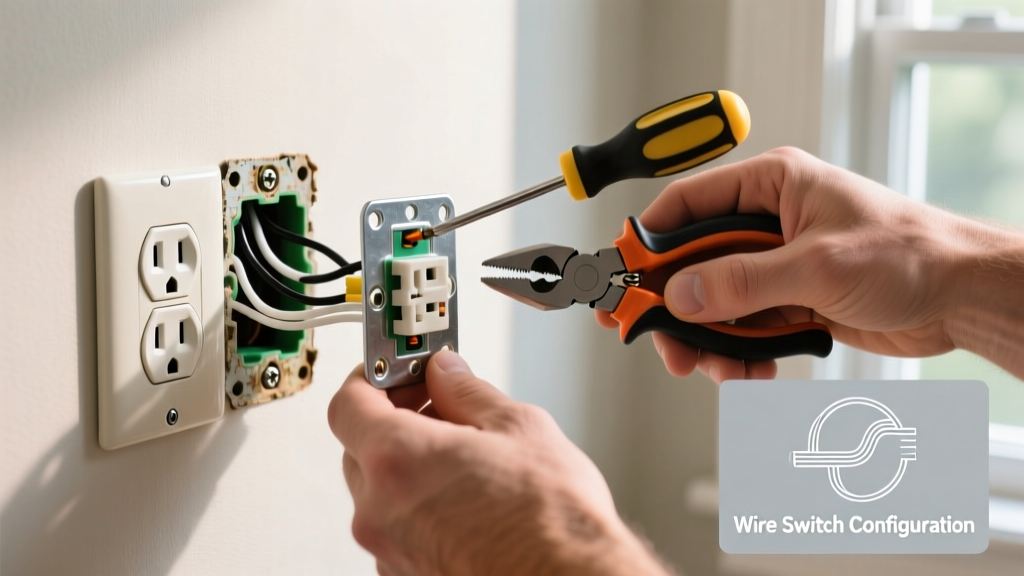
For permanent installations, high-draw appliances, or commercial equipment imported from China, the only truly safe and NEC-compliant solution is to abandon the adapter entirely. You must cut off the Chinese GB 1002 / Type I plug and wire on a proper North American NEMA 5-15P or 5-20P attachment plug.
The CPSC strongly advises against relying on temporary adapters for continuous-use appliances. Replacing the plug takes 10 minutes and costs less than $5 in parts.
Step-by-Step Plug Replacement Guide
- Procure a Listed Replacement Plug: Purchase a UL-listed NEMA 5-15P plug, such as the Leviton 5266-C (approx. $4.50) or a Hubbell 5266. Ensure it has an internal cord grip.
- Sever the Old Plug: Using flush-cut diagonal pliers, cut the Chinese Type I plug off the cord. Ensure the cut is straight and clean.
- Strip the Outer Jacket: Carefully score and remove 1.5 inches of the outer cord jacket, exposing the three inner conductors (Line, Neutral, Ground). Do not nick the copper strands.
- Strip the Conductors: Strip exactly 5/8 inch of insulation from the ends of the three inner wires.
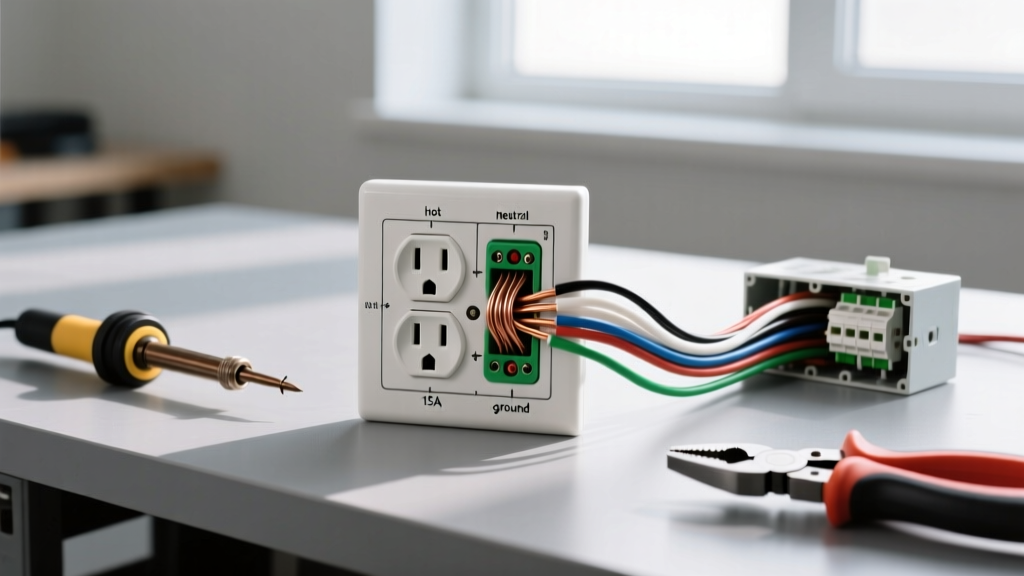
- Identify the Wires:
- Green (or Green/Yellow): Ground
- Blue or Brown: Line (Hot) - In Chinese wiring, Brown is typically Line, Blue is Neutral. Always verify with a multimeter if the device has a switch.
- Terminate the Connections:
- Connect the Green wire to the Green grounding screw.
- Connect the Brown (Line) wire to the Brass (dark) screw.
- Connect the Blue (Neutral) wire to the Silver (light) screw.
- Secure the Cord Grip: Ensure the internal clamp grabs the thick outer jacket of the cord, NOT the thin inner wires. This prevents strain on the terminal screws.
- Close and Test: Reassemble the plug housing and test the appliance.
Frequently Asked Questions
Can I use a Chinese power strip in the US with an adapter?
No. Chinese power strips are wired for 250V and often contain internal surge protection components (MOVs) rated for 275V AC. While they won't immediately explode on a 120V US circuit, the internal wire gauges are sized for 10A at 250V (2500W). Furthermore, using an adapter to plug a high-capacity power strip into a 15A US wall receptacle creates a bottleneck at the adapter joint, which is a primary cause of residential electrical fires.
Are CE and RoHS marks valid safety certifications in North America?
No. CE (Conformité Européenne) is largely a self-declaration of conformity for the European market and does not involve independent laboratory testing for electrical shock and fire hazards in the way UL or ETL does. RoHS only restricts hazardous materials like lead and cadmium. Neither mark satisfies OSHA or NEC requirements for listed electrical equipment in the United States. For more on NEMA standards and receptacle configurations, refer to the official NEMA guidelines.
My adapter feels warm to the touch. Is that normal?
No. A properly functioning, UL-listed adapter operating within its rated amperage should remain at or near ambient room temperature. If the plastic housing is warm, it indicates high internal resistance and imminent thermal failure. Unplug it immediately and discard it.