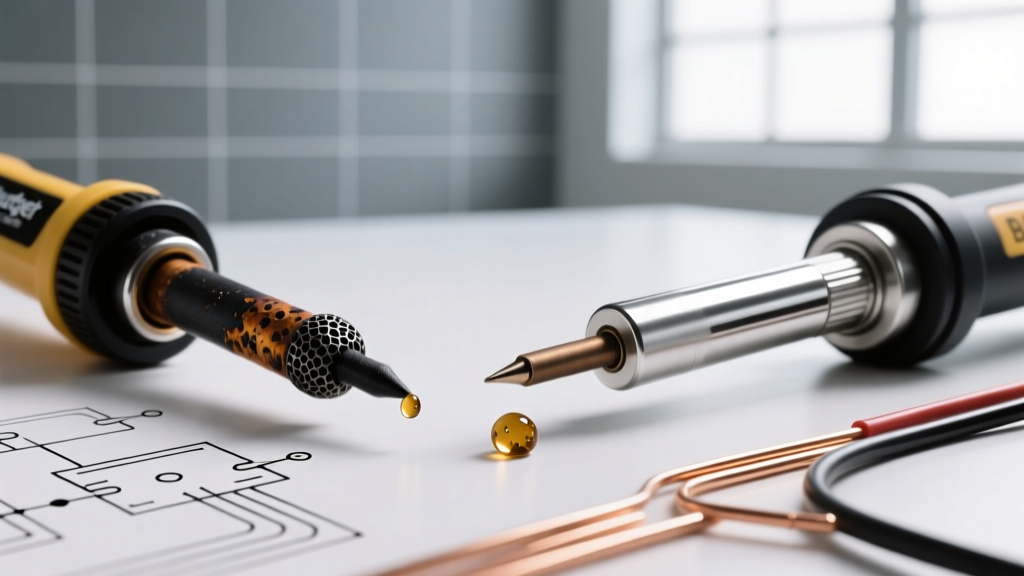

Every electronics hobbyist and professional has experienced the frustration of an oxidized soldering tip. You turn on your station, apply fresh SAC305 or 63/37 rosin-core solder, and instead of a smooth, shiny wetting action, the solder balls up and rolls off a black, crusty surface. This black crust is Iron(III) oxide (Fe2O3), and it forms when the protective iron plating on your tip reacts with oxygen at high temperatures. While oxidation is a natural chemical process, the speed and severity with which it destroys your tip depend entirely on the metallurgy of your soldering kit.
In 2026, the market is flooded with ultra-budget $15 USB-C soldering irons and generic 900M tip kits, sitting right next to $350+ premium stations from brands like JBC and Metcal. Understanding the material science behind these tools is the key to solving oxidation issues, optimizing your workflow, and ultimately saving money.
The Metallurgy of Soldering Tips: Copper, Iron, and Chrome
To understand why an oxidized soldering tip occurs, you must first understand how a tip is constructed. Solder easily dissolves copper. If a tip were made of solid copper, it would dissolve into the solder joint within minutes, creating a pitted, unusable mess. To prevent this, manufacturers use a multi-layer approach:
- Copper Core: Provides rapid thermal conductivity from the heating element to the workpiece.
- Iron Plating: A protective layer that prevents the solder from dissolving the copper. Iron does not readily alloy with tin/lead or SAC (Tin-Silver-Copper) solders.
- Chrome/Aluminum Barrier: Applied to the non-working areas of the tip to prevent solder creep (where solder climbs up the shaft of the tip).
The quality, thickness, and density of that middle iron plating dictate the lifespan of your tip and its resistance to oxidation.
Material Specifications: Budget vs. Premium
| Specification | Budget Kits (Generic 900M) | Mid-Tier (Hakko T18 Series) | Premium (JBC C245 / Weller RT) |
|---|---|---|---|
| Iron Plating Thickness | 100 - 150 microns (Thin) | 200 - 300 microns | 400+ microns (Proprietary Alloys) |
| Plating Density | Porous, prone to micro-cracking | Dense, electroplated | Ultra-dense, multi-stage forged |
| Average Cost per Tip | $0.50 - $1.50 | $7.00 - $9.50 | $38.00 - $55.00 |
| Expected Lifespan | 10 - 30 hours of use | 150 - 300 hours | 1,000+ hours (with proper care) |
Why Budget Kits Suffer from Rapid Oxidation
Budget soldering kits, particularly those utilizing the ubiquitous 900M series tips, suffer from severe manufacturing shortcuts. The iron plating is not only exceptionally thin, but the electroplating process is rushed, resulting in a porous surface. When subjected to the standard 350°C (662°F) required for lead-free SAC305 solder, oxygen penetrates these microscopic pores, oxidizing the iron layer from the inside out.
Expert Insight: According to the IPC J-STD-001 standards for soldered electrical assemblies, maintaining proper tip wetting is critical for reliable thermal transfer. An oxidized tip acts as a thermal insulator, forcing operators to increase temperature or dwell time, which paradoxically accelerates further oxidation and risks damaging sensitive PCB pads.
The Thermal Shock Factor
Budget kits often include a wet cellulose sponge for cleaning. Wiping a 350°C tip on a room-temperature wet sponge causes an instantaneous temperature drop of over 100°C. In premium tips, the thick, dense iron plating absorbs this thermal shock. In budget tips, this rapid contraction causes micro-cracking in the porous iron layer. Once cracked, the underlying copper is exposed to the air and the flux, leading to catastrophic pitting and immediate, irreversible oxidation.
Real-World Failure Modes: Step-by-Step
When using a budget kit, the degradation of an oxidized soldering tip follows a predictable, rapid failure cycle:
- Initial Dry-Burn: The user leaves the iron in its holder without a protective blob of solder. Oxygen attacks the thin iron plating.
- Flux Corrosion: The user applies aggressively activated water-soluble flux. The flux acids eat through the microscopic pores in the cheap iron plating.
- Copper Leaching: The iron barrier fails. Solder contacts the copper core. The copper dissolves into the solder joint, creating a visible crater (pit) on the tip.
- Complete Non-Wetting: The exposed copper and oxidized iron create a rough, black surface that physically rejects molten solder.
Reviving an Oxidized Soldering Tip: What Actually Works
Before throwing away a tip, it is crucial to determine if the oxidation is superficial or if the iron plating has been breached. Below is a comparison of common cleaning and revival methods, evaluated against the rigorous NASA-STD-8739.3 workmanship requirements for soldering tools.
| Method | Mechanism | Effectiveness on Oxidation | Risk to Tip Plating |
|---|---|---|---|
| Brass Wire Sponge | Mechanical abrasion (soft) | Low (Removes carbon, not heavy oxide) | Very Low |
| Wet Cellulose Sponge | Thermal shock & steam | Medium (Flakes off heavy crust) | High (Causes micro-cracking) |
| Tip Tinner / Activator | Chemical reduction (Aggressive flux + solder powder) | Very High (Strips oxide and re-tins simultaneously) | Low (If used correctly at lower temps) |
| Sandpaper / File | Heavy mechanical abrasion | N/A (Removes oxide by destroying tip) | Fatal (Strips iron plating entirely) |
The Tip Tinner Protocol
If your tip is black and will not wet, a high-quality Tip Tinner (such as those made by Kester or MG Chemicals) is your best option. As noted in Kester's technical documentation on flux activation, tip tinner contains a highly aggressive reducing agent mixed with SAC305 solder powder.
How to use it: Turn your station down to 250°C (482°F). Plunge the oxidized tip into the tinner paste for 2-3 seconds. The aggressive flux will chemically reduce the Iron(III) oxide back into bare iron, while the solder powder immediately wets the freshly exposed surface. Wipe gently on a dry brass sponge, re-tin with your standard rosin-core solder, and bring the station back up to working temperature.
Total Cost of Ownership (TCO) in 2026
When evaluating budget versus premium kits, the initial hardware cost is deceptive. Let us calculate the 2-year TCO for a hobbyist soldering 5 hours a week (approx. 500 hours total).
- Budget Kit (Generic 60W + 900M Tips): Station costs $20. At 20 hours per tip, you will need 25 replacement tips. At $1.00 each, tips cost $25. Total: $45. (Plus the hidden cost of ruined PCB pads and frustration).
- Mid-Tier (Hakko FX-888D + T18 Tips): Station costs $110. At 200 hours per tip, you need 3 tips. At $8.00 each, tips cost $24. Total: $134.
- Premium (JBC CD-2BQE + C245 Tips): Station costs $380. At 1,000 hours per tip, you need 1 tip. At $45.00, the tip costs $45. Total: $425.
While the premium kit requires a higher upfront capital expenditure, the cost per hour of flawless, oxidation-free soldering is vastly superior. Furthermore, premium stations feature instant tip-temperature recovery, meaning you can solder at 320°C instead of 380°C, which inherently slows the rate of iron oxidation.
Frequently Asked Questions
Can I use a Dremel or file to sand off the black oxidation?
No. Modern soldering tips are not solid metal; they are copper cores with a microscopic layer of iron plating. Using a file, sandpaper, or a Dremel tool will instantly strip away the iron plating, exposing the copper. The tip will dissolve into your solder within minutes and is permanently ruined.
Does lead-free solder cause faster oxidation than leaded solder?
Yes. Lead-free alloys like SAC305 require higher processing temperatures (typically 350°C to 380°C, compared to 300°C for 63/37 Sn/Pb). The rate of iron oxidation doubles approximately every 50°C increase in temperature. If you must use lead-free solder, investing in a premium tip with thick iron plating is mandatory.
How should I store my iron to prevent oxidation between uses?
Never leave a tip 'dry' in the holder. Before turning off your station, melt a large, generous blob of rosin-core solder over the entire working end of the tip. This sacrificial blob will oxidize instead of the tip's iron plating. When you turn the iron back on, simply wipe the sacrificial blob off on a brass sponge, and the tip underneath will be perfectly shiny and ready to use.