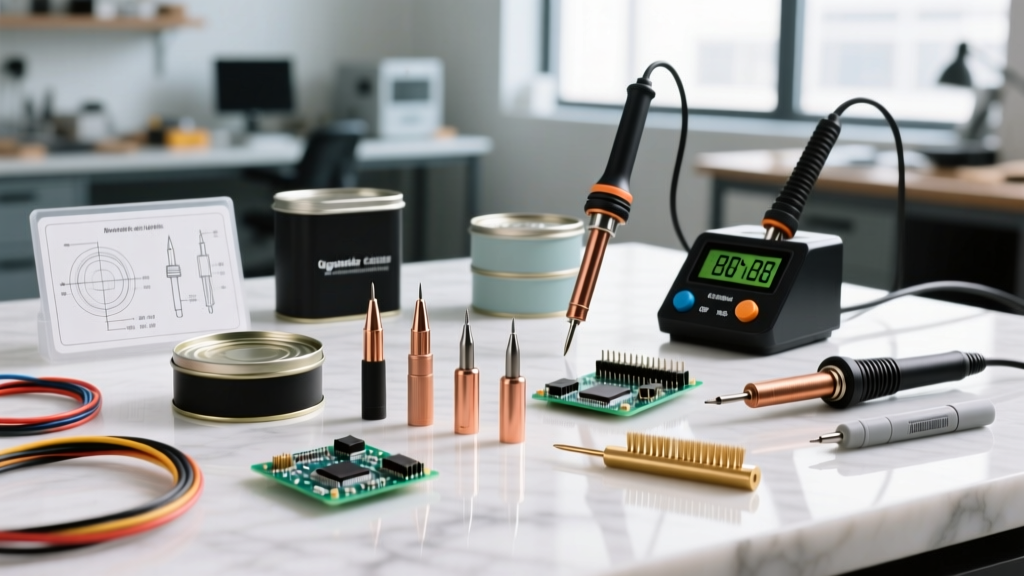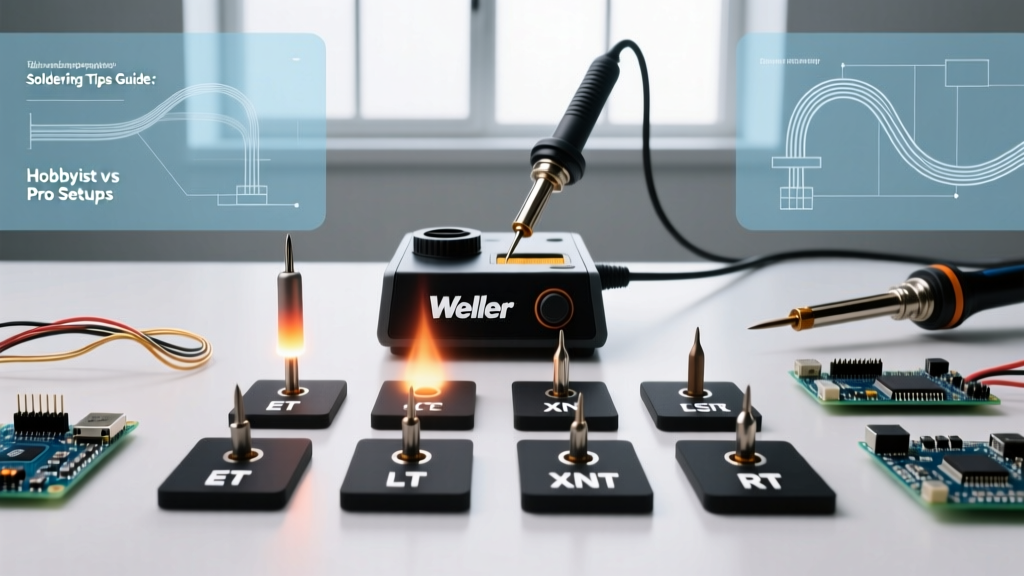

The Great Divide: Hobbyist vs. Professional Weller Ecosystems
When building or upgrading an electronics workspace, selecting the right soldering station is only half the battle. The actual point of contact—the soldering tip—dictates your thermal transfer, joint quality, and long-term operating costs. Weller dominates the market, but their ecosystem is strictly bifurcated. Understanding the engineering differences between hobbyist and professional Weller soldering tips is critical for anyone transitioning from basic DIY repairs to high-density SMD rework or production-level prototyping in 2026.
The fundamental difference lies in thermal architecture. Hobbyist tips rely on passive thermal conduction from a remote heating element, while professional tips integrate the heater and thermocouple directly into the tip's nose. This distinction drastically changes how the iron responds to high-thermal-mass components, such as multi-layer PCB ground planes or heavy gauge wire lugs.
Hobbyist Workhorses: The ET and LT Series
The hobbyist and prosumer tier is anchored by legendary stations like the Weller WES51 and the modern digital WE1010NA. These stations utilize two primary tip families:
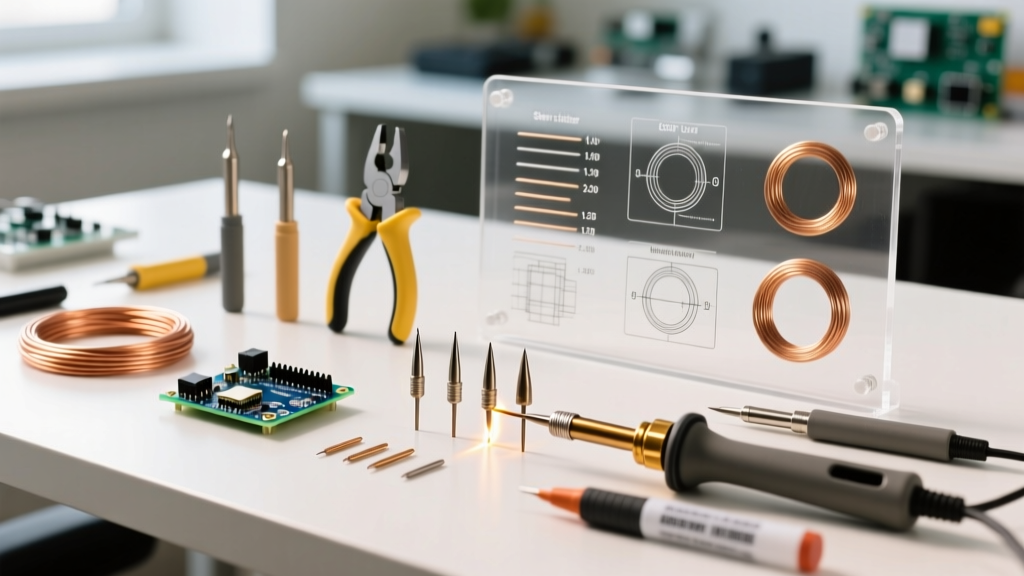
- ET Series (Screw-in): These feature a stainless steel sleeve that screws onto the wand to secure the copper core. The heating element sits inside the wand, and heat must travel through an air gap and the copper shank to reach the working end. Common shapes include the ETA (0.031-inch screwdriver) and ETB (0.062-inch).
- LT Series (Slip-on): Designed for faster changeover, LT tips slide over the heater and are secured by a retaining nut. They offer slightly better thermal transfer than the ET series but still suffer from the fundamental physics of remote heating.
Cost & Value: ET and LT tips are remarkably affordable, typically ranging from $6.50 to $9.00 per tip. For hobbyists working primarily with through-hole components, 60/40 leaded solder, and single-layer PCBs, this passive thermal architecture is entirely sufficient.
Professional Precision: XNT and RT Micro Series
Professional environments utilizing the Weller WX1020, WX2020, or the advanced WR2000 rework stations require immediate thermal recovery. This is achieved through active tip technology.
- XNT Series: The standard professional tip. The heater and sensor are embedded directly at the base of the tip shank, eliminating the air gap. Priced around $28 to $35 per tip, XNT tips offer a 40% faster heat-up time compared to LT series.
- RT Pico Series: Designed for micro-soldering and 0201/01005 SMD components. The RT series features a micro-heater and sensor integrated into the very tip of the cartridge. Because the thermal mass is incredibly low, RT tips can drop from 450°C to 150°C and recover to 350°C in under 0.8 seconds. These specialized cartridges cost between $42 and $55 each.
Weller Tip Series Comparison Matrix
| Series | Heater Location | Avg Price (2026) | Compatible Stations | Best Use Case |
|---|---|---|---|---|
| ET | Wand (Remote) | $6.50 - $9.00 | WES51, WESD51 | Through-hole, heavy wires, hobbyist DIY |
| LT | Wand (Remote) | $7.00 - $9.50 | WES51, WE1010NA | General purpose, mixed SMD/THT |
| XNT | Tip Base (Integrated) | $28.00 - $35.00 | WX1, WX2, WXP120 | Production SMD, lead-free alloys |
| RT | Tip Nose (Micro-Active) | $42.00 - $55.00 | WXMP, WXM, WR2000 | Micro-BGA, 0201 passives, flex circuits |
Thermal Recovery and Active Sensing: Why Pro Tips Cost 5x More
Why would a professional pay $50 for an RT tip when a $7 ET tip seemingly does the same job? The answer lies in the transition to lead-free solder alloys. According to the IPC J-STD-001 standards for soldered electrical assemblies, SAC305 (lead-free) solder requires a minimum wetting temperature of 217°C, but practical hand-soldering requires the tip to be set between 350°C and 380°C to ensure proper intermetallic compound (IMC) formation.
When a hobbyist ET tip touches a large copper ground plane, the thermal mass of the board instantly absorbs the heat. The tip temperature can plummet by 40°C to 60°C. Because the thermocouple in a WES51 wand is located inches away from the working end, the station's PID controller doesn't register the temperature drop immediately. By the time the 50W heater ramps up, the operator has already lingered on the pad for 4 seconds, risking pad delamination.
Thermal Profiling Insight: High-reliability soldering requires strict thermal profiling. As noted in the NASA Workmanship Standards for electronic assemblies, prolonged dwell times caused by inadequate thermal recovery are a primary cause of latent solder joint fractures and substrate damage. Active-sensing tips mitigate this by injecting wattage precisely at the point of thermal loss.
With an RT series tip, the sensor is millimeters from the pad. The moment the board absorbs heat, the micro-controller detects the micro-drop in temperature and injects up to 40W of power directly into the tip's nose. The temperature recovers almost instantaneously, allowing the operator to complete the joint in under 1.5 seconds.
Critical Failure Modes: How You Are Destroying Your Tips
Whether you are using a $7 ET tip or a $50 RT cartridge, improper maintenance will destroy the iron plating, leading to de-wetting and core corrosion. In 2026, the most common failure modes we see in lab environments include:
- Abrasive Sponges and Sandpaper: Using standard cellulose sponges soaked in tap water causes micro-thermal shock, cracking the iron plating. Using sandpaper or files to remove oxidation exposes the raw copper core, which will dissolve into the solder pool within minutes, ruining the tip permanently.
- Flux Carbonization: Modern no-clean and water-soluble fluxes become highly corrosive and carbonize at temperatures above 380°C. If left on the tip, this black crust acts as a thermal insulator, reducing heat transfer by up to 60%.
- Dry Heating (The RT Killer): Leaving an RT micro-tip idle at 380°C without solder coverage will oxidize the micro-plating in less than 15 minutes. Because RT tips have such low thermal mass, they oxidize significantly faster than heavy ET tips when left dry.
The 2026 Maintenance Protocol
To maximize the lifespan of your Weller soldering tips, implement this strict maintenance protocol:
- Use Brass Wool, Not Sponges: Always use a dry brass wire sponge (like the Weller WDC2). It removes oxidation without dropping the tip temperature or causing thermal shock.
- Utilize Tip Tinner: If a tip becomes oxidized and refuses to wet, do not scrape it. Dip the hot tip into a Weller WHLT001 Tip Tinner compound. The mild abrasives combined with aggressive flux and solder powder will chemically strip the oxidation and re-tin the tip in one motion.
- Enable Auto-Sleep: If you are using a digital station like the WE1010NA or WX2, configure the auto-sleep function to drop the temperature to 150°C after 5 minutes of inactivity. This alone will triple the lifespan of your tip plating.
- Always Tin Before Power-Down: The moment you turn off your station, melt a generous amount of 60/40 or SAC305 solder over the entire working surface of the tip. This sacrificial layer will oxidize instead of the tip's iron plating as it cools.
When to Cross the Professional Threshold
Upgrading from hobbyist to professional Weller soldering tips requires buying into a new station ecosystem; an RT tip will not fit a WES51 wand. You should make the financial leap to a WX-series station and XNT/RT tips if:
1. You are soldering multi-layer PCBs: If you frequently work on 4-layer to 8-layer boards with internal ground planes, the thermal lag of an ET tip will result in cold, grainy solder joints.
2. You are working with micro-SMD: If your work involves 0402, 0201, or fine-pitch QFN packages, the physical size and pinpoint heat injection of the RT Pico series are mandatory to prevent bridging and pad lift.
3. You are strictly using Lead-Free: SAC305 and SAC405 alloys demand high thermal budgets. The active sensing of XNT and RT tips ensures you aren't forced to run your station at a destructive 420°C just to achieve flow.
For casual Arduino wiring, basic kit assembly, and heavy-gauge RC battery connectors, the Weller WES51 with a standard ETB tip remains an unbeatable, cost-effective workhorse. But as modern electronics continue to shrink and thermal demands increase, investing in Weller's active-sensing professional tips is an investment in joint reliability and operator efficiency.
For more information on baseline equipment standards, refer to the official Weller Tools catalog to verify wand compatibility before purchasing replacement cartridges.