
Why Your Stock Wire Soldering Holder is Bottlenecking Your Workflow
If you are still using the $15 generic 'helping hands' with stiff alligator clips that came bundled in your beginner soldering kit, you are actively damaging your projects. Cheap wire soldering holder setups suffer from three critical failure modes: they mar delicate PTFE and silicone insulation with sharp metal teeth, they lack the thermal mass to act as a heat sink when tinning heavy-gauge wires, and their rigid goosenecks vibrate every time you apply flux or tin. In 2026, as DIY electronics push toward higher-current drone ESCs, custom mechanical keyboard matrices, and automotive 12V/24V wiring, precision wire management is no longer optional.
Upgrading your wire holding apparatus is one of the highest-ROI investments you can make for your workbench. A premium holder reduces cold joints caused by wire movement during the liquidus phase of the solder alloy and prevents insulation melt-back. Below, we break down the top-tier upgrades available this year, moving beyond basic clamps into professional-grade articulating arms and ESD-safe vises.
The 2026 Upgrade Matrix: Top Wire Soldering Holders Compared
Before diving into the deep-dive reviews, here is a rapid-fire comparison of the top three wire soldering holder upgrades dominating professional and advanced hobbyist benches in 2026.
| Model | Best Application | Est. Price (2026) | ESD Safe | Max Wire Gauge |
|---|---|---|---|---|
| QuadHands Workbench 650 | Multi-wire harnesses, complex splices | $89.00 | No (Anodized Al) | 10 AWG (with silicone caps) |
| PanaVise 201 'Junior' | Heavy-gauge power wires, XT60/XT90 | $38.00 | No (Neoprene jaws) | 4 AWG |
| Hakko 611 Digital Holder | Sensor wires, ESC telemetry, micro-connectors | $48.00 | Yes (<10^9 Ω) | 18 AWG |
1. QuadHands Workbench 650: The Ultimate Flexible Upgrade
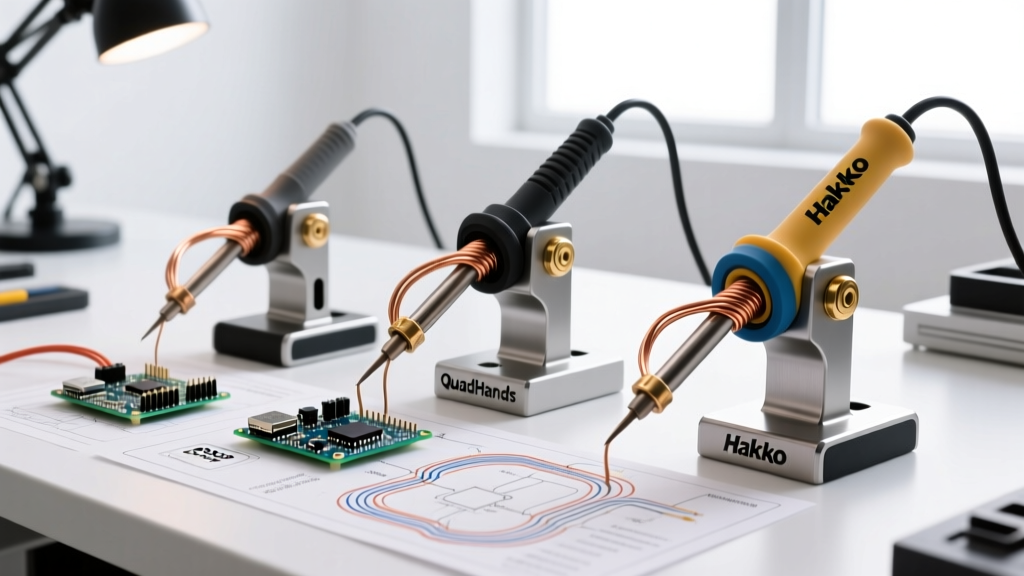
The QuadHands Workbench 650 has cemented itself as the gold standard for multi-point wire holding. Unlike cheap Amazon clones that use loose ball-joints requiring constant tightening with an Allen key, the 650 utilizes high-tension friction hinges that hold their position indefinitely, even when supporting the weight of a partially assembled wire harness.
- Jaw Material: Comes with interchangeable silicone jaw caps (Shore 40A hardness). This is critical because standard metal alligator clips will permanently indent or slice through 22 AWG silicone wire when clamped tightly. The 40A silicone grips the wire via friction without piercing the dielectric layer.
- Thermal Management: The aluminum arms act as a passive heat sink. When tinning 14 AWG wire at 380°C (required for most lead-free SAC305 alloys), the heat travels down the copper strands. The QuadHands arms absorb this thermal bleed, preventing the wire from getting too hot to handle and stopping the insulation from melting back.
- Failure Mode to Avoid: Beware of the $25 'Q-Hands' knockoffs. They use inferior zinc-alloy joints that strip out after 20-30 adjustments, leaving you with a floppy, unusable arm.
2. PanaVise 201 'Junior' Mini Vise: For Heavy-Gauge Power Wires
When you are soldering 10 AWG to 4 AWG silicone wires for FPV drone power trains or e-bike battery packs, articulating arms simply do not have the clamping force required. The wire's natural spring-back will pull it out of a friction grip the moment you apply a 100W soldering iron tip. The PanaVise 201 solves this with mechanical screw-driven clamping force.
Pro-Tip: When using the PanaVise for XT60 or XT90 connectors, wrap the wire in a piece of scrap Kapton tape before clamping. The neoprene jaws on the 201 model are generally safe, but the mechanical torque (up to 50 lbs of clamping force) can still deform soft, high-strand-count silicone wire if overtightened.
Priced around $38, the PanaVise 201 features a nylon glass-filled body that is naturally thermally insulating. This means the heat from your soldering iron stays in the wire joint where you want it, rather than being wicked away into a massive metal vise body, which can cause cold joints if your iron lacks sufficient thermal recovery.
3. Hakko 611 Digital PCB and Wire Holder: The ESD-Safe Standard
If your wire soldering involves telemetry cables, I2C sensor lines, or direct connections to bare microcontroller pads (like an STM32 or ESP32), Electrostatic Discharge (ESD) is a silent killer. The Hakko 611 is manufactured with ESD-safe thermoplastics and conductive rubber grips, ensuring that any static buildup on the wire or the operator is safely bled to ground rather than arcing through a sensitive MOSFET gate.
According to IPC standards for handling sensitive electronics, maintaining a point-to-point resistance of less than 10^9 ohms is mandatory for ESD-safe workspaces. The Hakko 611 meets this criteria, making it an essential upgrade for anyone moving from simple LED circuits to sensitive digital logic wiring.
Critical Features to Demand in a Premium Wire Holder
When evaluating a wire soldering holder upgrade in 2026, ignore the gimmick accessories (like cheap magnifying glasses or built-in LED lights that melt after a month) and focus on these core engineering metrics:
- Dielectric Protection: The clamping mechanism must not compromise the wire's insulation. Look for silicone, neoprene, or PTFE-coated jaws.
- Thermal Mass vs. Thermal Isolation: Decide based on your work. Tinning heavy wire requires a holder that acts as a heat sink (aluminum arms). Soldering connectors to thin wire requires a holder that isolates heat (nylon/plastic vises) so the joint reaches liquidus temperature faster.
- Base Weight and Footprint: A holder is useless if it tips over when you pull on a 12 AWG wire. Look for a weighted cast-iron or thick acrylic base with a minimum mass of 1.5 lbs (approx. 680g).
Step-by-Step: Transitioning to Articulating Arms
Upgrading to a multi-arm system like the QuadHands requires a shift in your workflow. Here is how to set up your bench for optimal wire harness assembly:
- Strip and Prep: Strip your wires and apply flux before clamping. Liquid flux can degrade certain porous silicone jaw caps over time.
- Position the Base: Place the heavy base on the edge of your soldering mat, ensuring the arms can reach over your fume extractor.
- Clamp the Primary Wire: Secure the heavier gauge wire first, positioning the stripped end exactly at the focal point of your workspace.
- Bring in the Secondary Wire: Adjust the secondary arm to bring the mating wire into a 'V' or parallel overlap configuration, depending on your splice type (Western Union vs. parallel splice).
- Lock the Joints: Once aligned, tighten the friction knobs just enough to prevent drift, but loose enough to allow micro-adjustments with your non-dominant hand.
Real-World Troubleshooting: Wire Slippage and Heat Sinking
Even with premium tools, advanced wiring presents unique challenges. Here is how to troubleshoot the most common issues encountered when upgrading your wire soldering holder setup.
Issue: The Wire Slips When Tinning 12 AWG+
The Cause: Heavy gauge wire requires high heat (380°C - 420°C) and significant physical force to apply the solder. The mechanical leverage of the thick wire overcomes the friction of the silicone jaws.
The Fix: Do not overtighten the jaws, as this will crush the copper strands. Instead, wrap a piece of bare 18 AWG copper wire tightly around the insulation, about half an inch from the strip line, and clamp the holder onto this copper wrap. This acts as both a mechanical anchor and an aggressive heat sink, protecting the insulation from melt-back. This technique aligns with the wire preparation guidelines outlined by the NASA Electronic Parts and Packaging (NEPP) program for high-reliability soldering.
Issue: Solder Wicking Up Into the Holder Jaws
The Cause: If you are tinning a wire and the solder wicks past the strip line and into the clamping jaw, it will permanently ruin silicone or neoprene grips.
The Fix: Always use a physical thermal barrier. A simple wrap of Kapton tape or a small piece of fiberglass sleeving pushed up to the strip line will stop solder wicking via capillary action before it reaches your expensive tooling.
Frequently Asked Questions
Can I use a standard PCB holder for soldering wires?
While PCB holders with alligator clips can technically hold wires, they lack the rotational articulation required to align two flexible wires for a splice. PCB holders are designed for rigid boards; wire holders must accommodate the natural spring-back and flexibility of stranded copper.
Is it worth buying the magnetic base attachments for wire holders?
For most DIYers, no. Magnetic bases (like those from MagHold) are excellent for attaching to heavy steel milling tables or automotive chassis, but they slide easily on standard ESD-safe silicone soldering mats. A heavy, rubber-footed gravity base is vastly superior for indoor electronics workbenches.
How do I clean melted flux off my silicone jaw caps?
Do not use isopropyl alcohol (IPA) or acetone, as these can dry out and degrade the Shore 40A silicone, causing it to crack. Instead, use a soft brass wire brush and warm soapy water to gently lift the cured rosin flux from the porous surface of the silicone caps.