
The Critical Role of Iron Soldering Tips in Modern Electronics
A high-end soldering station is only as effective as the interface connecting it to your PCB. When evaluating iron soldering tips, hobbyists and professionals alike often overlook the metallurgical engineering and thermal dynamics at play. As of 2026, the shift toward dense, multi-layer PCBs and lead-free SAC305 (Tin-Silver-Copper) solders has placed unprecedented thermal demands on tip geometries and plating durability. According to the IPC J-STD-001 standard for soldered electrical assemblies, proper tip wetting and thermal transfer are non-negotiable for achieving reliable intermetallic bonds without causing thermal damage to sensitive SMD components.
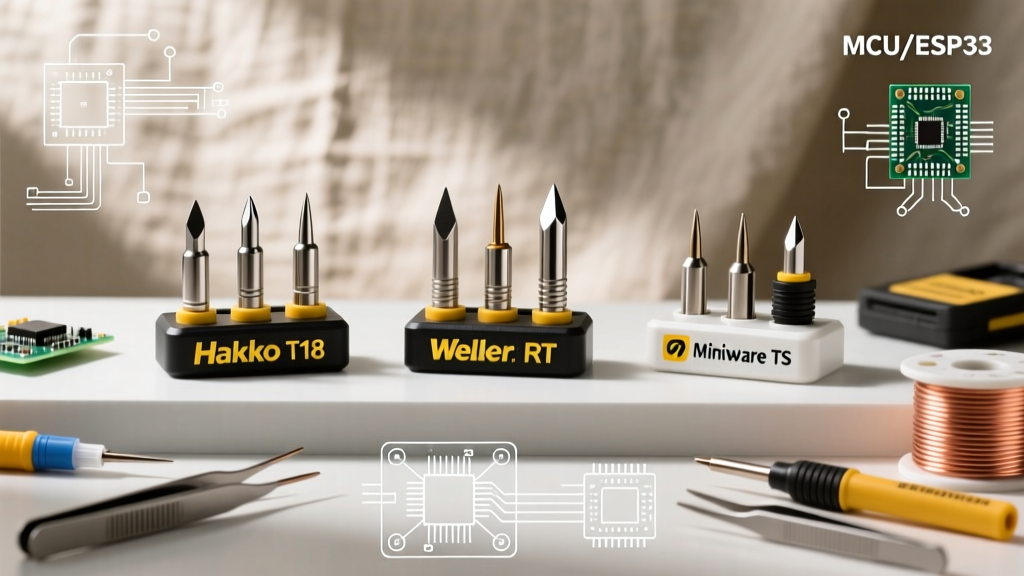
In this comprehensive review, we dissect three dominant iron soldering tips kits on the market: the industry-standard Hakko T18 series, the precision-engineered Weller RT active-tip series, and the budget-friendly Miniware TS/Pinecil lineup. We will compare thermal recovery times, tip longevity, specific geometry use-cases, and overall cost of ownership.
Quick Verdict: Which Kit Wins?
- Best Overall Value & Versatility: Hakko T18 Series (Approx. $45 for a 5-tip kit)
- Best for Micro-SMD & Fast Recovery: Weller RT Series (Approx. $60 for a 3-tip kit)
- Best for Field Repair & USB-C PD: Miniware TS Series (Approx. $25 for a 4-tip kit)
Contender 1: Hakko T18 Series (The FX-888D Standard)
The Hakko T18 series is arguably the most ubiquitous line of iron soldering tips in the DIY and professional repair space, designed primarily for the legendary FX-888D station. These tips utilize a composite copper core with a specialized iron plating (typically 100 to 150 microns thick) over the working surface, backed by a non-wettable chrome layer to prevent solder creep.
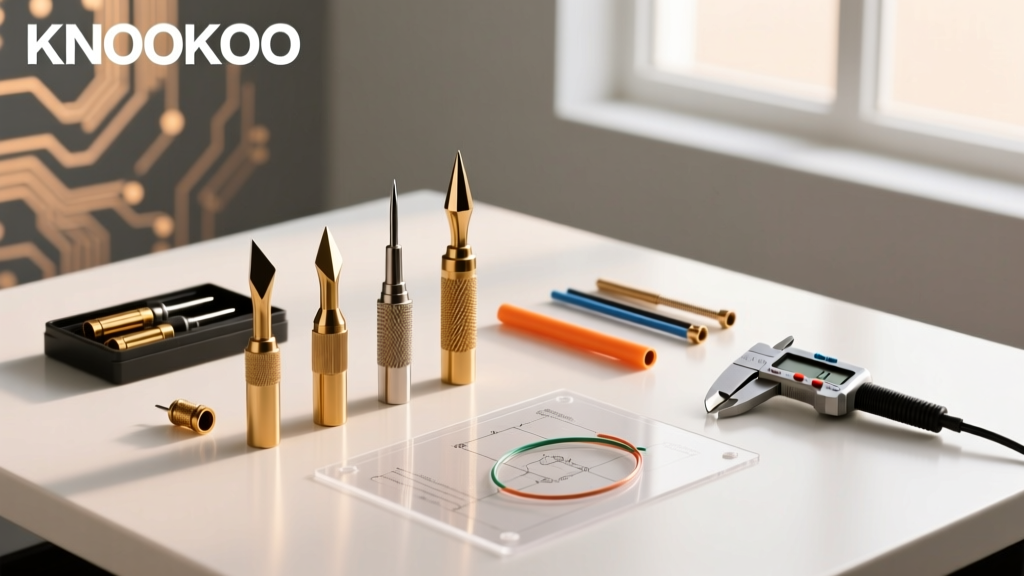
Standout Geometries in the Kit
- T18-D24 (2.4mm Chisel): The workhorse for 0805 to 1206 SMD components and standard through-hole capacitors. The flat face provides excellent thermal transfer to ground planes.
- T18-K (Knife / 45° Angle): Essential for drag-soldering TQFP-48 and QFP-64 microcontrollers. The edge allows for precise flux activation and solder wicking.
- T18-B2 (1.6mm Conical): Useful for tighter pitch SMD work, though it struggles with thermal recovery on heavy copper pours compared to the chisel variants.
Thermal Performance & Edge Cases
The T18 series relies on a ceramic heating element located in the handpiece, transferring heat to the tip via a physical sleeve connection. When dragging a T18-D24 across a heavy ground plane, the thermal recovery time from 350°C back to operating temperature takes approximately 6 to 8 seconds. While adequate for 90% of tasks, it can stall when soldering thick multi-layer motherboard traces.
Pro Tip: To maximize the life of your T18 tips when using aggressive lead-free fluxes, never exceed 360°C. The iron plating degrades exponentially above this threshold, leading to 'black tip' oxidation syndrome.
Contender 2: Weller RT Series (Active-Tip Precision)
Weller takes a fundamentally different approach with the RT series, designed for the WX1010 and WXMP stations. Instead of a separate heater and sensor in the handpiece, the RT series utilizes 'Active Tip' technology. The heating element, temperature sensor, and tip are integrated into a single, replaceable cartridge.
Standout Geometries in the Kit
- RT1 (0.8mm Conical): Unmatched for 0402 and 0201 passive components. The integrated sensor ensures the tip never overshoots, protecting delicate ceramic capacitors from micro-cracking.
- RT2 (1.6mm Chisel): Offers incredible thermal stability for general-purpose SMD rework.
- RT4 (0.4mm Pencil): Designed for ultra-fine pitch jumper wire repairs under a microscope.
Thermal Performance & Edge Cases
Because the sensor is embedded directly behind the working face, the Weller RT series boasts a blistering thermal recovery time of under 2 seconds. If you are doing high-volume rework on dense server boards, this active feedback loop prevents cold solder joints. However, the trade-off is cost; individual RT tips retail between $12 and $15 each, and the fragile 0.4mm pencil tips can bend if subjected to lateral pressure during scraping or cleaning.
Contender 3: Miniware TS / Pinecil Tips (The USB-C Disruptor)
For field technicians and EDC (Everyday Carry) enthusiasts, the Miniware TS100, TS101, and Pinecil smart irons have revolutionized portable soldering. These irons use direct resistive heating, passing current directly through the iron soldering tips themselves.
Standout Geometries in the Kit
- TS-B2 (Bevel / Hoof): The concave hoof shape holds a generous solder blob, making it phenomenal for drag-soldering and tinning thick wires.
- TS-I (Needle / Fine Conical): Good for basic SMD, but the direct resistive nature means the very tip can sometimes run slightly cooler than the base if the power supply cannot deliver peak amperage.
- TS-D25 (Wide Chisel): Excellent for XT60 connectors and heavy gauge silicone wires used in drone and robotics builds.
Thermal Performance & Edge Cases
Recovery time is highly dependent on your power delivery (PD) source. Running a Pinecil at 65W via a GaN charger yields recovery times comparable to the Hakko T18 (approx. 5-7 seconds). However, if the tip connection to the handpiece oxidizes, resistance increases, leading to erratic temperature readings. Regular cleaning of the tip insertion shaft with isopropyl alcohol is mandatory.
Head-to-Head Comparison Matrix
| Feature | Hakko T18 Series | Weller RT Series | Miniware TS Series |
|---|---|---|---|
| Heater Technology | Ceramic Core (Handpiece) | Active Integrated Cartridge | Direct Resistive (Tip) |
| Avg. Recovery Time (350°C) | 6 - 8 Seconds | 1.5 - 2 Seconds | 5 - 7 Seconds (at 65W) |
| Iron Plating Thickness | ~120 Microns | ~150 Microns | ~90 Microns |
| Average Price Per Tip | $8.50 - $10.00 | $12.00 - $15.00 | $4.00 - $6.00 |
| Best Use Case | General bench work, mixed SMD/TH | Micro-SMD, high-density rework | Field repair, drones, RC, EDC |
Metallurgy and Wetting: Why Tip Coating Matters
Understanding why iron soldering tips fail requires a look at metallurgy. Modern lead-free solders, particularly SAC305 (96.5% Tin, 3% Silver, 0.5% Copper), are highly aggressive. Tin has a natural affinity for iron and copper. If the protective iron plating on the tip is compromised, the molten tin will rapidly dissolve the underlying copper core, resulting in 'pitting' or cratering.
According to NASA's Workmanship Standards for Soldered Connections, maintaining a continuous intermetallic layer of solder on the tip is critical to prevent oxidation. A dry tip exposed to 350°C ambient heat will oxidize within minutes, forming a black, non-wettable iron oxide crust. Once a tip turns black, heat transfer drops by up to 80%, leading operators to incorrectly increase the station temperature, which only accelerates the oxidation cycle.
Maintenance Protocol for Maximum Tip Life
To ensure your investment in premium iron soldering tips lasts for years rather than weeks, implement this strict maintenance protocol:
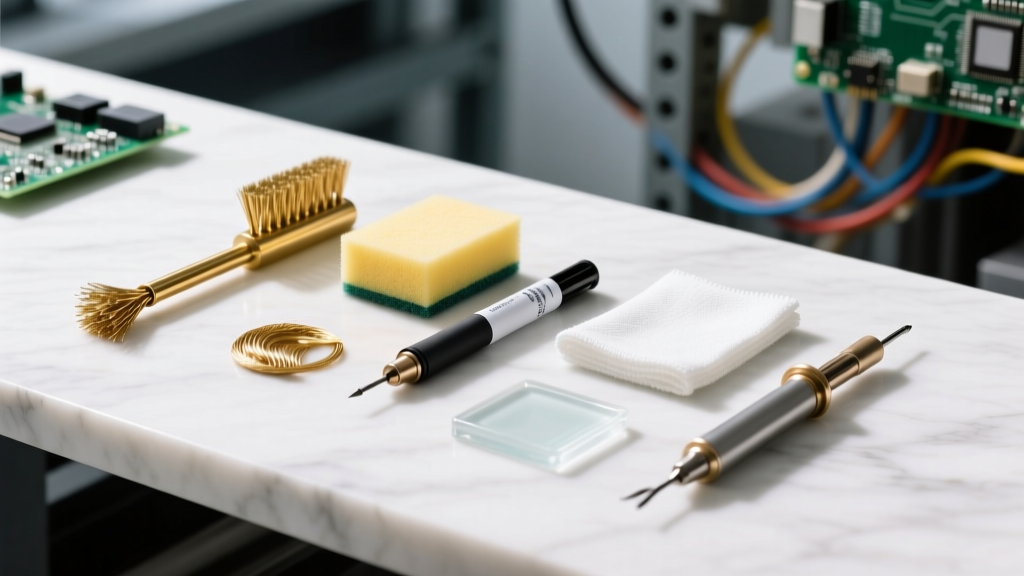
- Ditch the Wet Sponge: Traditional damp cellulose sponges cause a massive thermal shock. Wiping a 350°C tip on a room-temperature wet sponge drops the surface temperature by over 50°C instantly. Over time, this causes micro-fractures in the iron plating, exposing the copper core to corrosion.
- Use Brass Wool: A dry brass wire sponge (often called a tip cleaner) removes carbonized flux and excess solder while only dropping the tip temperature by roughly 10°C. It preserves the thermal mass and prevents plating fractures.
- The 'Tinning' Shutdown Rule: Never turn off your station with a clean tip. Before powering down, melt a generous blob of traditional 63/37 SnPb (Tin/Lead) solder onto the working surface. This sacrificial layer acts as an oxygen barrier. When you power up next time, simply wipe the sacrificial blob off in the brass wool and apply your working solder.
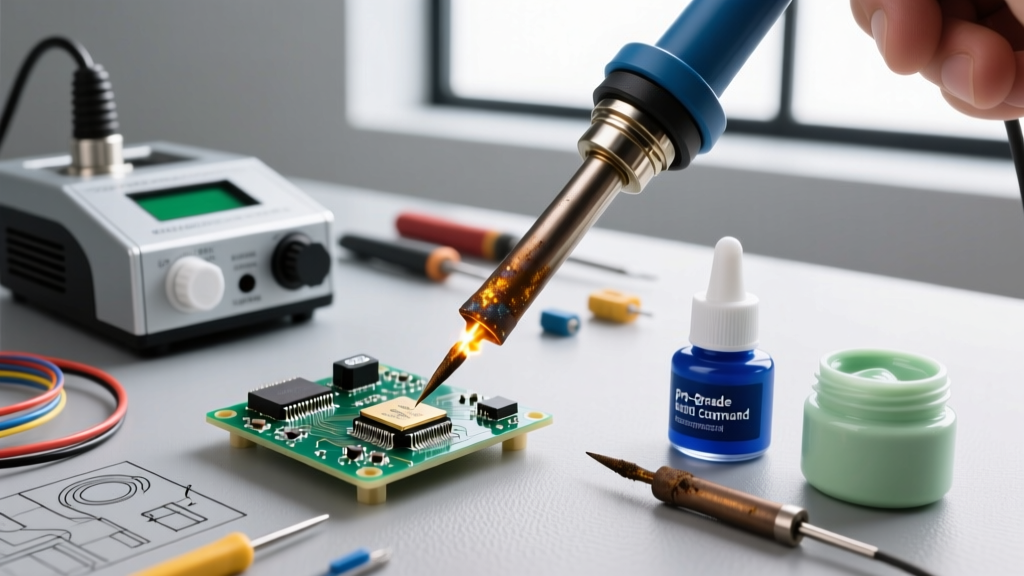
- Rescue Dead Tips Chemically: If a tip has oxidized (turned black), do not sand it with sandpaper or a file—this will instantly destroy the iron plating. Instead, use a specialized tip tinner/activator compound (a mixture of phosphoric acid and solder powder) at 300°C to chemically reduce the oxide and re-tin the surface.
Frequently Asked Questions (FAQ)
Can I use Hakko T18 tips on a Weller station?
No. Iron soldering tips are proprietary to their specific heating elements and physical sleeves. The Hakko T18 is designed for the FX-888D and FX-601 ceramic heaters, while Weller RT tips require the WXMP active handpiece. There are third-party 'clone' stations on the market that accept T18 footprints, but their internal PID controllers and heater wattages often differ, leading to inaccurate temperature readings and premature tip failure.
Why does my chisel tip wear out faster on one side?
Uneven wear is typically caused by user technique, specifically 'twisting' or applying lateral pressure while dragging the tip across a pad. Always pull the iron straight back. Additionally, if your station's heater core is slightly bent or the tip sleeve isn't fully seated, heat distribution will be asymmetrical, causing one side of the iron plating to degrade faster.
Are cheaper, no-name clone tips worth the risk?
While generic T18 clone kits can be found for under $15 for a set of 10, the copper purity and iron plating thickness are rarely up to OEM standards. Clone tips often feature plating as thin as 30-50 microns, which dissolves rapidly when using lead-free solder. For critical repair work where a cold joint could cost hundreds of dollars in ruined PCBs, the $8 investment in a genuine OEM tip is mathematically justified.