
The Thermal Bottleneck: Why Your Soldering Tip Matters More Than the Station
When evaluating soldering starter kits and professional workstations, beginners often fixate on wattage and digital displays. However, the actual joint quality is dictated entirely by the types of soldering tips transferring energy to the pad. In 2026, the market is flooded with $20 generic adjustable irons and $150+ precision stations like the Hakko FX-888D or Weller WE1010NA. While a premium station provides stable power, a budget kit's interchangeable tips often bottleneck thermal recovery, leading to cold joints and lifted pads.
Understanding the metallurgical and geometric differences between budget and premium tips is critical for anyone moving beyond basic through-hole DIY projects into surface-mount device (SMD) rework or lead-free soldering.
The Metallurgy Divide: Copper Cores and Iron Plating
The fundamental anatomy of a modern soldering tip consists of a high-conductivity copper core, electroplated with a layer of iron, followed by a chrome protective layer and a specialized wetting alloy at the working end. Copper is used because its thermal conductivity (~400 W/m·K) rapidly pulls heat from the ceramic element. However, molten solder dissolves raw copper. The iron plating (thermal conductivity ~80 W/m·K) acts as a sacrificial barrier.
Budget Kit Metallurgy (The $0.50 Tip)
Generic 900M-series tips found in budget Amazon kits utilize low-grade copper alloys and exceptionally thin, uneven iron plating. When subjected to the 350°C+ temperatures required for RoHS-compliant SAC305 (lead-free) solder, the thin iron layer rapidly oxidizes and flakes. Once the copper core is exposed, the molten solder eats into the tip, creating craters—a failure mode known as pitting.
Premium Kit Metallurgy (The $10.00 Tip)
Genuine tips from manufacturers like Hakko (T18 series) or Weller (ET series) feature precisely machined solid copper cores with thick, uniform iron plating. According to Hakko's official tip care guidelines, proper maintenance of these premium plated tips can yield hundreds of hours of active use without pitting, provided the user avoids abrasive cleaning methods that scratch the iron layer.
Core Types of Soldering Tips Across Kit Tiers
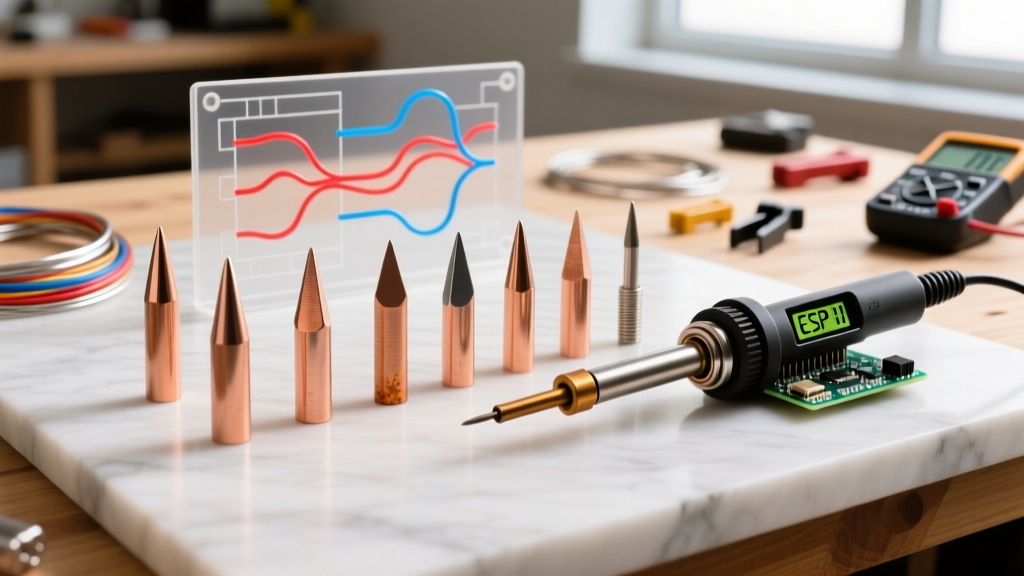
The geometry of the tip dictates the surface area in contact with the joint, which directly influences thermal transfer. Here is how standard tip geometries perform across budget and premium ecosystems.
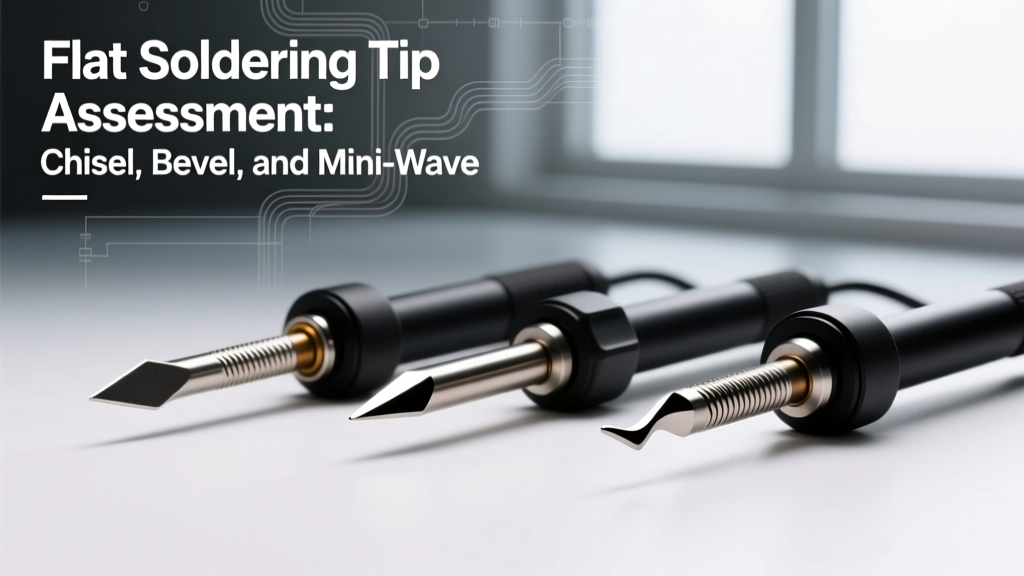
1. Chisel Tips (D-Series): The Workhorse
The chisel tip offers a flat, wide surface area, making it ideal for through-hole components and heavy ground planes. In a premium kit, a Hakko T18-D12 (1.2mm chisel) recovers its temperature in under 3 seconds after touching a massive ground plane. In a budget 60W kit, the same geometry suffers from severe thermal lag; the iron's poor thermal mass and the station's slow PID controller response can cause the tip temperature to drop by 40°C, taking up to 15 seconds to recover. This prolonged heat exposure risks delaminating the PCB's copper traces.
2. Conical Tips (B-Series): The SMD Misconception
Budget kits almost always default to a fine conical tip, marketing it for 'precision SMD work.' In reality, conical tips are notoriously poor for heat transfer because the contact point is minuscule. Professional technicians actively avoid conical tips unless working on ultra-fine 0201 components. For standard 0805 or 0603 SMD work, premium kit users prefer micro-chisels or bevel tips, which provide the necessary thermal mass to melt both pads simultaneously.
3. Bevel (C-Series) and Knife (K-Series): Advanced Geometry
Bevel tips feature a hollowed-out concave surface, excellent for drag-soldering SOIC chips and holding a reservoir of molten solder. Knife tips combine a chisel edge with a pointed tip, allowing technicians to clean tight spaces and drag-solder in a single tool. Budget kits rarely include high-quality bevel or knife tips; their included 'multi-purpose' tips often feature poorly machined bevels that hold excess flux, leading to carbon buildup and non-wetting surfaces.
Thermal Recovery Matrix: Budget vs Premium
The following matrix illustrates the real-world performance differences when applying various tip types to a standard 2oz copper ground plane joint using SAC305 solder.
| Tip Geometry | Budget Kit (Generic 60W) | Premium Kit (Hakko FX-888D) | Cartridge System (JBC CD-2BE) |
|---|---|---|---|
| Chisel (2.4mm) | Severe temp drop (-45°C); slow recovery (12s) | Moderate drop (-15°C); fast recovery (3s) | Negligible drop (-3°C); instant recovery (<1s) |
| Conical (1.0mm) | Fails to melt SAC305 on ground planes | Struggles; requires extended dwell time | Adequate for small pads, poor for planes |
| Bevel (1.5mm) | Flux carbonizes rapidly due to uneven heating | Excellent drag-soldering; stable thermal pool | Superior thermal retention for QFP drag |
The 'Upgrade Tip on a Cheap Iron' Fallacy
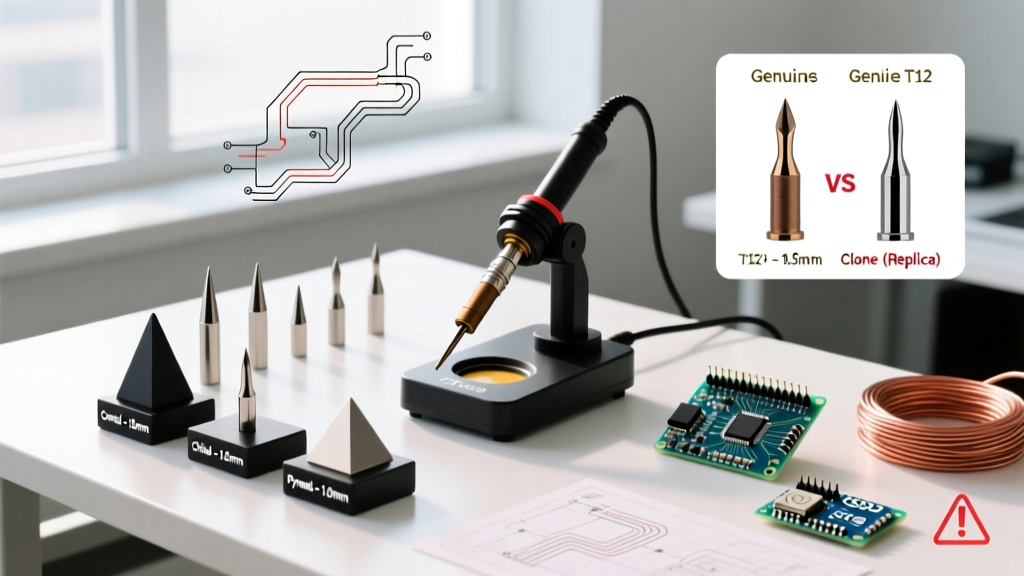
A common myth in DIY electronics forums is that you can buy a $15 clone station and simply install genuine $10 Hakko T18 tips to achieve premium results. This fundamentally misunderstands thermal sensor placement.
According to the IPC J-STD-001 soldering standard, precise thermal profiling is required to ensure proper intermetallic compound (IMC) formation. A tip is only as accurate as the thermocouple measuring it.
In budget irons, the thermistor is located deep inside the ceramic heating element, far from the actual tip. Even if you install a premium, high-conductivity tip, the station's sensor cannot accurately read the temperature at the working end, resulting in massive temperature overshoots and undershoots. Premium stations embed the sensor directly inside the tip sleeve or, in the case of advanced cartridge systems like JBC or Weller RT, integrate the heater and thermocouple directly into the tip itself.
Common Failure Modes by Kit Tier
Recognizing how your tip is failing can help you determine if the issue is your technique, your solder chemistry, or the inherent limitations of a budget kit.
- Pitting (Budget Vulnerability): Molten solder dissolves the copper core through micro-fractures in thin iron plating. The tip develops physical craters and will no longer wet evenly. Solution: Discard immediately; pitting is irreversible.
- Oxidation / Blackening (Universal): Exposure to high heat (above 380°C) and oxygen creates an iron oxide layer that solder will not stick to. Solution: Use a damp cellulose sponge or brass wool and re-tin immediately. Never file or sand the tip.
- Core Burnout (Budget Clone Stations): Cheap stations often lack sleep modes, leaving the tip at 350°C for hours. The flux inside the rosin-core solder burns onto the tip, creating a hard, black carbon crust that acts as a thermal insulator.
- Galvanic Corrosion (Moisture Traps): Using a soaking wet sponge on a hot budget tip causes rapid thermal shock, micro-cracking the iron plating and allowing moisture to corrode the copper core from the inside out.
Actionable Buying Framework for 2026
If you are building a workspace, how should you allocate your budget regarding tips and stations?
1. The Hobbyist (Under $50 Total)
If you are strictly using a budget kit like the Pinecil V2 or a generic 60W adjustable iron, stick to 63/37 Tin-Lead solder. Lead-free SAC305 requires higher temperatures (350°C-380°C) that will destroy budget tip plating in a matter of weeks. Buy bulk generic chisel tips (900M-T-K) at $0.50 each and treat them as consumables. For deep DIY knowledge on maintaining these budget setups, Adafruit's Guide to Excellent Soldering offers excellent foundational techniques that minimize tip wear.
2. The Serious Maker ($100 - $150 Total)
Invest in a Hakko FX-888D or Weller WE1010NA. The initial cost is higher, but the T18 or ET series tips cost around $9 each and will last a year or more with proper care. Stock up on two specific geometries: a 1.6mm Chisel (T18-D16) for 90% of your work, and a 1.0mm Bevel (T18-C1) for drag soldering ICs. Avoid conical tips entirely.
3. The Professional / Rework Specialist ($400+ Total)
Move to an active-tip cartridge system like the JBC CD-2BE. The C245 tips cost roughly $48 each, but the integrated heater/sensor technology provides instantaneous thermal recovery. This allows you to use smaller, lower-mass tips (like micro-chisels) to solder heavy ground planes without overheating the surrounding sensitive SMD components.
Final Verdict
The types of soldering tips included in a kit are the ultimate indicator of its true capability. Budget kits provide a false economy; the low upfront cost is quickly negated by the constant replacement of pitted, poorly machined tips and the frustration of cold joints. Premium kits demand a higher initial investment but deliver predictable thermal performance, precise IMC layer formation, and a significantly lower long-term cost of ownership. Match your tip geometry and metallurgy to your solder alloy and thermal demands, and your joint reliability will improve dramatically.