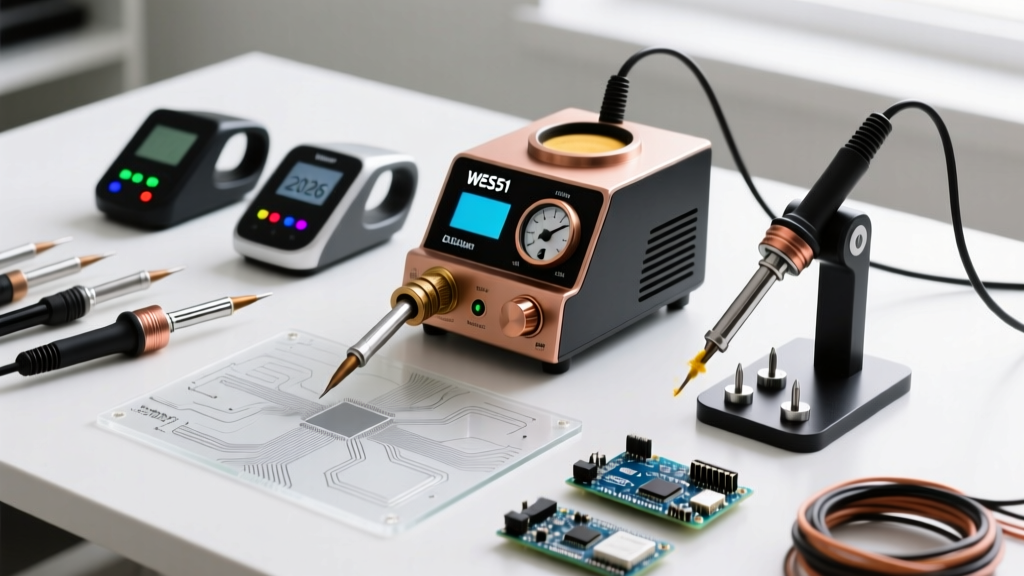

The Legacy and Limitations of the WES51 Soldering Station
For over two decades, the Weller WES51 soldering station has been the undisputed workhorse of electronics repair labs, manufacturing floors, and DIY benches. Renowned for its rugged analog dial, reliable 50-watt power delivery, and virtually indestructible ESD-safe chassis, it set the gold standard for through-hole and basic SMD rework. However, as we navigate the component densities of 2026, the analog architecture of the WES51 is showing its age. Modern 0201 surface-mount components, dense multi-layer PCB ground planes, and lead-free solder alloys demand faster thermal recovery and precise digital PID tuning that an analog dial simply cannot provide.
Furthermore, the WES51 utilizes a nichrome heating element wrapped around a ceramic core. A notorious failure mode occurs when technicians tap the handpiece against a hard surface to dislodge solder dross; this micro-shock fractures the ceramic core, severing the heater wire and instantly killing the pencil. Combined with the rising cost and diminishing availability of genuine Weller ETA series tips, many professionals and serious hobbyists are actively seeking a modern replacement.
The Analog Drift Problem: Over time, the potentiometer inside the WES51's analog control dial accumulates carbon dust and oxidation. This results in "temperature drift," where the station outputs 350°C when the dial is set to 320°C, risking thermal pad delamination on sensitive PCBs.
2026 Comparison Matrix: WES51 vs. Modern Successors
Below is a technical breakdown comparing the legacy WES51 against the top digital soldering stations available in 2026, categorized by their thermal architecture and use-case.
| Station Model | Wattage / Power | Temperature Control | Thermal Recovery | Approx. 2026 Price |
|---|---|---|---|---|
| Weller WES51 (Legacy) | 50W (Line AC) | Analog Dial (Triac) | ~30 seconds | $120 (Used/NOS) |
| Weller WESD51 | 50W (Line AC) | Digital PID | ~20 seconds | $145 |
| Hakko FX-888D | 70W (Line AC) | Digital PID | ~15 seconds | $115 |
| Pine64 Pinecil V2 | 65W-100W (USB-C PD) | Digital RISC-V PID | ~5 seconds | $26 |
| JBC CD-2BQE | 130W (Line AC) | Digital Cartridge | < 2 seconds | $560 |
Contender 1: Weller WESD51 (The Direct Digital Successor)
If you have a massive inventory of Weller ETA and SMT tips and want to upgrade without abandoning your ecosystem, the WESD51 is the logical next step. As documented in Weller's official tooling archives, the WESD51 retains the exact same handpiece and tip compatibility as the WES51 but replaces the analog dial with a digital push-button interface and a microcontroller-driven PID loop.
- Pros: Drop-in replacement for WES51 users; retains ESD-safe grounding; digital readout eliminates analog drift; lockout feature prevents unauthorized temp changes on production floors.
- Cons: Still limited to 50 watts; thermal recovery on heavy ground planes is sluggish compared to cartridge-based systems; ETA tips remain relatively expensive.
Contender 2: Hakko FX-888D (The Value & Reliability King)
The Hakko FX-888D remains the most popular benchtop station for general electronics repair. Stepping up to 70 watts, it utilizes the T18 tip series, which features a thicker iron plating and a larger thermal mass than the Weller ETA. The digital interface is intentionally simplistic—featuring only two buttons and a digital display—which reduces the learning curve for production line operators.
- Pros: Exceptional build quality; 70W provides better thermal headroom for lead-free solder; T18 tips are widely available and cost-effective ($6-$9 each).
- Cons: The T18 tip design still separates the heater from the tip's outer copper shell, creating a thermal bottleneck; the UI requires entering a "setup mode" to change basic parameters like sleep timeout.
Contender 3: Pine64 Pinecil V2 (The Smart Disruptor)
The Pinecil V2 has completely disrupted the soldering market by decoupling the power supply from the station. Powered via USB-C Power Delivery (PD 3.1), it can draw up to 100W from a compatible laptop charger or GaN brick. Inside the ergonomic silicone grip sits a RISC-V processor running the open-source IronOS firmware, maintained by the community at Pine64. It uses standard Hakko T12 or TS100 compatible tips, which feature an integrated thermocouple for vastly superior PID tuning.
- Pros: Unbeatable price-to-performance ratio; ultra-fast 5-second heat-up; highly customizable firmware (supports Bluetooth app control, custom boot logos, and precise PID curve adjustments); portable.
- Cons: Requires a high-quality 65W+ USB-C PD power supply (not included); lacks the heavy, grounded metal chassis of a traditional benchtop station, which some ESD-sensitive environments mandate.
Contender 4: JBC CD-2BQE (The Professional Endgame)
For aerospace, automotive ECUs, and heavy multi-layer PCB rework, the JBC CD-2BQE is the undisputed champion. JBC utilizes a revolutionary cartridge system where the heating element and thermocouple are manufactured directly inside the copper core of the tip. This eliminates the air gap and thermal interface material found in traditional stations, resulting in a thermal recovery time of under 2 seconds.
- Pros: Instantaneous thermal recovery; handles massive ground planes without dropping below the solder's liquidus temperature; ergonomic handpiece with interchangeable silicon sleeves; integrated tip extraction tool prevents burns.
- Cons: High barrier to entry ($560 for the station); proprietary C245 cartridges are expensive ($35-$50 each) and wear out faster if left idle at high temperatures.
Compliance, Safety, and Thermal Profiling
When upgrading from a WES51, it is critical to consider the thermal requirements of modern manufacturing standards. According to the IPC (Association Connecting Electronics Industries), specifically the IPC J-STD-001 requirements for soldered electrical and electronic assemblies, maintaining strict thermal profiles is mandatory to prevent intermetallic compound (IMC) overgrowth and pad cratering. The WES51's slow recovery often forced technicians to dwell the iron on a pad for 4-5 seconds to achieve flow, violating the recommended 2-3 second maximum dwell time. Upgrading to a cartridge-based system like JBC or an integrated T12 system like the Pinecil ensures you hit the target temperature instantly, preserving PCB integrity.
A Note on Fume Extraction
Modern lead-free fluxes require higher activation temperatures (often 350°C+), which generates denser, more hazardous colophony-based fumes. Regardless of which station you choose to replace your WES51, ensure your bench is equipped with an active HEPA and carbon filtration extraction arm. Prolonged exposure to unventilated soldering fumes is a known respiratory hazard, and proper benchtop extraction is a non-negotiable aspect of a modern, safe laboratory environment.
Final Verdict: Which Upgrade Should You Choose?
- Choose the WESD51 if you are a production manager who needs to maintain ESD compliance, lock out temperature settings, and utilize an existing inventory of Weller ETA tips.
- Choose the Hakko FX-888D if you want a traditional, heavy benchtop unit with slightly more power (70W) and cheap, globally available replacement tips.
- Choose the Pinecil V2 if you are a hobbyist, field repair technician, or DIYer who values portability, smart features, and rapid thermal recovery on a budget.
- Choose the JBC CD-2BQE if you are a professional micro-solderer or data recovery specialist working on 10+ layer PCBs where a 2-second thermal recovery is the difference between a successful repair and a scrapped motherboard.