
The 2026 Landscape: Where the Soldering Gun Still Reigns
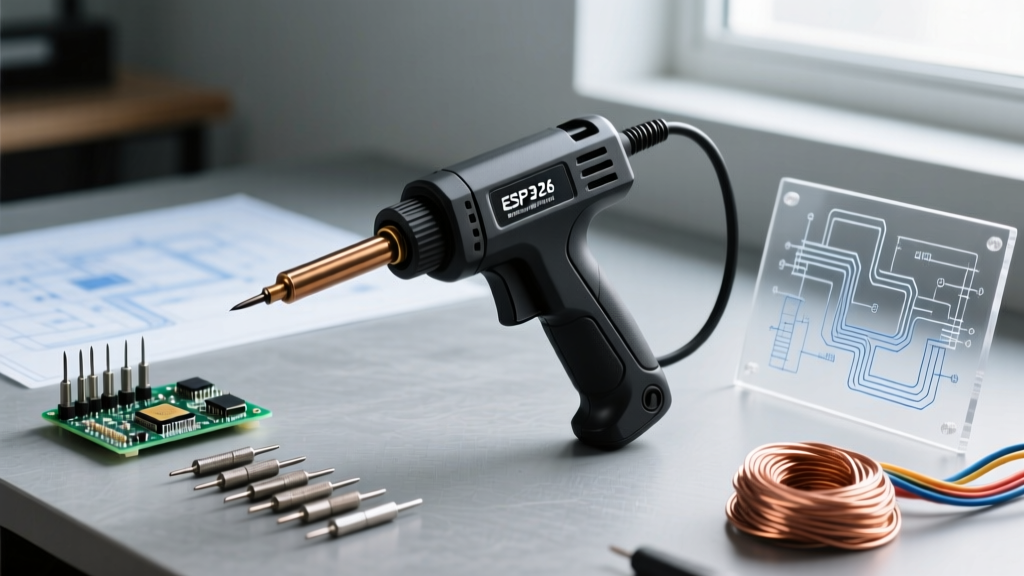
In the modern electronics workbench of 2026, brushless DC soldering stations and smart induction systems have completely taken over precision PCB work. However, when it comes to high-thermal-mass applications—such as soldering 4 AWG battery lugs, XT90 RC connectors, automotive wiring harnesses, and heavy-duty plumbing—the traditional hand held soldering gun remains an irreplaceable powerhouse. Unlike pencil-style irons that rely on thermal conduction from a heated ceramic core, a soldering gun utilizes a step-down transformer to push hundreds of amps directly through the copper tip, achieving operational temperatures in under three seconds.
Choosing the right tool requires understanding the trade-offs between raw wattage, duty cycle, and tip longevity. Below, we break down the top-performing models on the market, analyzing their internal failure modes, ergonomic profiles, and specific use cases to help you make an informed investment.
Quick Comparison Matrix: Top 4 Hand Held Soldering Guns
| Model | Peak Wattage | Heat-Up Time | Primary Use Case | Est. Price (2026) |
|---|---|---|---|---|
| Weller D550PK | 260W / 200W | ~3.5 seconds | Industrial terminal blocks, 4-8 AWG wire | $135 - $150 |
| Weller 8200PKS | 140W / 100W | ~4.0 seconds | Automotive harnesses, XT60 connectors | $65 - $80 |
| Stahl Tools SSGT250 | 250W | ~3.0 seconds | Budget heavy-duty, stained glass foiling | $40 - $55 |
| Iso-Tip 7700 Cordless | 90W (Peak) | ~6.0 seconds | Field HVAC, automotive repair | $120 - $140 |
In-Depth Reviews & Failure Mode Analysis
1. Weller D550PK (260W/200W) - The Industrial Standard
The Weller D550PK is the undisputed heavyweight champion of the soldering gun category. Featuring a dual-heat trigger mechanism, pulling the trigger halfway engages the 200W primary winding, while pulling it fully engages the 260W secondary winding. This tool is designed for massive thermal transfer, easily flowing 63/37 rosin-core solder onto thick copper buss bars and large ring terminals.
- Pros: Unmatched thermal recovery; robust bakelite housing; widely available replacement tips (CT6D7 series).
- Cons: Heavy (over 3 lbs); generates a massive magnetic field.
- Known Failure Mode: The internal micro-switch is prone to carbon arcing after approximately 5,000 to 7,000 trigger cycles. If your gun begins to cut out or requires a 'double-pull' to heat, the switch assembly (Weller part #8200-6) must be replaced. Fortunately, this is a cheap, 10-minute fix with a standard Torx driver.
2. Weller 8200PKS (140W/100W) - Best for Automotive Harnesses
For automotive electricians and drone builders working with 12 AWG to 16 AWG silicone wire, the 260W D550 is often overkill and risks melting wire insulation. The Weller 8200PKS offers a much more manageable 140W peak output. Its lighter weight (1.5 lbs) reduces wrist fatigue during long harness-building sessions, and the narrower tip profile allows for better access inside tight Deutsch connector housings.
- Pros: Excellent ergonomics; precise heat control for mid-gauge wires; built-in LED work lights (a modern update over older D550 models).
- Cons: Struggles with anything thicker than 10 AWG wire.
3. Stahl Tools SSGT250 (250W) - The Budget High-Wattage Option
If you only need a high-wattage hand held soldering gun for occasional plumbing or stained-glass copper foiling, the Stahl Tools SSGT250 provides 250W of raw power at a fraction of the cost of professional units. However, cost-cutting is evident in the internal winding quality and the tip metallurgy.
- Pros: Highly affordable; rapid heat-up; includes multiple chisel tips in the box.
- Cons: Poor duty cycle; tip oxidation.
- Known Failure Mode: The transformer core lacks adequate thermal mass for continuous operation. Holding the trigger for more than 45 seconds at a time will cause the internal bobbin to overheat, eventually melting the plastic casing near the trigger guard. Users must employ a 'pulse' soldering technique to avoid catastrophic housing failure.
4. Iso-Tip 7700 Cordless - For Field Technicians
Corded guns are useless when you are under the dashboard of a vehicle or on a rooftop HVAC unit. The Iso-Tip 7700 utilizes an internal rechargeable battery pack to deliver up to 90W of cordless heat. While 2026 models have seen slight upgrades in battery management systems, the physics of battery sag still limits its continuous output.
- Pros: Total portability; no risk of AC ground loops; safe for basic automotive sensors.
- Cons: Limited to ~15 large joints per charge; battery degradation over 3-4 years.
The Physics & Pitfalls: Transformer Induction and PCB Damage
It is critical to understand why a hand held soldering gun works, and more importantly, where it must never be used. Inside the gun, 120V AC mains power is fed into a primary coil with hundreds of turns of thin wire. This induces a current in a secondary coil consisting of a single, massive loop of copper (which forms the tip). This steps the voltage down to roughly 0.2V - 0.5V, but spikes the amperage to between 300 and 600 Amps. This massive current is what generates instant resistive heating at the tip.
CRITICAL WARNING: Never use a transformer-based soldering gun on sensitive microcontrollers, ESP32 modules, or modern PCBs. The massive alternating magnetic field generated by the secondary loop can induce parasitic voltages in nearby circuit traces, instantly frying MOSFETs and logic gates. Furthermore, the lack of closed-loop temperature control violates the thermal profile limits outlined in NASA-STD-8739.3 for high-reliability electronic soldering.
For PCB work, always use a temperature-controlled DC soldering station. Reserve the soldering gun strictly for passive, high-mass components like heavy gauge wires, metal chassis lugs, and copper pipes.
Maintenance: Dressing Copper vs. Plated Tips
Unlike modern soldering irons that use iron-plated copper tips to resist oxidation, traditional soldering guns use solid, bare copper tips. Bare copper dissolves into molten tin-lead solder over time—a process known as 'leaching.' To maintain optimal thermal transfer:
- Never file a hot tip: Filing a heated copper tip accelerates oxidation and ruins the surface tension required for solder flow.
- Dress cold: Unplug the gun and let it cool completely. Use a fine-grit flat file to gently reshape the tip until bright copper is exposed.
- Pre-tin immediately: The moment you power the gun back on and the tip reaches melting temperature, aggressively coat it in flux-cored solder to create a protective barrier against atmospheric oxygen.
Safety and Fume Extraction Standards
High-wattage soldering guns vaporize flux at an alarming rate. The resulting rosin fumes contain colophony, a known respiratory sensitizer that can trigger occupational asthma. According to NIOSH guidelines on soldering safety, local exhaust ventilation (LEV) is mandatory when performing high-volume soldering. A simple desk fan is insufficient, as it merely blows the hazardous particulates across your face. Invest in a HEPA/Carbon fume extractor positioned within 6 inches of the solder joint to capture the plume at the source.
Frequently Asked Questions
Can I use a hand held soldering gun for stained glass work?
Yes, but with caveats. Soldering guns are frequently used in stained glass for 'tacking' pieces together or for quick copper-foil seams. However, because they lack precise temperature regulation, they can easily overheat the copper foil adhesive, causing it to lift from the glass. For long, continuous bead runs, a rheostat-controlled iron (like a Hakko FX-601) is vastly superior.
Why does my soldering gun buzz loudly when I pull the trigger?
The loud hum is the sound of the transformer's laminated steel core vibrating due to magnetostriction—the physical expansion and contraction of the metal as the 60Hz AC magnetic field fluctuates. While normal, an excessively loud or rattling buzz indicates that the internal core bolts have loosened over time due to thermal cycling. Tightening the chassis screws and the internal core brackets usually resolves the issue.
Is a 260W gun too powerful for 14 AWG wire?
Yes. Applying 260W to a relatively small 14 AWG wire will cause the copper strands to heat up faster than the solder can flow, often resulting in melted PVC or silicone insulation inches away from the joint. For 14 AWG to 18 AWG wires, use the 100W/140W Weller 8200PKS or a standard 60W-80W temperature-controlled pencil iron.