
Beyond the Dictionary: The Modern Soldering Iron Definition
If you search for the traditional soldering iron definition, most dictionaries will return a rudimentary description: a hand tool with a heated metal tip used to melt solder and join electronic components. However, for professional engineers, PCB rework technicians, and serious hobbyists operating in 2026, this archaic definition is entirely insufficient. Today, a soldering iron is not merely a heated stick; it is a precision thermal delivery system governed by closed-loop feedback, advanced metallurgy, and strict adherence to standards like the NASA Workmanship Standards for electronic assembly.
Understanding the true, modern soldering iron definition requires breaking down the core heating technologies that drive these tools. The market is currently dominated by three distinct thermal architectures: Ceramic Core, Induction (Curie Point), and Direct Cartridge. Each fundamentally alters how thermal energy is transferred to a solder joint, dictating everything from SMD rework success rates to heavy-ground-plane through-hole soldering.
Core Heating Technologies: The 2026 Comparison Matrix
Before diving into the physics and failure modes of each system, review the comparative matrix below. This data reflects current market pricing and performance benchmarks for standard electronics workbench configurations.
| Technology | Representative Model | Heat-Up Time | Thermal Recovery | Avg. Tip Cost | Price Range (2026) |
|---|---|---|---|---|---|
| Ceramic Core | Hakko FX-888D | ~25 seconds | Moderate (PID controlled) | $8 - $12 | $110 - $130 |
| Induction (SmartHeat) | Metcal MX-5200 | ~8 seconds | Exceptional (Physics-limited) | $25 - $35 | $500 - $600 |
| Direct Cartridge | JBC CD-2BQE | ~2 seconds | Instantaneous | $35 - $45 | $480 - $520 |
| USB-C PD (Hybrid) | Pine64 Pinecil V2 | ~6 seconds | Fast (RISC-V PID) | $2 - $4 | $26 - $35 |
Ceramic Core Heaters: The Legacy Standard
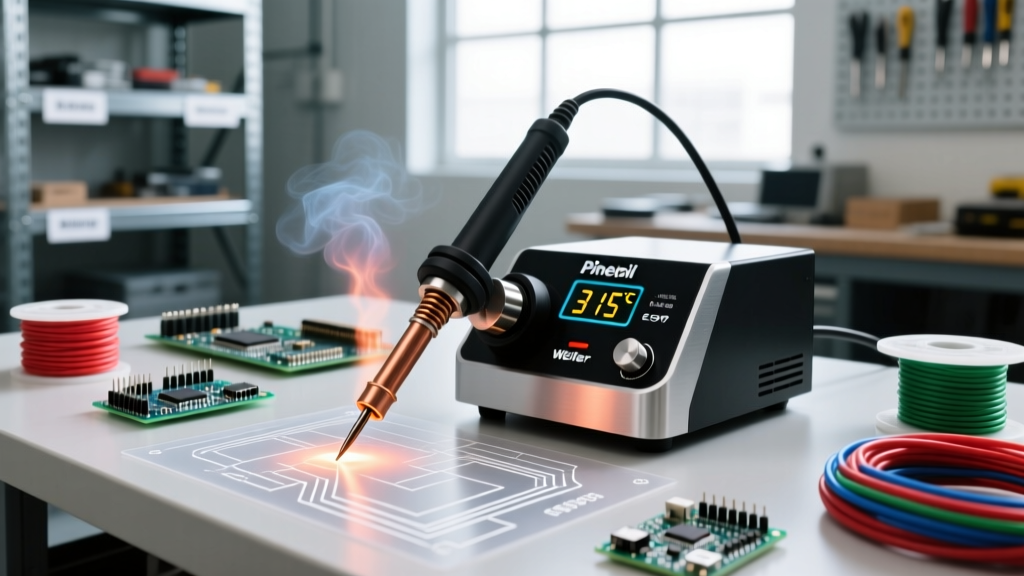
When most people picture a soldering station, they are visualizing a ceramic core heater. In this architecture, a nichrome or ceramic heating element is housed inside a hollow metal wand. The soldering tip slides over this element, and heat is transferred via conduction through the air gap and the physical contact points between the heater and the tip's inner bore.
The Thermal Lag Problem
The primary limitation of the ceramic definition of a soldering iron is thermal lag. Because the thermocouple (temperature sensor) is located inside the heater core—not at the very tip of the iron—the system relies on a PID (Proportional-Integral-Derivative) controller to guess the temperature at the tip based on the core's heat output. When you apply a cold, 14-gauge wire to a tinned tip, the tip's temperature plummets. The thermocouple takes several seconds to register this drop, instruct the station to send more power, and push that heat through the metal wand to the tip.
Expert Insight: To mitigate thermal lag on ceramic stations like the Weller WE1010NA or Hakko FX-888D, technicians must artificially compensate by setting the station 20°C to 30°C higher than the solder's liquidus point, and utilizing the largest tip geometry (like a chisel or bevel) that the pad will allow to maximize thermal mass.
Induction and Curie Point: The Physics-Driven Approach
Expanding the soldering iron definition to include induction technology introduces a paradigm shift: removing the temperature sensor entirely. Pioneered by brands like Metcal and OK International, SmartHeat induction technology relies on the fundamental laws of ferromagnetism.
How Curie Temperature Dictates Soldering
An RF (Radio Frequency) generator in the base station sends a high-frequency alternating current through a coil in the handpiece. This induces eddy currents in the ferromagnetic core of the soldering tip, causing it to heat up rapidly. Here is the genius of the design: the tip's core is engineered from a specific alloy with a precise Curie temperature (the point at which a material loses its permanent magnetic properties).
- Below Curie Point: The core is magnetic, eddy currents flow, and the tip heats up.
- At Curie Point: The core loses its magnetism, eddy currents cease, and heating stops instantly.
- Above Curie Point: As the tip transfers heat to a cold PCB pad, it drops below the Curie threshold, regains magnetism, and instantly resumes heating.
This means an MX-5200 station does not require a microcontroller, a thermocouple, or PID tuning. The temperature control is baked into the metallurgical physics of the tip itself. The downside? You cannot simply turn a dial to change the temperature. To solder at 350°C instead of 380°C, you must physically swap to a tip forged with a different Curie-point alloy.
Direct Cartridge Systems: The Speed Kings
If the ceramic iron is a legacy tool and the induction iron is a physics marvel, the direct cartridge system is the undisputed king of modern SMD rework and rapid prototyping. In this architecture, popularized by JBC Tools, the traditional separation between 'heater' and 'tip' is abolished.
Heater, Sensor, and Tip as One
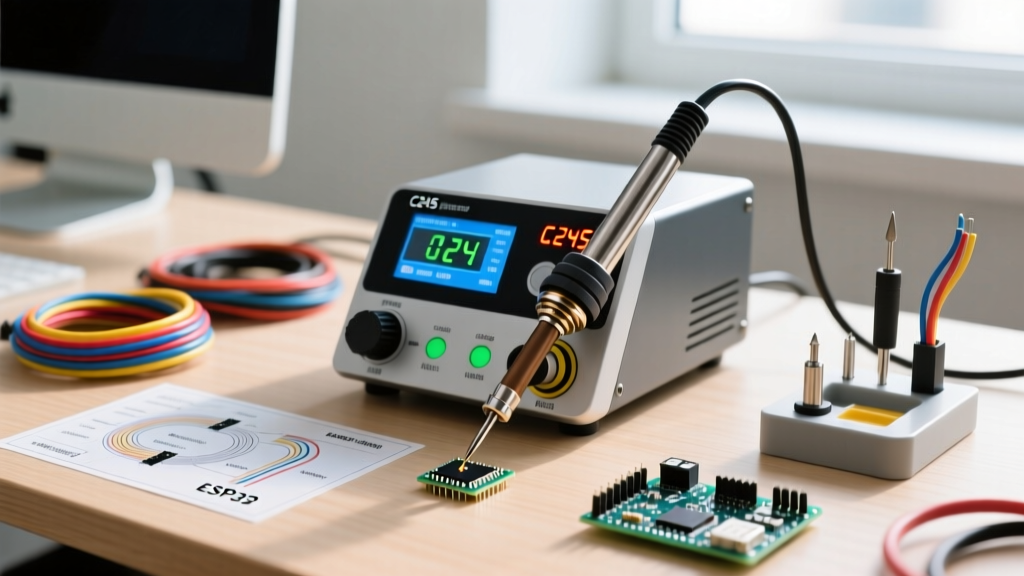
In a JBC CD-2BQE or T245 handpiece, the consumable cartridge is the heater. The heating element and the thermocouple are integrated directly into the extreme front of the tip, millimeters from the solder joint. This structural evolution completely redefines the soldering iron definition from a 'conduction tool' to a 'direct-injection thermal system.'
Because the thermal mass is incredibly low and the sensor is at the point of contact, a JBC station detects a temperature drop the millisecond the tip touches a ground plane, and the station's 130-watt amplifier dumps current into the cartridge to recover the heat. The result is a 2-second heat-up time from room temperature to 350°C, and virtually zero thermal stall, even when dragging solder across multi-layer PCBs with heavy copper pours.
Do Gas and Butane Torches Fit the Definition?
A frequent debate in electronics forums is whether catalytic butane irons (like the Weller P2K or Master Appliance ProMix) fit the technical definition of a soldering iron. By strict IPC and NASA workmanship standards, a soldering iron must provide controlled, localized thermal transfer without an open flame.
Butane tools utilize a catalytic reaction where butane gas passes over a platinum-coated ceramic element, creating a flameless, exothermic reaction. While they fit the dictionary definition of a 'hand tool used to melt solder,' they lack the closed-loop thermal management required for sensitive SMD components, MOSFETs, or RF shielding. They are best classified as portable thermal probes, strictly reserved for field repairs, automotive wiring, and heavy-gauge plumbing where grid power is absent and thermal precision is secondary to raw heat output.
Purchasing Framework: Matching the Tool to Your Workbench
Applying the modern soldering iron definition to your purchasing decision requires an honest assessment of your workload. Use this framework to allocate your budget effectively in 2026:
1. The Hobbyist and General Repair Tech
Recommendation: Pine64 Pinecil V2 or Hakko FX-888D.
Why: If you are repairing consumer electronics, flashing microcontrollers, or building DIY audio amps, the $26 Pinecil (powered by a 65W USB-C PD brick) offers RISC-V driven PID control that rivals $150 ceramic stations. For those preferring a traditional benchtop footprint, the Hakko FX-888D remains the undisputed workhorse, provided you invest in high-quality flux and learn to leverage tip geometry to overcome thermal lag.
2. The SMD Rework and Micro-Soldering Specialist
Recommendation: JBC CD-2BQE (T245 handle).
Why: When working under a microscope with 0201 imperial components or drag-soldering 0.5mm pitch QFP chips, thermal stall results in cold joints and prolonged heat exposure that delaminates pads. The JBC cartridge system's instantaneous recovery allows you to use lower overall temperatures (e.g., 320°C), preserving flux activity and protecting sensitive silicon dies.
3. The High-Volume Manufacturing Environment
Recommendation: Metcal MX-5200.
Why: In a production line where ten technicians are soldering the exact same through-hole connectors all day, the Metcal system ensures absolute process control. Because the temperature is locked by the tip's Curie alloy, it is physically impossible for an operator to accidentally crank the dial to 450°C and burn the PCB. The higher consumable cost is easily offset by the elimination of thermal damage and scrapped boards.
Frequently Asked Questions
Does the wattage of a soldering iron determine its maximum temperature?
No. Wattage dictates thermal recovery speed, not maximum temperature. A 40-watt iron and a 100-watt iron can both reach 400°C. However, the 100-watt iron will maintain that temperature when applied to a large, heat-sinking ground plane, whereas the 40-watt iron's temperature will plummet, resulting in a cold, unreliable solder joint.
Why do modern soldering iron definitions emphasize 'closed-loop' systems?
A closed-loop system continuously reads the tip temperature via a thermocouple and adjusts power output to maintain the set point. Open-loop systems (like cheap $15 mains-powered irons) simply pump a fixed amount of wattage into the heater continuously, leading to massive temperature overshoots that can destroy static-sensitive components and oxidize tips within hours.
How does tip geometry affect the functional definition of the tool?
The tip acts as a thermal capacitor. A fine conical tip holds very little thermal energy, making it functionally useless for anything but micro-SMD work. A heavy bevel or chisel tip holds a massive amount of thermal energy, allowing it to bridge the gap between the heater and the solder joint efficiently. Choosing the wrong geometry effectively downgrades a $500 station to the performance level of a $20 wall-wart iron.