
The Weller Soldering Pencil Ecosystem: Beyond the Brand Name
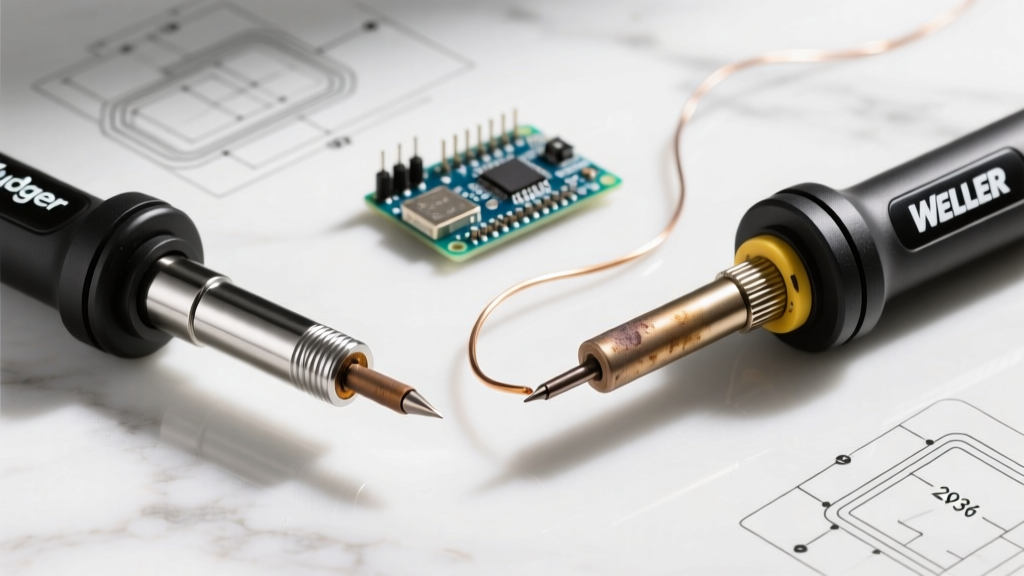
When outfitting an electronics workbench, the Weller brand is often the default choice for engineers, technicians, and hobbyists alike. However, assuming all Weller tools offer the same performance is a critical mistake. When evaluating a Weller soldering pencil, you are actually choosing between two vastly different engineering philosophies: the budget-friendly nichrome-wound legacy models and the premium ceramic-core, silver-embedded micro stations.
In 2026, the gap between entry-level and professional-grade soldering handpieces has widened. Budget models remain excellent for basic through-hole components and heavy-gauge wiring, but they fail catastrophically when tasked with modern 0402 SMD components or multi-layer PCBs with extensive ground planes. This analysis dissects the metallurgical, thermal, and economic differences between Weller's budget and premium soldering pencils to help you determine which tier actually belongs on your bench.
Budget Tier: The Nichrome Workhorses
Weller's budget lineup is dominated by standalone pencils and entry-level variable stations. These tools rely on traditional heating methods that prioritize low manufacturing costs over rapid thermal feedback.
Weller SP40NKUS Standalone Pencil (40W)
The SP40NKUS is a ubiquitous 40-watt standalone iron, typically priced around $28 to $35. It utilizes a nichrome wire heating element wrapped around a ceramic core. The heat is transferred to the tip via a physical set screw and a hollow copper sleeve.
- Thermal Recovery: Slow (8 to 12 seconds after contact with a large pad).
- Tip Series: SMI and SM series (screw-on sleeve).
- Failure Modes: The physical gap between the heating core and the copper sleeve creates thermal lag. If left in a stand at 400°C, the thin iron plating on budget SMI tips rapidly oxidizes, leading to tip galling and non-wetting surfaces within weeks.
Weller WLC100 Station Pencil
The WLC100 is a 40-watt variable temperature station (approx. $55 to $65). While it offers a dial for temperature adjustment, the handpiece itself uses the same basic nichrome architecture as the standalone models. The tip-to-ground resistance is uncalibrated, making it a risky choice for handling static-sensitive CMOS or RF ICs.
Premium Tier: Ceramic Core and Rapid Heating Technology
Weller's premium handpieces—designed for the WE and WX station platforms—abandon the traditional separate heater-and-tip design. Instead, they utilize Rapid Heating Technology (RT), where the ceramic heating element and the temperature sensor are embedded directly inside the tip cartridge.
Weller WXMP Micro Pencil (40W)
The WXMP is a marvel of ergonomic engineering, weighing a mere 52 grams. Priced around $145 to $160 (handpiece only, requiring a WX1 or WXD station), it is designed for high-density micro-soldering.
- Thermal Recovery: Under 1 second. The sensor detects the temperature drop at the exact point of solder contact.
- Tip Series: RT (Rapid Heating Technology) micro tips.
- Metallurgical Advantage: RT tips feature an internal silver interlayer between the copper core and the outer iron plating. Silver's thermal conductivity (429 W/m·K) vastly outpaces copper, ensuring instantaneous heat transfer to the joint.
Weller WSP80 Precision Pencil (80W)
For mixed-technology boards requiring both delicate SMD work and heavy power connectors, the WSP80 ($165 to $185) delivers 80 watts of controllable power. It uses the larger RT3 tip series, providing the thermal mass necessary to solder 10 AWG wires to massive ground planes without the heater maxing out its duty cycle.
Head-to-Head Technical Comparison Matrix
| Feature | SP40NKUS (Budget) | WLC100 Iron (Budget) | WXMP (Premium) | WSP80 (Premium) |
|---|---|---|---|---|
| Wattage | 40W | 40W | 40W | 80W |
| Heater Type | Nichrome Wound | Nichrome Wound | Ceramic (In-Tip) | Ceramic (In-Tip) |
| Recovery Time | ~10 Seconds | ~8 Seconds | < 1 Second | < 1.5 Seconds |
| Tip Series | SMI / SM | SMI / SM | RT Micro | RT3 |
| Avg Tip Cost (2026) | $5.50 - $7.00 | $5.50 - $7.00 | $13.00 - $16.00 | $14.00 - $18.00 |
| ESD Grounding | Ungrounded / High Ω | Uncalibrated | < 2 Ohms | < 2 Ohms |
| Handpiece Price | ~$30 | Included w/ Station | ~$155 | ~$175 |
Thermal Shock and Joint Reliability: The Hidden Cost of Budget Irons
The primary argument for upgrading to a premium Weller soldering pencil is joint reliability. According to the NASA-HDBK-8739.3 Workmanship Standard for Soldering, thermal shock and inadequate heat application are leading causes of disturbed and cold solder joints. When a budget nichrome iron contacts a multi-layer PCB ground plane, the tip temperature can plummet by 50°C or more. If the iron cannot recover before the flux burns off, the solder freezes prematurely, resulting in a grainy, disturbed joint that may pass visual inspection but will fail under thermal cycling.
Premium Weller RT tips eliminate this thermal lag. Because the thermocouple is situated millimeters from the working face, the station's microprocessor (via the WX or WE base unit) injects a burst of current the millisecond the tip touches the board. This adherence to strict thermal profiles is a core requirement in the IPC J-STD-001 Requirements for Soldered Electrical and Electronic Assemblies, which mandates that soldering equipment must maintain the tip temperature within a tight tolerance during the wetting phase.
Metallurgy Deep Dive: Why Premium Tips Last Longer Despite Higher Costs
At first glance, paying $15 for a single Weller RT tip compared to $6 for an SMI tip seems like poor economics. However, examining the cross-sectional metallurgy reveals a different story.
The Iron Plating Discrepancy
Budget SMI tips feature a relatively thin layer of iron plating (typically 50 to 80 microns) over the copper core. In 2026, with the widespread use of aggressive, no-clean, and lead-free solder pastes (like SAC305), this thin plating is rapidly eaten away by tin dissolution. Once the tin breaches the iron layer and touches the copper core, the tip develops deep craters (pitting) and is rendered useless.
Premium Weller RT and RT3 tips feature an engineered, multi-layered working face. The iron plating on the wetting surface is often thickened to 150+ microns, backed by a proprietary silver-alloy interlayer. This not only accelerates heat transfer but drastically slows down the tin dissolution process. In high-volume rework environments, a single RT tip will frequently outlast three to four budget SMI tips, effectively neutralizing the upfront price premium.
Total Cost of Ownership (TCO) Over 3 Years
Let us model a realistic 3-year Total Cost of Ownership for a daily user (assuming 5 days a week, 8 hours a day).
- Budget Path (SP40/WLC100): Initial iron cost: $35. Due to oxidation and pitting from slow thermal recovery and high idle temperatures, a heavy user will replace the SMI tip roughly every 3 weeks. Over 150 weeks, that is 50 tips at $6 each ($300). Total 3-Year TCO: $335. (Note: This excludes the cost of scrapped PCBs due to cold joints).
- Premium Path (WXMP/WSP80): Initial handpiece cost: $165. The rapid recovery allows the user to lower the idle temperature to 300°C without sacrificing performance, vastly reducing oxidation. An RT tip replaced every 6 weeks means 25 tips over 150 weeks at $14 each ($350). Total 3-Year TCO: $515.
While the premium TCO is roughly $180 higher over three years, the ROI is realized in labor savings. If a premium pencil saves a technician just 15 minutes of rework per week, or prevents the scrapping of a single $100 development board, the premium Weller soldering pencil pays for itself within the first quarter.
Final Verdict: Which Weller Soldering Pencil Fits Your Bench?
Choosing between budget and premium is not about brand loyalty; it is about matching the tool's thermal dynamics to your specific component density.
- Choose the Budget Tier (SP40 / WLC100) if: You are a hobbyist primarily working with through-hole components, thick-gauge automotive wiring, or basic Arduino prototyping where pad sizes are large and thermal mass requirements are forgiving.
- Choose the Premium Tier (WXMP / WSP80) if: You are a professional engineer, a repair technician working on modern smartphones and laptops, or a production facility assembling mixed-technology PCBs. The sub-1-second thermal recovery, strict ESD grounding (<2 ohms), and ergonomic micro-weight of the WXMP are non-negotiable requirements for high-yield, IPC-compliant micro-soldering.
Ultimately, a premium Weller soldering pencil is an investment in joint integrity. In an era where a single microcontroller can cost upwards of $40, risking a cold joint to save $120 on a handpiece is a false economy.