
The Thermodynamics of Ironless Soldering
When your primary soldering station fails, or you are stranded off-grid with a broken connection, knowing how to solder without a soldering iron transitions from a neat party trick to a critical survival skill. Soldering, at its core, is simply the localized application of thermal energy to melt a filler metal (solder) so it wets and bonds to a base metal. The tool used to deliver that heat is secondary to the physics of heat transfer.
In 2026, the consumer electronics and DIY repair landscape is dominated by lead-free alloys like SAC305 (melting point 217°C / 422°F), alongside traditional 63/37 Sn/Pb eutectic solder (melting point 183°C / 361°F). To achieve a reliable metallurgical bond, the joint itself must reach these temperatures, not just the heat source. According to industry guidelines published by IPC (Association Connecting Electronics Industries), proper wetting requires the flux to activate—typically around 150°C to 180°C—before the solder melts, cleaning the oxidation layer. Without a traditional iron's copper tip to provide conductive thermal mass, alternative tools rely on convection (hot air), radiation (flames), or high-current induction. Let us compare the four most effective alternative tools for the job.
Tool 1: Hot Air Rework Stations (The Precision Choice)
If you have access to a benchtop power supply but no iron, a hot air rework station is the most controlled alternative. Models like the YIHUA 858D (approx. $45) or the professional-grade Quick 861DW (approx. $180) use forced convection to heat the joint.
Execution Strategy
- Temperature Dial: Set to 350°C (662°F) for leaded solder, or 380°C (716°F) for SAC305 lead-free.
- Airflow: Keep it between 30% and 40%. High airflow will blow small SMD components (like 0603 resistors) off the pads, causing 'tombstoning'.
- Distance: Hold the nozzle exactly 1 inch (2.5 cm) above the joint, moving in tight circles to distribute the thermal load evenly across the pad and the wire.
Expert Insight: Hot air relies heavily on flux. Because air is a poor thermal conductor compared to solid copper, you must apply a generous amount of tacky flux (like Amtech NC-559) to the joint before heating. The flux acts as a secondary thermal bridge and prevents rapid oxidation. For a deeper dive on flux mechanics, refer to SparkFun's comprehensive soldering tutorial.
Tool 2: Butane Micro-Torches (The Field Repair Choice)
For automotive wiring, heavy-gauge RC battery leads, or off-grid plumbing, a butane micro-torch like the Blazer GT8000 Big Shot (approx. $75) or the SE MT6000 (approx. $25) is unmatched for raw BTU output. However, it is the most dangerous tool for delicate PCBs.
Execution Strategy
- Flame Chemistry: Adjust the torch so the yellow tip disappears, leaving only a sharp, hissing blue cone. The hottest part of the flame is just outside the tip of this blue cone (approx. 1,300°C).
- Thermal Buffering: Never aim the flame directly at the solder joint. Aim it at the wire about an inch away from the joint, allowing the copper wire's natural thermal conductivity to carry the heat into the solder cup or splice.
- Insulation Warning: Standard PVC wire insulation melts at roughly 105°C (221°F) and will catch fire if exposed to direct flame. Strip the wire further back than usual, or use high-temp silicone wire (which withstands up to 200°C) for the repair.
Tool 3: Transformer Soldering Guns (The Heavy-Duty Choice)
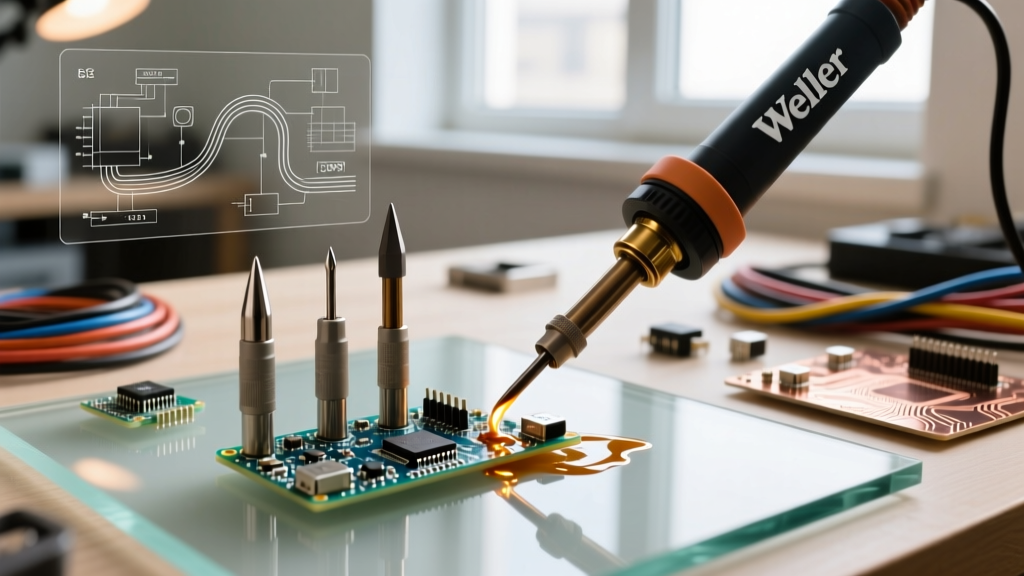
While often confused with irons, a soldering gun like the legendary Weller D550 260W (approx. $110) operates on an entirely different principle. It uses a step-down transformer to send a massive, low-voltage current (hundreds of amps) directly through the tip loop, heating it via electrical resistance in under three seconds.
Execution Strategy & Edge Cases
The trigger-activated nature of a soldering gun makes it excellent for intermittent heavy-duty soldering (like 10 AWG chassis grounds or stained glass copper foil). However, the massive current loop generates a strong alternating magnetic field at the tip.
- Failure Mode Alert: Never use a soldering gun near Hall-effect sensors, unshielded inductors, or older EEPROMs. The magnetic spike can erase memory or permanently bias magnetic components.
- Trigger Discipline: Pull the trigger to the 'low' setting first to preheat the joint and activate the flux, then squeeze to 'high' to melt the solder. Releasing the trigger too quickly before the solder flows results in a grainy, disturbed cold joint.
Tool 4: The 10 AWG Copper Wire Hack (The Survival Choice)
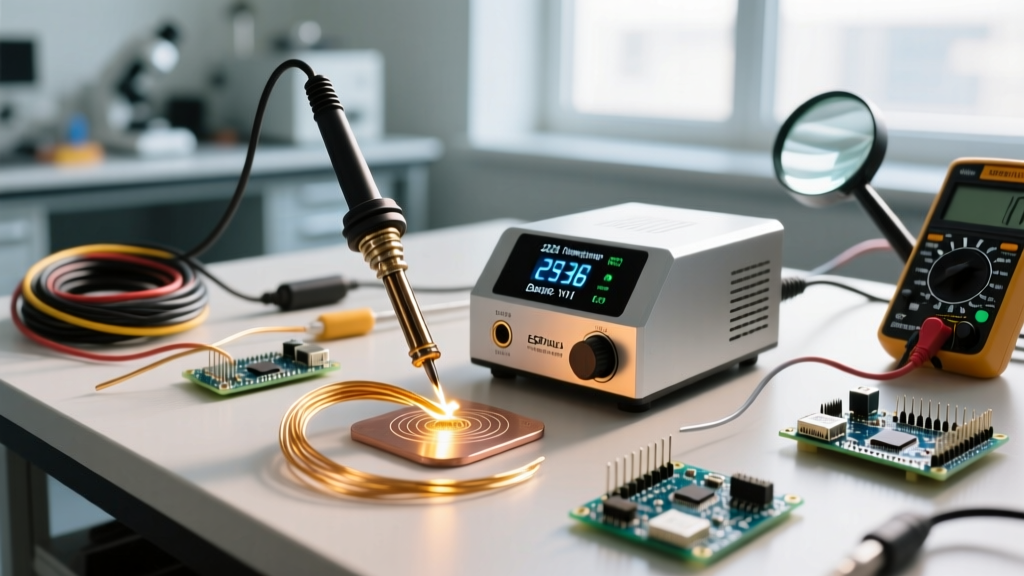
If you have zero electronic tools, a camp stove, and a piece of solid copper wire, you can fabricate a makeshift thermal transfer wand. Copper has a thermal conductivity of approximately 400 W/m·K, meaning it transfers heat rapidly from a source to a tip.
Step-by-Step Survival Soldering
- Strip a 12-inch length of 10 AWG or 8 AWG solid bare copper wire.
- Wrap one end tightly around a wooden dowel or a pair of heavy leather pliers to create an insulated handle.
- Use a file or sandpaper to bevel the opposite end into a blunt point.
- Hold the bare copper over a propane camp stove or a cluster of candle flames until the tip reaches roughly 250°C (you can test this by touching rosin-core solder to the tip; if it melts and balls up, you are at temperature).
- Quickly transfer the heated copper wand to your fluxed wire joint, apply the solder, and hold until the joint wets completely.
Note: This method suffers from rapid thermal depletion. You will only get 2 to 3 seconds of working time per heat cycle, making it suitable only for simple wire splices, not PCB pads.
Head-to-Head Comparison Matrix
| Alternative Tool | Heat Transfer Method | Precision Level | Est. Cost (2026) | Best Application | Component Risk |
|---|---|---|---|---|---|
| Hot Air Station (e.g., YIHUA 858D) | Forced Convection | High (SMD capable) | $45 - $180 | PCB rework, SMD, heat-shrink | Low (if airflow managed) |
| Butane Torch (e.g., Blazer GT8000) | Radiation / Convection | Very Low | $25 - $75 | Heavy gauge wire, plumbing, RC | Extreme (melts PCBs/PVC) |
| Soldering Gun (e.g., Weller D550) | Electrical Resistance | Medium | $110 - $130 | Chassis grounds, stained glass | High (Magnetic erasure) |
| DIY Copper Wand + Stove | Conduction | Very Low | $5 (Materials) | Emergency off-grid wire splices | High (Thermal depletion) |
Critical Failure Modes to Avoid
When improvising soldering tools, the margin for error shrinks drastically. Keep these failure modes in mind to ensure your emergency repair does not become a permanent hazard:
- Lifted Pads (Thermal Shock): FR4 fiberglass PCBs have a Glass Transition Temperature (Tg) typically around 130°C to 170°C. Applying a 1,300°C butane flame directly to a PCB will instantly delaminate the board and rip the copper pads off the substrate. Always use hot air for PCBs.
- Dry Joints from Flux Burn-Off: If your alternative tool takes too long to heat the joint, the rosin flux will boil away and carbonize before the solder melts. This leaves a grey, porous, high-resistance joint. As highlighted in Adafruit's Guide to Excellent Soldering, a good joint must be shiny and concave. If it looks dull and lumpy, re-flux and reheat.
- Insulation Creep: When using a heat gun or torch, heat travels down the copper wire away from the flame. This can melt the PVC insulation an inch away from your splice, exposing live wire and creating a short-circuit hazard. Use a heat-sink clip (or a metal binder clip) on the wire between the joint and the insulation to absorb excess thermal energy.
Final Verdict
Learning how to solder without a soldering iron is about understanding thermal mass and heat transfer. For delicate electronics and PCB repairs, a Hot Air Rework Station is the only acceptable substitute that maintains professional integrity. For field repairs on heavy-gauge automotive or drone wiring, a Butane Micro-Torch offers the necessary BTU output to overcome the thermal mass of thick copper. Reserve the Soldering Guns for heavy chassis work, and keep the DIY Copper Wand in your mental toolbox for when you are truly off the grid. Always prioritize flux application and joint cleanliness, regardless of the heat source you are forced to improvise.