
The Hardware Store Heavyweights: Understanding the Home Depot Soldering Gun
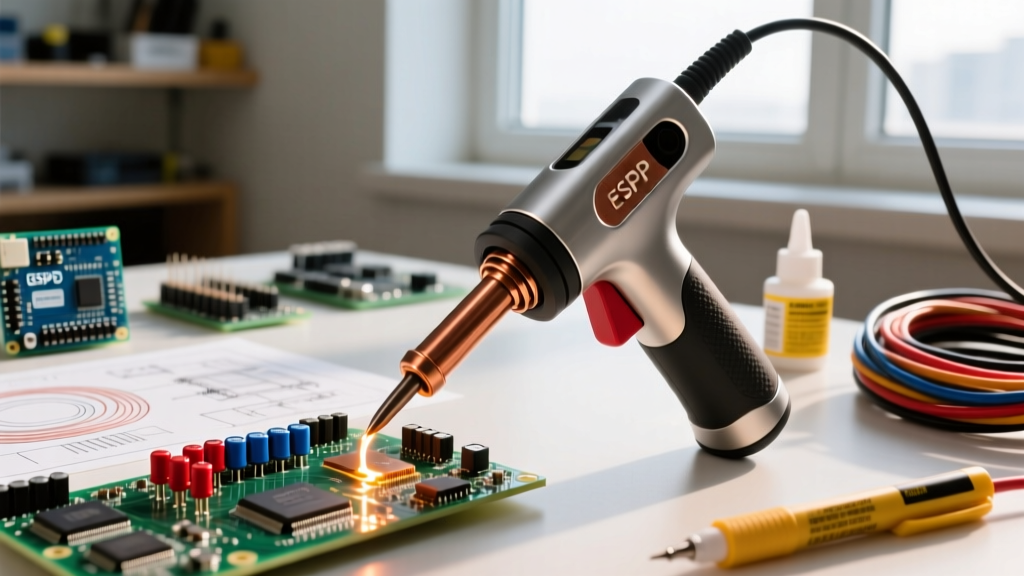
When you walk down the welding and soldering aisle searching for a Home Depot soldering gun, you are not looking at standard ceramic-core soldering irons. You are looking at transformer-based, trigger-operated thermal tools designed for high thermal mass applications. In 2026, while the electronics market has shifted toward digital, ESD-safe micro-stations, the classic soldering gun remains an indispensable beast for electricians, stained-glass artists, and RC hobbyists working with heavy-gauge copper.
However, pulling the wrong tool off the shelf can result in destroyed microcontrollers or cold, brittle solder joints on 4 AWG battery cables. This deep dive dissects the exact models available at major hardware retailers, the underlying physics of transformer heating, and the strict operational boundaries you must respect.
The Physics: Step-Down Transformers and I²R Heating
To understand why a hardware store soldering gun behaves differently than a $200 Hakko FX-951 station, you must understand the internal step-down transformer. When you pull the trigger, 120V AC is fed into a primary coil with hundreds of windings. This induces a massive current in a secondary coil consisting of only one or two turns of thick copper or aluminum.
The output at the tip is typically between 0.2V and 0.5V AC, but the amperage spikes to 150A – 300A. Because the tip itself is a low-resistance copper loop, the heat is generated directly inside the tip via Joule heating (I²R). This yields two unique characteristics:
- Near-Instant Thermal Recovery: The tip is the heating element. There is zero thermal lag from a ceramic core to the tip surface.
- Electromagnetic Interference (EMI): The high-current AC loop generates a localized alternating magnetic field, which is catastrophic for unshielded, ESD-sensitive semiconductor components.
Shelf Analysis: The 2026 Home Depot Soldering Gun Lineup
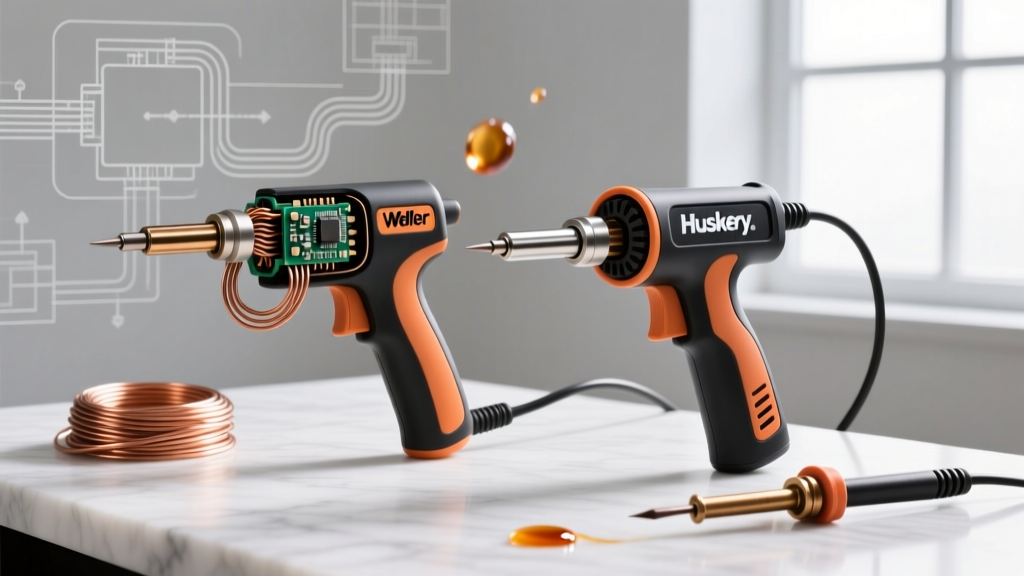
Inventory fluctuates, but three distinct tiers of soldering guns dominate the hardware store shelves. Here is how they break down in real-world performance and pricing.
1. The Undisputed Standard: Weller 9400PKS (100/140W)
Priced consistently around $55 to $65, the Weller 9400 is the gold standard for DIYers and professional electricians alike. The dual-position trigger allows you to hit 140W for initial heat-up, then release to 100W for maintenance. It comes in a kit (PKS) with a coil of 60/40 rosin-core solder and a few replacement tips. The internal transformer is potted and robust, easily surviving decades of job-site abuse.
2. The Overkill Option: Weller D550 (200/260W)
Retailing for $115 to $130, the D550 is a massive, heavy-duty gun meant for sweating large copper pipes, joining thick stained-glass came, or soldering heavy grounding lugs. It reaches operating temperature in roughly 6 seconds. Unless you are routinely soldering 2 AWG wire or 1/2-inch copper plumbing joints, the D550's thermal mass will easily scorch standard electrical insulation and lift PCB pads.
3. The Budget Contender: Husky 150W Soldering Gun Kit
At roughly $25 to $30, the in-house Husky brand offers a 150W transformer gun. While it provides adequate raw heat for basic wire splicing, the internal secondary winding is often aluminum rather than copper, and the tip threading is prone to galvanic oxidation. It is a viable 'keep-in-the-truck' backup, but it lacks the long-term tip availability and transformer longevity of the Weller units.
Feature Comparison Matrix
| Model | Wattage | Heat-Up Time | Tip Material | 2026 Avg. Price | Best Application |
|---|---|---|---|---|---|
| Weller 9400PKS | 100W / 140W | ~6 Seconds | Copper Loop | $59.00 | 10-4 AWG Wire, XT90 Connectors |
| Weller D550 | 200W / 260W | ~6 Seconds | Copper Loop | $125.00 | Plumbing, Heavy Lugs, Stained Glass |
| Husky 150W Kit | 150W (Single) | ~9 Seconds | Copper/Alloy | $28.00 | Occasional DIY Wire Splicing |
Critical Applications vs. Forbidden Zones
Knowing when to use a transformer gun is just as important as knowing when to leave it in the toolbox. According to the IPC J-STD-001 Requirements for Soldered Assemblies, thermal profiles and tool selection must match the thermal mass of the termination to prevent insulation damage or cold joints.
Where the Soldering Gun Excels
- High-AWG Electrical Terminations: Soldering 8 AWG to 4 AWG stranded wire into Anderson Powerpole connectors or heavy-duty ring terminals. The high thermal mass of the copper wire acts as a heatsink; a standard 60W iron will result in a cold, grainy joint.
- RC Hobby Battery Plugs: XT90, XT150, and AS150 connectors require massive, instantaneous heat to flow 60/40 solder into thick brass bullet connectors without melting the surrounding plastic housing.
- Stained Glass Foil Work: The broad, flat loop tips are ideal for running smooth beads of 60/40 solder over copper foil tape.
The Danger Zone: NEVER Use a Gun On
Expert Warning: Never use a transformer-based Home Depot soldering gun on printed circuit boards (PCBs), microcontrollers (Arduino, ESP32), or MOSFETs. The AC magnetic field generated by the tip loop can induce parasitic voltages in circuit traces, instantly destroying ESD-sensitive CMOS and FET components. Furthermore, the lack of precise temperature control will delaminate FR4 fiberglass boards.
Flux Chemistry: The Hardware Store Trap
A critical mistake DIYers make when buying a soldering gun kit is using the included solder for the wrong application. Many hardware store kits bundle acid-core (plumbing) solder. Acid flux is highly corrosive and designed to strip oxidation from copper pipes. If you use acid-core solder on electrical wiring, the residual flux will continue to corrode the copper strands, leading to high-resistance failures and potential fire hazards, directly violating NFPA 70 (National Electrical Code) standards for conductive terminations.
The Fix: Always discard the plumbing solder if working on electronics or electrical wiring. Purchase separate 63/37 (Eutectic) or 60/40 Rosin-Core (RMA) solder. For heavy-gauge wires, a 0.062-inch to 0.080-inch diameter rosin-core wire is required to ensure adequate flux volume for the joint's surface area.
Field Maintenance: The 10 AWG Tip Hack
Soldering gun tips are essentially thick copper wires bent into a U-shape and threaded at the ends. Over time, the tip work-hardens from repeated thermal expansion and contraction, eventually snapping. Furthermore, the tip surface pits from galvanic oxidation and flux burns.
Instead of waiting for replacement parts, professional electricians use a well-known field hack:
- Cut a 6-inch length of 10 AWG solid bare copper wire (standard THHN ground wire).
- Use needle-nose pliers to bend the center into a tight U-shape or flat spade, depending on your joint geometry.
- Wrap the ends tightly around the gun's terminal posts and secure with the provided hex nuts.
- Apply a heavy coat of rosin paste flux and 'tin' the new copper loop immediately upon first power-up to prevent instant oxidation.
This DIY tip costs pennies and often outlasts OEM replacements because pure electrical-grade copper has superior thermal conductivity compared to cheaper alloyed OEM tips.
Troubleshooting Common Gun Failures
If your Home Depot soldering gun begins to fail, diagnose the issue using this systematic approach before throwing it away:
- Gun Hums but Tip Stays Cold: The secondary circuit is open. Check the terminal nuts. If they are tight, the copper loop has likely snapped internally or the threads have stripped. Replace the tip.
- Gun Gets Extremely Hot in the Handle: The primary transformer coil is shorting, or the cooling vents on the thermoplastic shell are clogged with rosin vapor and dust. Disassemble and clean the vents with isopropyl alcohol.
- Solder Balls Up and Refuses to Wet: The tip has oxidized into a black, crusty layer. Never file the tip with sandpaper or a file, as this removes the protective iron plating (if applicable) or exposes fresh copper that will instantly burn. Instead, plunge the hot tip into a block of solid rosin flux, then aggressively wipe it on a damp cellulose sponge while applying fresh 60/40 solder.
Final Verdict for the 2026 DIYer
The hardware store soldering gun is a highly specialized, brute-force thermal tool. If your projects involve heavy electrical wiring, automotive harnesses, or stained glass, the Weller 9400PKS remains an unmatched, cost-effective investment. However, if you are building drones, repairing motherboards, or soldering SMD components, leave the gun on the shelf and invest in a proper digital, ESD-safe micro-soldering station. Understanding the boundary between these two worlds is the hallmark of a true electronics craftsman.
For more information on proper tool selection and safety standards, refer to the Weller Tools Official Soldering Gun Lineup documentation and local electrical codes.