
The Heavyweight Thermal Contenders: Budget vs. Legacy
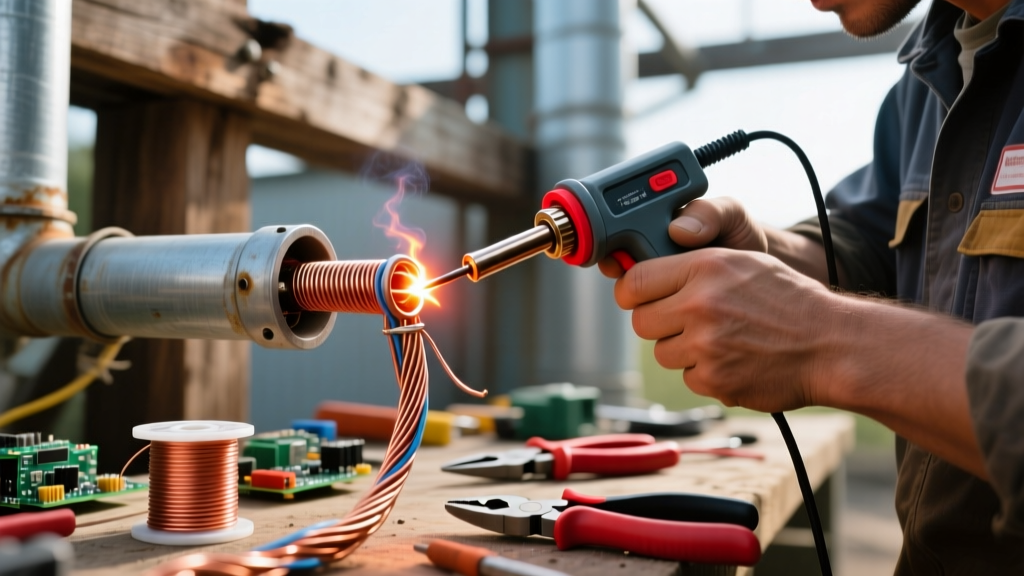
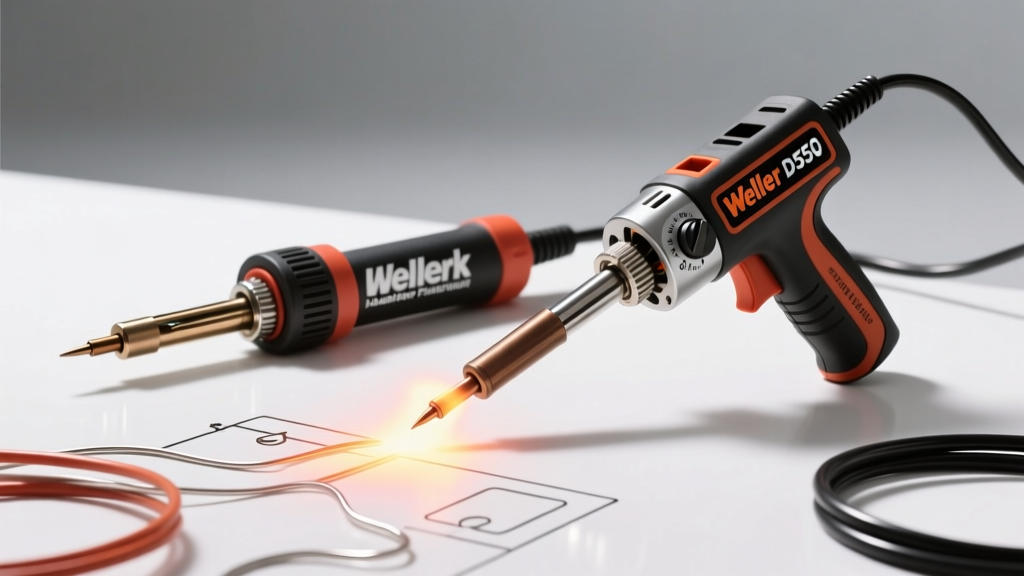
When your project involves 10 AWG battery cables, heavy-duty XT90 connectors, or stained glass copper foil, a standard 60W pencil iron simply will not cut it. You need the brute-force thermal delivery of a soldering gun. In the 2026 DIY and professional electrical landscape, the Harbor Freight soldering gun (specifically the Pittsburgh 200W/100W Dual Heat model, Item 60490) remains a popular entry point for hobbyists. However, it faces direct competition from the industry standard: the Weller D550PK 120W/200W Soldering Gun Kit.
Is the Harbor Freight soldering gun a hidden gem that punches above its weight class, or does its low price tag reflect critical compromises in transformer metallurgy and switch longevity? In this comprehensive tool comparison, we tear down the physics, failure modes, and real-world performance of both units to help you decide which tool belongs on your workbench.
2026 Specifications and Pricing Matrix
Before diving into the teardown data, let us establish the baseline specifications and current market pricing for both models. Note that supply chain adjustments and tariff implementations have shifted prices slightly in 2026.
| Feature | Pittsburgh (Harbor Freight) 200W/100W | Weller D550PK 120W/200W |
|---|---|---|
| 2026 Retail Price | $34.99 | $74.99 |
| Max Wattage | 200W (Trigger fully depressed) | 200W (Trigger fully depressed) |
| Heating Speed (to 600°F) | ~4.5 seconds | ~3.8 seconds |
| Tool Weight | 1.45 lbs | 1.85 lbs |
| Tip Type | Solid Copper Loop (Screw-mounted) | Solid Copper Loop (Nut-mounted) |
| Built-in Work Light | Yes (Incandescent/LED hybrid) | Yes (LED) |
Transformer Metallurgy and Thermal Recovery
A soldering gun is fundamentally a step-down transformer. The primary coil consists of hundreds of turns of thin copper wire, while the secondary coil is essentially a single turn made of the thick copper tip itself. This design drops the voltage to a fraction of a volt (typically around 0.2V to 0.5V) but multiplies the current to hundreds of amps. The immense heat is generated via Joule heating ($I^2R$) at the narrowest point of the tip.
The Weight Factor: Why Heavier Often Means Better
As noted in the table, the Weller D550PK is noticeably heavier than the Harbor Freight soldering gun. This weight discrepancy is not a design flaw; it is a direct indicator of the copper mass inside the primary windings and the silicon steel laminations in the transformer core. The Weller utilizes a larger, more robust core that resists magnetic saturation.
When you hold the trigger down to heat a massive 4 AWG solar battery lug, the transformer core absorbs significant back-EMF. The smaller core in the Pittsburgh gun saturates faster, causing excess energy to dissipate as heat within the tool's primary windings rather than transferring to the tip. Consequently, the Harbor Freight gun's plastic snout and internal chassis become uncomfortably hot during extended 30-second duty cycles, whereas the Weller dissipates heat more efficiently, maintaining better thermal recovery on the workpiece.
Trigger Mechanics and Real-World Failure Modes
The most common point of failure in any soldering gun is the trigger switch. Because these tools draw between 1.5 and 2.5 amps on the primary side at 120V AC, the microswitch must handle significant inductive kickback when released.
- Harbor Freight Failure Mode: The Pittsburgh gun uses a generic, budget-tier microswitch. Users frequently report that after 500 to 1,000 actuation cycles, the internal contacts begin to arc and pit. This increases the contact resistance of the switch, resulting in a voltage drop before the primary coil. The symptom is a tool that hums loudly, gets hot in the handle, but fails to push adequate current to the tip.
- Weller Advantage: Weller employs a heavy-duty, arc-suppressed switch rated for high inductive loads. It is designed to withstand tens of thousands of cycles in industrial environments. The tactile feedback is also crisper, allowing for better modulation of the dual-heat trigger.
Tip Longevity: Pitting, Oxidation, and Maintenance
Both guns rely on solid copper loop tips. Unlike pencil irons that use iron-plated tips to resist oxidation, solid copper tips are sacrificial. Flux acids and high heat will inevitably cause pitting and grooving on the working edge.
The copper purity in the Weller Tools replacement tips (such as the 7150 series) is exceptionally high, which ensures uniform electrical resistance and even heating. The Harbor Freight replacement tips (Item 69318) are noticeably cheaper (around $5 for a pack of three versus $12 for a single Weller tip) but are made from lower-grade copper alloys. This results in uneven hot spots, faster oxidation, and a tip shape that degrades into a jagged mess after just a few hours of heavy soldering. To maintain the Harbor Freight tip, you will need to frequently file it flat with a fine-grit bastard file to ensure proper surface contact with your lugs and wires.
Safety Considerations: Induced EMF and Grounding
It is critical to remember that soldering guns generate a massive alternating magnetic field at the tip. According to standard OSHA electrical safety guidelines and general electronics best practices, this localized electromagnetic interference (EMI) can induce stray voltages in nearby conductive loops.
Expert Warning: Never use a soldering gun on live, powered circuit boards. Furthermore, the induced EMF from the tip can easily destroy sensitive, unshielded CMOS logic chips and MOSFETs, even if the board is powered off but connected to a grounded plane. For delicate PCB work, always use a temperature-controlled pencil station. Reserve the soldering gun for heavy-gauge wire, chassis grounding, and stained glass.
Both the Weller and the Harbor Freight models feature double-insulated housings, but the Weller's strain relief and internal grounding shielding for the work light circuit are vastly superior, reducing the risk of 120V AC coupling into your workpiece via parasitic capacitance.
Final Verdict: Which Tool Belongs on Your Bench?
Choosing between the Harbor Freight soldering gun and the Weller D550PK comes down to your specific use case, duty cycle, and budget.
Buy the Harbor Freight Pittsburgh Gun If:
- You are a weekend DIYer or automotive hobbyist who only solders heavy-gauge wires (12 AWG to 4 AWG) a few times a year.
- You are building a mobile solar setup or making custom battery packs where the tool will see intermittent, short-burst usage.
- Your budget is strictly capped, and you do not mind replacing the microswitch or filing down the tips as part of routine maintenance.
Buy the Weller D550PK If:
- You are a professional HVAC technician, electrician, or stained-glass artist who relies on the tool daily.
- You require consistent thermal recovery and joint reliability that aligns with IPC J-STD-001 standards for heavy-duty electrical assemblies.
- You want a legacy tool with a proven track record of surviving decades of drops, flux exposure, and heavy trigger actuation.
Frequently Asked Questions
Can I use these soldering guns for plumbing and copper pipes?
No. While a 200W soldering gun generates intense localized heat, it lacks the total thermal mass output required to heat a 1/2-inch or 3/4-inch copper pipe and fitting evenly. For plumbing, you must use a propane or MAP-Pro gas torch. Attempting to solder a water pipe with a gun will result in a cold, leaky joint.
Why does my soldering gun magnetize my screwdrivers?
The single-turn secondary coil (the tip) carries hundreds of amps of AC current, creating a powerful alternating magnetic field. If you hold a steel screwdriver near the tip while the trigger is depressed, the magnetic flux can permanently magnetize the steel. Keep precision screwdrivers and magnetic-sensitive components away from the snout.
How do I prevent the tip screws from seizing?
Both the Weller and Harbor Freight models suffer from seized tip screws due to flux fumes and extreme heat cycling. Apply a tiny dab of high-temperature anti-seize compound (like copper-based Never-Seez) to the threads of the mounting screws when installing a new tip. Do not use standard grease, as it will instantly vaporize and smoke.