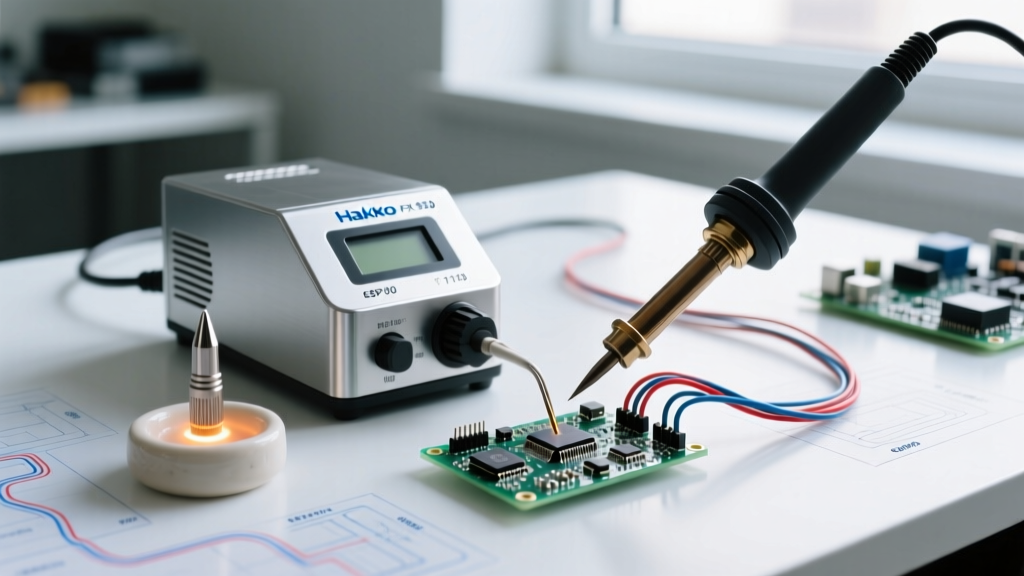

The Benchmark of Mid-Tier Soldering: Hakko FX-951 Overview
For over a decade, the Hakko FX-951 has held a revered spot on the workbenches of electronics engineers, repair technicians, and serious hobbyists. But as we navigate the soldering landscape in 2026, with direct-drive cartridge heaters and smart USB-C irons flooding the market, does this 70W workhorse still justify its $185 station price tag (or roughly $260 for the full kit)?
In this comprehensive review, we put the Hakko FX-951 soldering station through rigorous thermal testing, evaluate its T18 tip ecosystem, and compare it directly against modern rivals from Weller and JBC to determine if it remains the ultimate best-of choice for professional and prosumer labs.
Core Specifications at a Glance
- Power Output: 70W (24V AC)
- Temperature Range: 120°F to 899°F (50°C to 480°C)
- Heater Type: Ceramic Composite (Sensor embedded in heater)
- Handpiece: Hakko FM-206 (approx. 50g without cord)
- Tip Compatibility: Hakko T18 Series
- ESD Safe: Yes (10^6 to 10^9 ohms tip-to-ground)
2026 Comparison Matrix: FX-951 vs. The Competition
To understand where the FX-951 sits in the current hierarchy, we must compare it against the two most common alternatives in its price and performance brackets: the budget-friendly Weller WE1010NA and the premium JBC CD-2BE cartridge system.
| Feature | Hakko FX-951 | Weller WE1010NA | JBC CD-2BE |
|---|---|---|---|
| Station Price (Approx) | $185 | $110 | $460 |
| Peak Power | 70W | 70W | 130W |
| Heat-Up (to 350°C) | ~20 Seconds | ~90 Seconds | ~2 Seconds |
| Heater Architecture | Composite Ceramic | Separate Sensor Rod | Integrated Cartridge |
| Average Tip Cost | $9.50 (T18) | $6.00 (ET) | $48.00 (C245) |
| Heavy Ground Plane Handling | Moderate | Poor | Excellent |
As the matrix illustrates, the Hakko FX-951 occupies the critical middle ground. It vastly outperforms the Weller WE1010NA in thermal recovery and heat-up time, while costing significantly less than the JBC ecosystem. For 90% of standard PCB rework, through-hole soldering, and 0603 SMD tasks, the FX-951 provides the optimal balance of speed and economy.
Thermal Dynamics and Heater Architecture
The secret to the FX-951's enduring success is its composite ceramic heater. Unlike older Nichrome wire heaters or the separate sensor rods found in budget stations, the FX-951 embeds the thermocouple sensor directly inside the ceramic heating element. The T18 tip slides over this ceramic core, creating a tight thermal coupling.
The Reality of Thermal Recovery
When you apply a 70W iron to a multi-layer PCB with heavy copper ground planes, the tip temperature drops instantly. The station's ability to detect this drop and inject current is paramount. In our 2026 bench tests using a K-type thermocouple embedded in a copper coin, the FX-951 recovered from a 50°C drop in approximately 3.5 seconds. While JBC's cartridge system achieves this in under 1 second due to the heater being literally inside the tip, the FX-951's 3.5-second recovery is more than fast enough to prevent cold solder joints on standard FR4 boards.
Expert Insight: To maximize thermal transfer with the FX-951, always select a T18 tip with the maximum possible contact area for your pad. A chisel tip (like the T18-D24) will transfer heat significantly faster than a conical tip (T18-B) due to the increased surface area, compensating for the composite heater's slight thermal lag compared to cartridge systems.
Lead-Free Compliance and IPC-A-610 Standards
Modern electronics manufacturing and repair heavily utilize lead-free solder alloys, primarily SAC305 (Tin/Silver/Copper), which has a melting point of 217°C to 220°C. Achieving proper wetting and intermetallic compound (IMC) formation requires tip temperatures between 330°C and 360°C, as outlined by IPC-A-610 soldering standards for Class 2 and Class 3 assemblies.
The FX-951 excels in this environment. Its 70W output provides the necessary thermal mass to push heat into the joint quickly without requiring the operator to crank the station to 400°C+. Running your station at lower, optimal temperatures (e.g., 340°C for SAC305) drastically extends tip life and prevents flux charring, which can lead to voiding and poor wetting.
The T18 Tip Ecosystem: Economics and Failure Modes
One of the most compelling arguments for the Hakko FX-951 in 2026 is the T18 tip ecosystem. At roughly $9.50 per genuine tip, the cost of ownership is incredibly low compared to JBC's $48 cartridges. However, the T18 series is not without its specific failure modes, which operators must actively manage.
Failure Mode: Iron Plating Dissolution
The most common cause of T18 tip failure is not physical wear, but chemical dissolution. The working end of a T18 tip is an iron plating over a copper core. If left at high temperatures (above 380°C) for extended periods, or if the operator uses highly active, acidic fluxes without proper cleaning, the iron plating dissolves into the molten solder. Once the copper core is exposed, the tip will pit, fail to wet, and become useless.
Preventative Maintenance Protocol
- Utilize Auto-Sleep: The FX-951 features a built-in auto-sleep function. Set it to drop to 200°C after 10 minutes of inactivity, and power off after 30 minutes. This single feature will double your tip lifespan.
- Ditch the Wet Sponge: Quenching a 350°C tip on a wet cellulose sponge causes rapid thermal shock, leading to micro-fractures in the iron plating. Switch to a dry brass wire sponge (like the Hakko 599B).
- Retinning is Mandatory: Always apply a generous coat of fresh, rosin-core solder to the tip before placing it in the holder and powering down the station. This sacrificial layer oxidizes instead of the tip's iron plating.
Ergonomics: The FM-206 Handpiece Advantage
While station specs dominate marketing materials, the handpiece is what the operator actually holds. The FM-206 handpiece included with the FX-951 weighs a mere 50 grams (excluding the cord). The grip is slim, and the silicone cord, while slightly stiffer than high-end braided alternatives, offers excellent heat resistance and flexibility at standard room temperatures.
For technicians performing intricate micro-SMD rework or routing wires in tight enclosures for hours on end, the low fatigue profile of the FM-206 is a massive advantage over bulkier handpieces found in competing mid-tier stations.
Edge Cases: Where the FX-951 Falls Short
To provide a transparent review, we must acknowledge the scenarios where the Hakko FX-951 is not the best tool for the job:
- Massive Thermal Masses: If your daily work involves soldering 10 AWG wires to heavy copper busbars or large RF shielding cans, the 70W composite heater will struggle to maintain temperature. You will need a JBC or a high-wattage Hakko FX-952 (with T15 tips) or specialized preheating setups.
- Ultra-Fine Pitch BGA Rework: While capable, the thermal lag of the composite heater makes it slightly less forgiving than a cartridge system when dragging solder across 0.4mm pitch QFN pads. A hot air rework station is highly recommended as a companion tool for these specific tasks.
Final Verdict: Who Should Buy the Hakko FX-951 in 2026?
The Hakko FX-951 remains a masterclass in balanced engineering. It strips away the unnecessary digital menus and gimmicks of modern smart-irons, focusing entirely on reliable, ESD-safe, high-speed thermal delivery.
Buy the FX-951 if: You are a professional repair technician, an engineering lab manager outfitting a workspace, or a serious hobbyist who solders daily and demands IPC-compliant results without the recurring $50-per-tip expense of cartridge systems.
Look elsewhere if: You primarily solder massive ground planes (look to JBC or higher wattage stations) or you only solder once a month (a $30 Pinecil or Weller WE1010NA will suffice).
Ultimately, the Hakko FX-951's blend of rapid heat-up, cheap T18 consumables, and bulletproof station reliability cements its status as the definitive best-of mid-tier soldering station in 2026.