
The 100W Soldering Iron Landscape in 2026: Why Wattage Matters
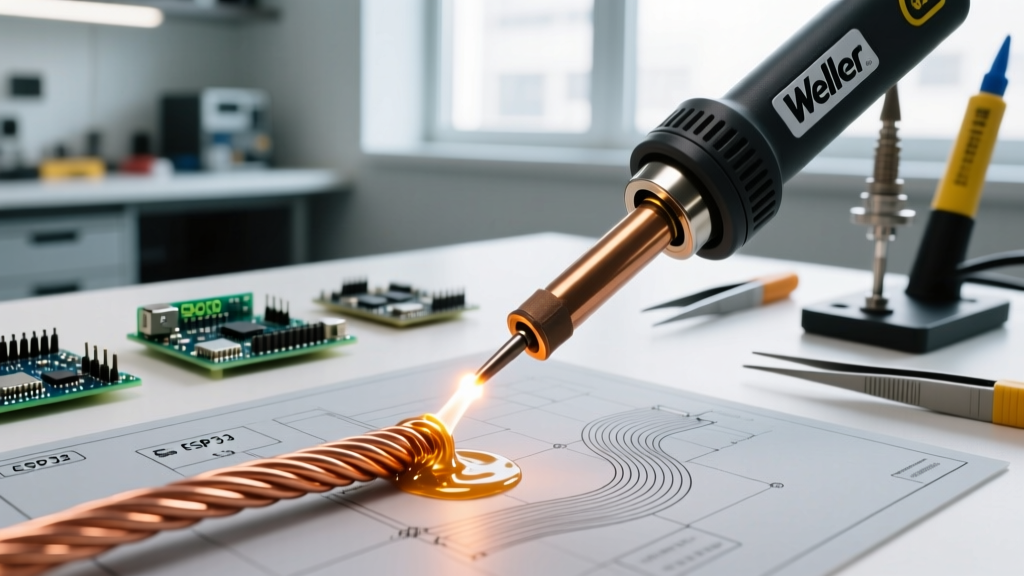
When tackling heavy thermal loads—such as soldering 10 AWG battery cables, grounding lugs on thick copper planes, or joining brass plumbing fittings—a standard 40W to 60W station simply cannot deliver the necessary Joules per second to maintain alloy flow. This is where the Weller soldering iron 100W category becomes indispensable. In 2026, the demand for high-wattage irons has surged alongside the proliferation of high-current EV battery builds, heavy-duty drone wiring, and robust industrial control panels.
However, not all 100W irons are created equal. The market is split between standalone heavy-duty irons and microprocessor-controlled digital stations that hover right around the 95W–100W mark. According to the IPC J-STD-001 standards for soldered electrical assemblies, maintaining proper wetting times and avoiding prolonged heat exposure (which degrades flux and damages component substrates) requires an iron with rapid thermal recovery. A high-wattage iron achieves this by instantly replenishing heat drawn away by massive thermal sinks.
In this best-of comparison, we dissect the top Weller models that dominate the 100W class, evaluating their heating elements, tip ecosystems, and ideal use cases.
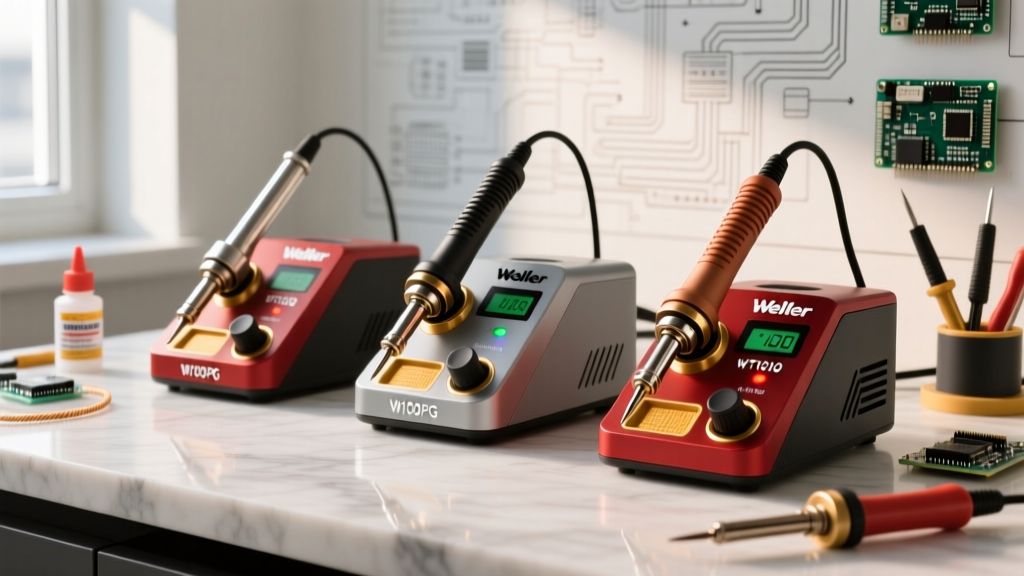
Head-to-Head Comparison Matrix
| Model | Type | Exact Wattage | Temp Range | Tip Ecosystem | Est. Price (2026) |
|---|---|---|---|---|---|
| Weller W100PG | Standalone Iron | 100W | Fixed (via Tip) | ETA Series | $75 - $85 |
| Weller WT1010 | Digital Station | 95W | 120°F - 850°F | RT / RTW Series | $420 - $460 |
| Weller W100 | Standalone Iron | 100W | Fixed (via Tip) | ETA Series | $55 - $65 |
Deep Dive: The Contenders
1. Weller W100PG (100W Heavy-Duty Pro Guard)
The Weller W100PG is the undisputed workhorse for electricians, automotive technicians, and hobbyists who need raw, unadulterated thermal mass. The 'PG' stands for Pro Guard, featuring a built-in stainless steel safety rest and a heat-resistant silicone grip that extends further down the shaft than standard irons, protecting your knuckles from radiant heat during extended plumbing or heavy wire sessions.
- Heating Technology: Uses a robust ceramic heating element paired with Weller's legendary ETA series tips. The temperature is determined by the physical tip inserted (e.g., an ETA tip marked '7' operates at 700°F / 371°C).
- Best Use Case: Soldering 8 to 14 AWG silicone wires, XT90/XT150 connectors, and large brass terminals. It is also highly favored for stained glass and light plumbing where digital precision is unnecessary but raw heat is mandatory.
- The Drawback: Lack of digital temperature control. If you transition from a massive ground plane to a delicate 20 AWG signal wire, you must physically swap the tip or use a separate iron to avoid thermal shock to the PCB pad.
2. Weller WT1010 (95W Digital Soldering Station)
While technically rated at 95W, the Weller WT1010 is the premier digital station that fulfills the '100W class' search intent for advanced electronics engineers. It bridges the gap between raw power and micro-soldering precision. As highlighted in the Digi-Key Soldering Equipment Catalog, the WT series represents the modern standard for ESD-safe, high-power bench stations.
- Heating Technology: The WT1010 utilizes the RT and RTW (Rapid Heating) tip series. These tips feature an integrated heater and thermocouple directly at the soldering edge, resulting in a heat-up time of under 9 seconds and near-instantaneous thermal recovery.
- Best Use Case: Mixed-environment labs. You can set the station to 380°C (716°F) for lead-free SAC305 solder on a multi-layer PCB, and the 95W reserve ensures the temperature won't drop below 360°C even when touching a large copper pour.
- The Drawback: The initial capital expenditure is high, and the proprietary RTW tips cost significantly more ($45-$55 each) compared to the older ETA tips.
3. Weller W100 (100W Standard Standalone)
The Weller W100 is the stripped-down, budget-friendly sibling of the W100PG. It delivers the exact same 100W thermal output and uses the same ETA tip ecosystem, but it omits the integrated Pro Guard stand. You will need to purchase a separate heavy-duty stand (like the Weller PH100) to use it safely on a bench.
- Best Use Case: Field repair kits and mobile technicians who already have a custom holster or stand setup and want to save $20 on the iron itself.
- The Drawback: Without the integrated guard, the bare metal shaft poses a higher burn and fire risk if accidentally rolled off a workbench without a dedicated stand.
Thermal Dynamics and Tip Metallurgy
Understanding why a Weller soldering iron 100W model outperforms higher-wattage generic brands requires looking at tip metallurgy. According to Weller Tools engineering documentation, their high-wattage tips utilize a solid copper core plated with iron, nickel, and chromium.
Expert Insight: Wattage alone does not melt solder; thermal mass and surface area do. A 100W iron paired with a microscopic conical tip will still fail to solder a 10 AWG wire because the tip's surface area cannot transfer the Joules fast enough. Always pair high-wattage irons with heavy chisel or bevel tips (like the Weller ETA or RTW chisel variants) to maximize the contact patch.
When working with lead-free alloys like SAC305 (which melts at 217°C but requires a working temperature of 350°C–380°C for proper wetting), the iron's ability to push 100W into the joint prevents the flux from burning out before the solder flows. This eliminates the dreaded 'cold joint' scenario where the solder balls up and refuses to wick into the wire strands.
Failure Modes and Edge Cases to Avoid
Even with the best equipment, improper use of a 100W iron can lead to catastrophic failures. Here are the most common edge cases we see in the field:
- Pad Lifting on FR4 PCBs: Applying a 100W iron with a broad chisel tip to a small SMD pad without using a thermal interface (like a dab of fresh 63/37 leaded solder) will transfer heat too aggressively. The epoxy in the FR4 substrate will undergo glass transition, and the copper pad will lift off the board in seconds.
- Tip Oxidation at High Temps: Leaving a W100PG or WT1010 idle at 400°C (750°F) for more than 5 minutes will cause rapid oxidation of the iron plating. Once the tip turns black and refuses to wet, it is effectively ruined. Always use the station's auto-standby feature (on the WT1010) or manually lower the temperature/dial back the tip selection when not actively soldering.
- Flux Core Vaporization: High-wattage irons vaporize rosin and no-clean flux cores almost instantly. When soldering thick wires, feed the solder wire into the joint, not directly onto the iron tip, to ensure the flux activates exactly where the metallurgical bond is forming.
Final Verdict: Which 100W Weller Should You Buy?
Your choice depends entirely on your primary workload:
- Choose the Weller W100PG if your daily routine involves automotive wiring, drone builds, XT90 connectors, or light plumbing. It is rugged, inexpensive to maintain, and delivers massive thermal shock to thick metals.
- Choose the Weller WT1010 if you are an electronics engineer, repair technician, or advanced hobbyist who needs 100W-class thermal recovery for multi-layer PCBs, but also requires the digital precision to safely work on smaller components without swapping stations.
- Choose the Weller W100 only if you are building a mobile field-repair kit on a strict budget and already own a compatible heavy-duty iron stand.
Investing in the right Weller soldering iron 100W model in 2026 ensures that your joints meet IPC Class 2 and 3 reliability standards, saving you from costly rework and field failures down the line.