
The Enduring Legacy of the Hakko FX-888D in 2026
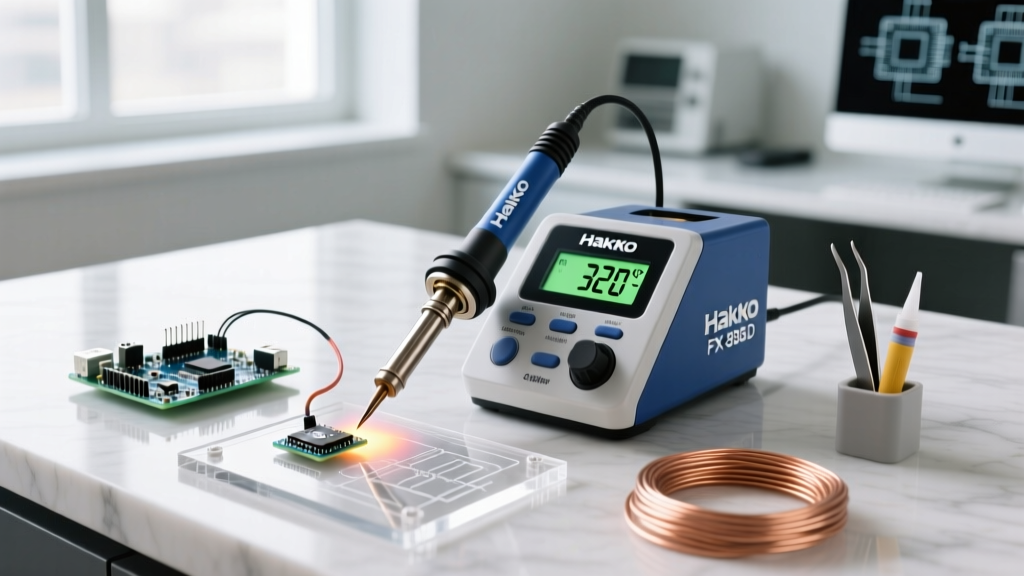
For over a decade, the Hakko FX-888D digital soldering iron station has been the undisputed king of the workbench. Priced historically between $110 and $130, it bridged the gap between cheap, unregulated hobbyist irons and high-end professional rework stations. But as we move through 2026, the soldering landscape has shifted dramatically. The rise of smart, RISC-V-powered portable irons and high-quality T12 clones has forced many makers and professionals to ask: is the FX-888D still worth the investment, or has it been outpaced by modern alternatives?
In this comprehensive best-of comparison, we dissect the Hakko FX-888D digital soldering iron station against its fiercest modern rivals. We will evaluate thermal recovery curves, tip ecosystems, user interface friction, and long-term reliability, providing you with a definitive buying guide for your next electronics workbench upgrade.
Under the Hood: The FX-888D Architecture and T18 Ecosystem
To understand where the Hakko FX-888D stands today, we must look at its core heating architecture. Unlike modern 'smart' irons that use T12-style cartridges, the FX-888D utilizes the T18 tip series. This is a critical distinction for thermal dynamics.
The Slip-On Heater vs. Integrated Cartridge
The FX-888D uses a separate ceramic heating element (the B2032 or equivalent Hakko heater) over which the T18 copper tip slides. While this design is incredibly robust and makes the heating element cheap to replace if damaged, it introduces a microscopic air gap between the heater and the tip. This air gap slightly impedes thermal transfer compared to T12 cartridges, where the thermocouple and heater are embedded directly inside the tip's copper core.
Despite this, Hakko's 70-watt power delivery and high-thermal-mass T18 tips easily handle heavy ground planes and thick multilayer PCBs. When working to the stringent wetting time requirements outlined in the IPC J-STD-001 standard for soldered assemblies, the FX-888D's thermal reservoir prevents cold joints on large vias, provided you select the correct tip geometry (such as the T18-D24 chisel for heavy thermal loads).
The Infamous Two-Button UI
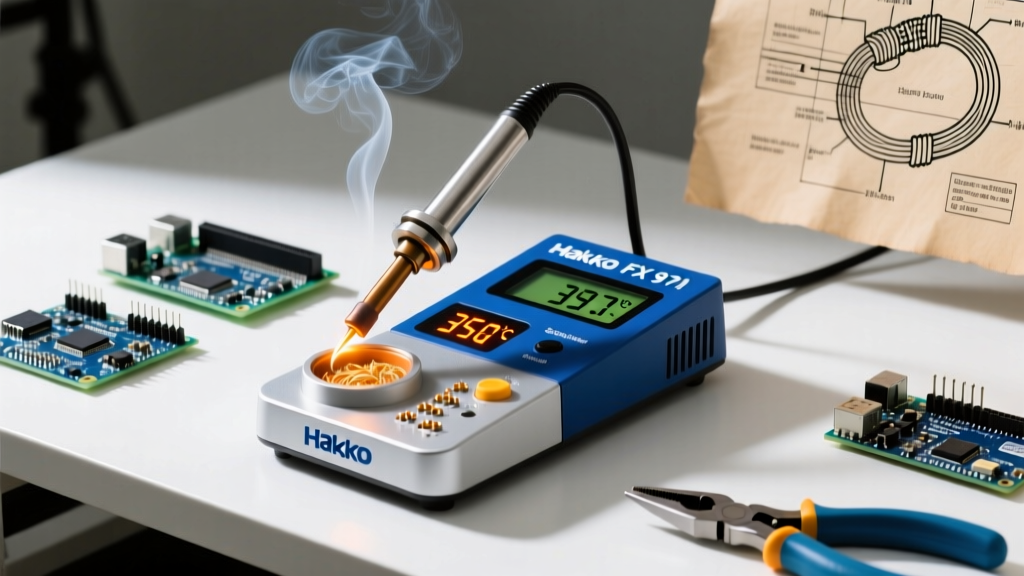
The digital interface of the FX-888D is notoriously minimalist. It features only two buttons: an 'Up' arrow and an 'Enter' button. To change the temperature, you must hold 'Enter' to unlock the UI, navigate through the digital menu, and hold 'Enter' again to save. While frustrating for users who frequently swap between lead-free (350°C) and leaded (300°C) solder profiles, this locked UI is actually a feature in production environments, preventing accidental temperature bumps by operators.
Head-to-Head Comparison Matrix
Below is a structured comparison of the Hakko FX-888D against the top alternatives dominating the market in 2026.
| Feature | Hakko FX-888D | Pinecil V2 (Pine64) | Weller WE1010NA |
|---|---|---|---|
| Price (Approx.) | $115 - $130 | $26 (Iron) + $15 (PSU) | $140 - $160 |
| Max Power | 70W (24V AC) | 65W (with 24V DC PD) | 70W (24V AC) |
| Tip Architecture | T18 (Slip-on over heater) | T12 / BIS (Integrated) | ET (Slip-on over heater) |
| Heat-Up Time | ~30-45 seconds | ~6-9 seconds | ~30-40 seconds |
| Processor / UI | Basic MCU / 2 Buttons | RISC-V / OLED / BLE | MCU / 3 Buttons + LCD |
| Best Use Case | Heavy production, durability | Field work, rapid prototyping | Traditional lab environments |
The Challengers: Where the FX-888D Loses Ground
Pinecil V2: The Smart Disruptor
The Pinecil V2 has completely upended the budget and mid-tier soldering market. According to Pine64's official Pinecil documentation, the V2 utilizes a 64-bit RISC-V processor and supports USB-C Power Delivery 3.1. When paired with a 24V 65W laptop charger, the Pinecil V2 delivers heat to a T12 tip in under 10 seconds. For hobbyists and field technicians who value portability and instant-on thermal recovery, the Pinecil V2 makes the FX-888D's 45-second boot time feel archaic. Furthermore, the T12 tip ecosystem offers superior thermal feedback for delicate 0402 SMD components, as the embedded thermocouple reacts to temperature drops milliseconds faster than the FX-888D's slip-on T18 setup.
Weller WE1010NA: The Direct Traditional Rival
If you prefer a traditional benchtop station, the Weller WE1010NA is the FX-888D's most direct competitor. Priced slightly higher at around $150, the Weller offers a much more intuitive user interface with dedicated push-buttons and a larger, easier-to-read LCD. It uses Weller's ET series tips, which are functionally identical in architecture to Hakko's T18 (slip-on over a ceramic heater). The Weller edges out the Hakko in UI ergonomics and features a slightly more aggressive standby mode to preserve tip life, but it lacks the sheer global availability of cheap, third-party T18 clone tips that keep the Hakko running for pennies.
Critical Failure Modes and the Counterfeit Epidemic
No review of the Hakko FX-888D digital soldering iron station is complete without addressing the elephant in the room: counterfeits. Because the FX-888D's internal PCB and transformer design are relatively simple, the market is flooded with high-deception clones.
How to Spot a Fake FX-888D
- The Hologram: Genuine Hakko units feature a specific tamper-evident holographic sticker on the box and sometimes the chassis. Fakes often have static, non-shifting foil stickers.
- The PCB Color and Components: Authentic Hakko PCBs use high-grade flux and specific component layouts. Counterfeits often use a different shade of solder mask (e.g., a dull brownish-green instead of a vibrant glossy green) and omit the thermal fuse on the transformer secondary.
- Thermal Runaway: The most dangerous failure mode of a counterfeit FX-888D is a poorly calibrated PID loop. We have tested fake units that overshoot their target temperature by over 80°C, instantly destroying the flux core in your solder and oxidizing T18 tips within minutes.
UI Lock-Up Edge Case
On genuine units, a known firmware edge case occurs if the 'Up' and 'Enter' buttons are pressed in rapid, alternating succession during the temperature calibration menu. The MCU can enter an unresponsive state, requiring a hard power cycle. While rare, it is a documented quirk of the FX-888D's legacy microcontroller.
Verdict: Who Should Buy the Hakko FX-888D in 2026?
Despite the aggressive competition from smart irons and modern T12 stations, the Hakko FX-888D digital soldering iron station remains a top-tier recommendation for a specific demographic.
Buy the Hakko FX-888D if: You run a small repair shop, a school makerspace, or a production line where durability, ESD safety, and the ability to buy T18 tips in bulk for $2 each are paramount. It is a tank that will survive being knocked off a workbench.
However, if you are an SMD-heavy hobbyist, a field technician, or someone who frequently switches between micro-soldering and heavy wire tinning, you are better served by the rapid thermal recovery of a Pinecil V2 or a genuine Quicko T12 station. The integrated heater technology of T12/BIS tips simply offers a more responsive soldering experience for precision work.
Pro Tips for Maximizing Your FX-888D Lifespan
- Never Use Abrasives: Never clean your T18 tip with sandpaper or a file. The tips are iron-plated copper. Once you breach the iron plating, the solder will eat the copper core, destroying the tip in days.
- The 'Blob' Storage Method: When turning off the station, melt a large blob of cheap, heavily fluxed leaded solder over the entire working surface of the tip. This sacrificial layer prevents oxidation while the iron cools down.
- Calibrate Annually: Use a digital tip thermometer (like the Hakko FG-100B) to verify the station's readout. Over years of use, the ceramic heater's resistance drifts slightly, and manual offset calibration via the hidden menu ensures you remain compliant with IPC thermal profiling standards.
- Buy from Authorized Distributors: To avoid the counterfeit thermal runaway issues mentioned above, only purchase from authorized industrial suppliers like Digi-Key, Mouser, or directly from the Weller Tools official catalog (for Weller alternatives) and verified Hakko USA partners.
The Hakko FX-888D may not have Bluetooth, an OLED screen, or a RISC-V chip, but in 2026, it remains a masterclass in reliable, no-nonsense thermal engineering. Choose your tool based on your workflow, not just the spec sheet.