
The M12 Ecosystem: Proprietary Tips vs. Industry Standards
The Milwaukee M12 Soldering Iron (Model 2488-20) fundamentally changed field electronics repair and electrical termination by eliminating the power cord. However, this cordless convenience introduces a highly polarizing constraint for bench technicians and field engineers alike: a completely proprietary tip ecosystem. If you are transitioning from a Hakko FX-888D or a Weller WES51 station, you will quickly discover that standard 900M or ET-series tips are physically incompatible. As of 2026, the market for Milwaukee soldering iron tips remains restricted to Milwaukee's own first-party replacements, forcing professionals to weigh the benefits of battery-powered portability against the limitations of a closed tip architecture.
Unlike the open ecosystems of Pine64 or Hakko, where dozens of third-party manufacturers produce specialized micro-tweezers, drag-soldering blades, and hot-air nozzles, Milwaukee's lineup is strictly utilitarian. This guide provides a deep-dive metallurgical and practical comparison of the available Milwaukee M12 tips, analyzing thermal recovery, degradation rates with lead-free alloys, and specific use-case viability.
Comprehensive Breakdown of Milwaukee M12 Tip Models
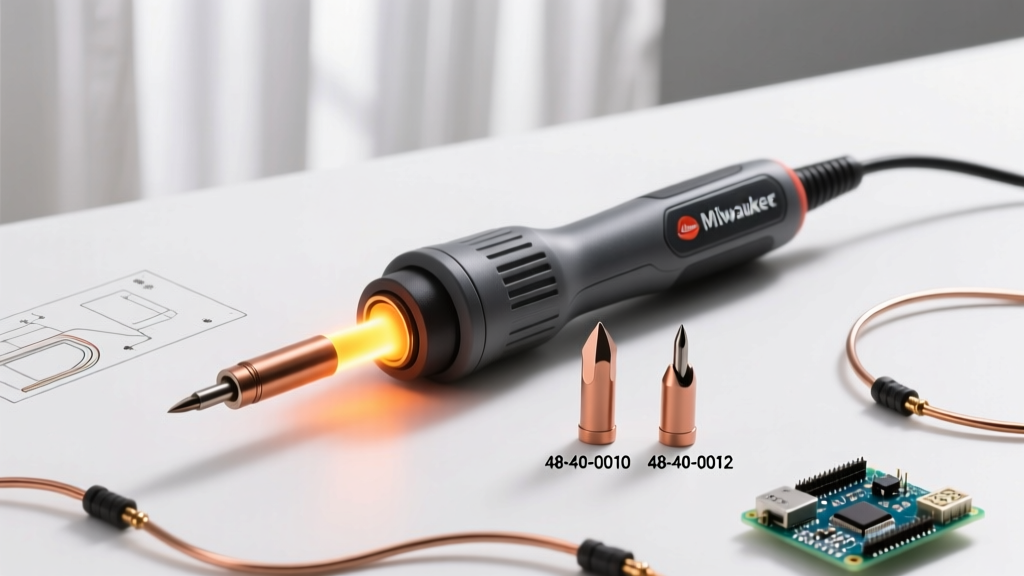
Milwaukee currently supports the M12 Soldering Iron with two primary tip geometries. Both utilize a set-screw retention mechanism rather than the friction-fit ceramic heater sleeves found in modern bench stations. This mechanical coupling slightly increases thermal resistance between the heating element and the tip shroud, a critical factor when working with high-thermal-mass components.
48-40-0010: The 1/8" Chisel Tip (The Workhorse)
The Milwaukee 48-40-0010 is a 1/8-inch (3.2mm) chisel tip designed for heavy-duty electrical terminations. In the context of IPC J-STD-001 standards for soldered electrical assemblies, this tip excels at delivering the rapid thermal transfer required for Class 2 and Class 3 wire-to-board connections.
- Optimal Use Cases: Soldering 12 AWG to 18 AWG stranded copper wire, terminating XT60/XT90 connectors in drone and RC applications, and tinning heavy ground lugs on automotive chassis.
- Thermal Dynamics: The flat chisel face maximizes surface area contact. When paired with 63/37 leaded rosin-core solder, the 48-40-0010 achieves flow in under 1.5 seconds on standard copper pads.
- Failure Modes: The sharp 90-degree edges of the chisel are prone to pitting if used with highly activated (corrosive) plumbing fluxes. Always use Rosin Mildly Activated (RMA) flux for electronics.
48-40-0012: The 1/16" Pencil/Conical Tip (The Precision Pitfall)
The Milwaukee 48-40-0012 is a 1/16-inch (1.6mm) conical pencil tip. While marketed for precision work, experienced PCB rework technicians often view conical tips with skepticism due to the physics of thermal transfer.
Expert Insight: A conical tip's point of contact is infinitesimally small. When attempting to reflow a surface-mount capacitor on a multi-layer PCB with internal ground planes, the tip acts as a thermal bottleneck. The heat cannot transfer into the pad faster than the ground plane dissipates it, leading to cold solder joints or the temptation to dwell too long and delaminate the FR4 board.
If you must use the 48-40-0012 for 0805 or 0603 SMD components, you must heavily rely on high-quality tacky flux (like Amtech NC-559) and pre-heat the board to 120°C to compensate for the M12 iron's localized thermal limitations.
Thermal Dynamics and Tip Degradation in 2026
Understanding the metallurgy of Milwaukee soldering iron tips is crucial for managing your operational budget. Like most premium tips, Milwaukee utilizes a solid copper core for rapid heat conduction, layered with an iron plating for solder erosion resistance, and finished with a chromium coating on the non-wetting areas.
The primary enemy of the M12 tip ecosystem is oxidation during idle periods. The Milwaukee 2488-20 lacks an automatic sleep mode or motion-sensing standby feature found in the Hakko FX-951 or Pinecil V2. If a technician leaves the iron on at 700°F (371°C) while stripping wires, the iron plating on the tip will oxidize within 15 to 20 minutes. Once oxidized, the tip turns black, refuses to wet with fresh solder, and essentially becomes a thermal insulator rather than a conductor.
Lead-Free Solder (SAC305) Wear Rates
With the industry's continued shift toward RoHS-compliant SAC305 (Sn96.5/Ag3.0/Cu0.5) lead-free alloys, tip degradation has accelerated across all brands. SAC305 requires processing temperatures between 340°C and 380°C. At these elevated temperatures, the tin in the solder aggressively dissolves the iron plating of the Milwaukee tips. Field data suggests that when used exclusively with lead-free solder at maximum temperature settings, a Milwaukee 48-40-0010 tip will require replacement after approximately 12 to 15 hours of active dwell time.
Comparison Matrix: Milwaukee vs. Industry Benchmarks
How do Milwaukee's proprietary offerings stack up against the gold standards of bench soldering? The following matrix compares physical attributes, pricing, and ecosystem flexibility as of early 2026.
| Feature | Milwaukee 48-40-0010 (M12) | Hakko T18-B (FX-888D) | Weller ET-A (WES51) |
|---|---|---|---|
| Tip Geometry | 1/8" Chisel (Screw-mount) | 1.6mm Chisel (Slip-in sleeve) | 1/32" Chisel (Threaded barrel) |
| Avg. Retail Price | $14.00 - $16.00 | $7.50 - $9.00 | $6.50 - $8.00 |
| Thermal Coupling | Moderate (Air gap at set-screw) | Excellent (Direct ceramic wrap) | Good (Barrel contact) |
| Ecosystem Variety | 2 Official Geometries | 30+ Geometries (Inc. Micro/Knife) | 15+ Geometries |
| Primary Environment | Field Service / HVAC / Auto | PCB Rework / Manufacturing | General Bench / Education |
Cost of Ownership and Field Availability
The most significant friction point for Milwaukee soldering iron tips is the cost-to-variety ratio. At roughly $15 per tip, Milwaukee charges nearly double the price of a genuine Hakko T18 series tip. Furthermore, the procurement channels are vastly different.
If a bench technician blows a Hakko tip, they can source a replacement same-day from specialized electronics distributors like Digi-Key, Mouser, or local electronics surplus shops. Milwaukee tips, conversely, are distributed through industrial supply houses, Home Depot, and Milwaukee Tool authorized service centers. For an HVAC technician or a solar panel installer already visiting an industrial supplier for crimpers and multimeters, this is a non-issue. For a micro-soldering repair shop focusing on smartphone logic boards, the lack of specialized micro-tips (like bent tweezers or ultra-fine drag-soldering blades) makes the M12 entirely unsuitable as a primary station.
Best Practices for Maximizing Milwaukee Tip Lifespan
To mitigate the high replacement cost and oxidation vulnerabilities of the M12 system, implement the following standard operating procedures in your toolkit:
- The "Shutdown Blob" Rule: Never turn off the M12 iron with a clean tip. Before powering down, apply a massive, golf-ball-sized blob of cheap, heavily fluxed 60/40 leaded solder to the working end. This sacrificial blob will oxidize instead of the iron plating. Wipe it off on brass wool only after the iron has fully heated up on its next use.
- Ditch the Wet Sponge: Wet cellulose sponges cause rapid thermal shock to the copper core, leading to micro-fractures in the iron plating over time. Always use dry brass wire tip cleaners.
- Temperature Discipline: The M12 dial tempts users to max out the heat for faster melting. Resist this. Set the dial to the lowest temperature that allows the solder to flow within 2-3 seconds of contact. For standard 63/37 rosin-core solder, this is typically around 600°F (315°C) on the Milwaukee dial.
Final Verdict: Who Should Buy Into the Milwaukee Tip Ecosystem?
Evaluating Milwaukee soldering iron tips requires separating bench-top ideals from field realities. If your daily work involves repairing multi-layer PCBs, soldering 0402 SMD components, or performing delicate audio jack replacements, the Milwaukee M12 and its limited tip selection will frustrate you. The lack of micro-chisels and knife tips, combined with the higher per-unit cost, makes it a poor choice for precision electronics manufacturing.
However, if you are an automotive technician splicing 14 AWG sensor wires under a dashboard, an HVAC specialist repairing control boards in unpowered attics, or a field engineer terminating heavy-gauge solar combiner boxes, the 48-40-0010 chisel tip is a revelation. The thermal mass of the 1/8" chisel, driven by the M12's high-amperage lithium-ion discharge, cuts through heavy ground planes with ease. In these rugged, high-thermal-demand scenarios, the proprietary nature of Milwaukee's tips is a worthwhile trade-off for the unmatched freedom of cordless, high-wattage field soldering.